
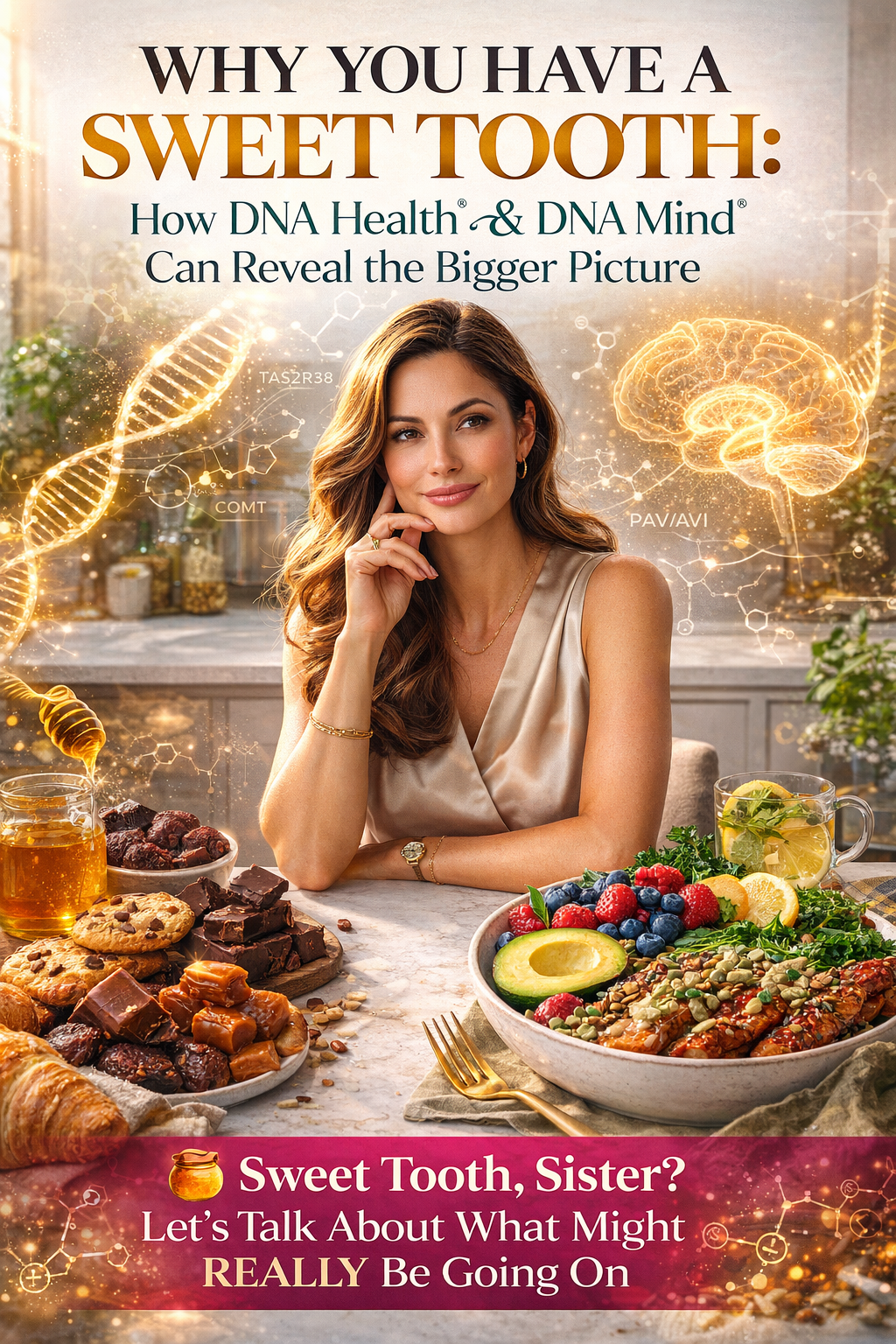
Why You Have a Sweet Tooth: How DNA Health® & DNA Mind® Can Reveal the Bigger Picture
🍯 Sweet Tooth, Sister? Let’s Talk About What Might Really Be Going On
You’ve Googled it.
You’ve searched DuckDuckGo.
You’ve scrolled social media.
You’ve read the “just drink more water” posts, the “you only crave sugar because you lack discipline” takes, and the wellness advice that sounds suspiciously like somebody copied and pasted the same three tips into 47 reels.
And yet… here you are.
Still craving sweets.
Still wondering why your body seems to have a dessert-related personality.
Still sensing that something is missing from the usual conversation.
If that sounds like you, welcome. You are in the right place.
As a Traditional Naturopath and Functional Diagnostic Nutrition Practitioner, I work with women who are looking for more than generic advice. They want context. They want insight. They want to understand why they keep dealing with the same patterns, even when they are trying to make better choices.
And when it comes to a sweet tooth, I do not like reducing everything to “self-control.”
Sometimes cravings are about habit.
Sometimes they are about blood sugar.
Sometimes they are about stress.
Sometimes they are about reward pathways, taste perception, and deeper Metabolic Chaos® patterns that make your body and brain far more vulnerable to the sugar pull than people realise.
That is why I believe in testing, not guessing.
🧬 Why “Testing, Not Guessing” Matters in the Sweet-Tooth Conversation
Let’s be honest: most people have been given painfully basic advice about cravings.
Eat less sugar.
Try harder.
Don’t keep sweets in the house.
Have more willpower.
Pray and chew gum.
Now, while some practical habits do matter, that kind of advice often skips over the bigger picture. And for women who have already tried to “be good” and still feel stuck in cycles of sweet cravings, energy dips, and food noise, surface-level advice usually does not cut it.
That is where functional testing can be helpful.
Not because every person needs every test under the sun.
Not because genetics are destiny.
But because data can help explain why one woman can casually take or leave sweets, while another feels like her body and brain are in an ongoing negotiation with chocolate, pastries, or “healthy” sugar-laden snacks.
For this particular topic, two of my favourite tools are DNA Health® and DNA Mind®. DNALife describes DNA Health as a test that assesses genetic variations across key metabolic pathways such as methylation, inflammation, oxidative stress, insulin resistance, and food responsiveness, including bitter taste. DNALife describes DNA Mind as a test reporting on variants in 30 genes involved in pathways such as dopamine, serotonin, inflammation, and methylation, with insights relevant to mood disorders, neurodegenerative disorders, and addictive behaviour.
That combination is gold for the woman who knows her sweet tooth is not just about liking dessert.
🍬 Your Sweet Tooth May Not Be Random
One of the biggest mistakes people make is assuming a sweet tooth is always just about poor habits or lack of discipline.
Sometimes it is not random at all.
Sometimes there are real biological tendencies shaping:
how food tastes to you
how satisfying meals feel
how your brain responds to reward
how stress affects your eating patterns
how easily you default to quick comfort foods
That does not mean your genes are bossing you around like a tiny tyrant in your cells. It means your body may have certain predispositions that deserve to be understood with wisdom.
This is where DNA Health® helps zoom in on the taste and metabolism side, and DNA Mind® helps zoom in on the reward and behaviour side.
And when you put those together, things often start making more sense.
👅 DNA Health®: Taste Perception, Food Responsiveness, and the Sweet-Tooth Puzzle
DNALife states that DNA Health® assesses more than 35 genes involved in key metabolic processes and specifically includes food responsiveness, including areas such as bitter taste, caffeine sensitivity, salt sensitivity, lactose intolerance, and gluten intolerance.
That matters because how you perceive taste can influence your relationship with food.
One gene that often comes into this conversation is TAS2R38, a bitter taste receptor gene. Research shows that TAS2R38 is a major determinant of sensitivity to bitter compounds such as PROP, and that common haplotypes such as PAV and AVI are strongly associated with differences in bitter taste perception.
The Ala262Val change is one of the classic amino-acid substitutions used in the TAS2R38 haplotype pattern. A person with a PAV/AVI combination is commonly considered a medium or intermediate taster. In practical terms, that means she may sit somewhere between highly sensitive bitter tasters and those who barely register bitterness.
Now, why does that matter for a sweet tooth?
Because taste perception can shape food preference.
If someone experiences bitter notes differently, that can influence which foods feel naturally appealing or less appealing. Research has linked TAS2R38 variation to differences in taste sensitivity and food preferences, even though the relationship is not identical in every person or every population.
In everyday language:
If your DNA Health® report shows a TAS2R38 pattern such as PAV/AVI, that may help explain why your palate leans a certain way. You may not be as bitter-sensitive as a strong taster, but you also may not be completely indifferent to bitterness. That “medium taster” profile can influence how foods register for you and may partly shape why sweeter, more palatable foods feel especially appealing.
That is not an excuse.
It is not a sentence.
It is insight.
And insight creates healing opportunities.
🧠 DNA Mind®: When the Issue Is Not Just Taste… But Reward
Now let’s talk about the other half of the story.
Because many women do not just crave sweets because they taste good.
They crave them because:
they are stressed
they are mentally tired
they are overwhelmed
they are under-recovered
they want comfort
they want stimulation
they want a reward
they want their brain to quiet down for five blessed minutes
That is where DNA Mind® can be incredibly helpful.
DNALife says that DNA Mind reports on variants in 30 genes related to pathways involving dopamine, serotonin, inflammation, and methylation, and that it includes insights relevant to addictive behaviour.
That matters because dopamine is involved in reward, motivation, reinforcement, and behavioural drive. In other words, it is highly relevant when we are talking about food reward, pleasure seeking, and patterns that may feel compulsive.
One gene that often gets attention here is COMT.
⚡ Fast COMT and the “I Know I’m Not Hungry, but I Still Want Sugar” Pattern
The COMT gene helps break down catecholamines such as dopamine. A commonly discussed variant is Val158Met (rs4680). Research indicates that the Val form is associated with higher COMT activity, which means faster breakdown of dopamine compared with the Met form. In casual wellness language, this is often described as “fast COMT.”
Why does this matter?
Because dopamine is part of how we experience reward, drive, novelty, and reinforcement. Research suggests COMT rs4680 variation can influence reward learning and other reward-related processes.
So, if someone has a fast COMT-type pattern, it may help explain why she tends to seek out stronger reward input under stress, boredom, exhaustion, or emotional overload.
That can show up as:
reaching for sweets after a hard day
using sugar as a quick emotional lift
needing a “treat” to feel regulated
stronger reward-seeking around ultra-palatable foods
feeling like healthy habits are harder to maintain when stressed
Now, let me be clear and professional here:
fast COMT does not diagnose addiction, and it does not mean someone is doomed to compulsive behaviour. It means there may be a predisposition toward certain reward-related tendencies that deserve to be understood and supported wisely. Research on COMT and addiction-related outcomes is mixed across contexts, but COMT variation is consistently discussed in relation to dopamine tone, reward processing, and impulsivity-related traits.
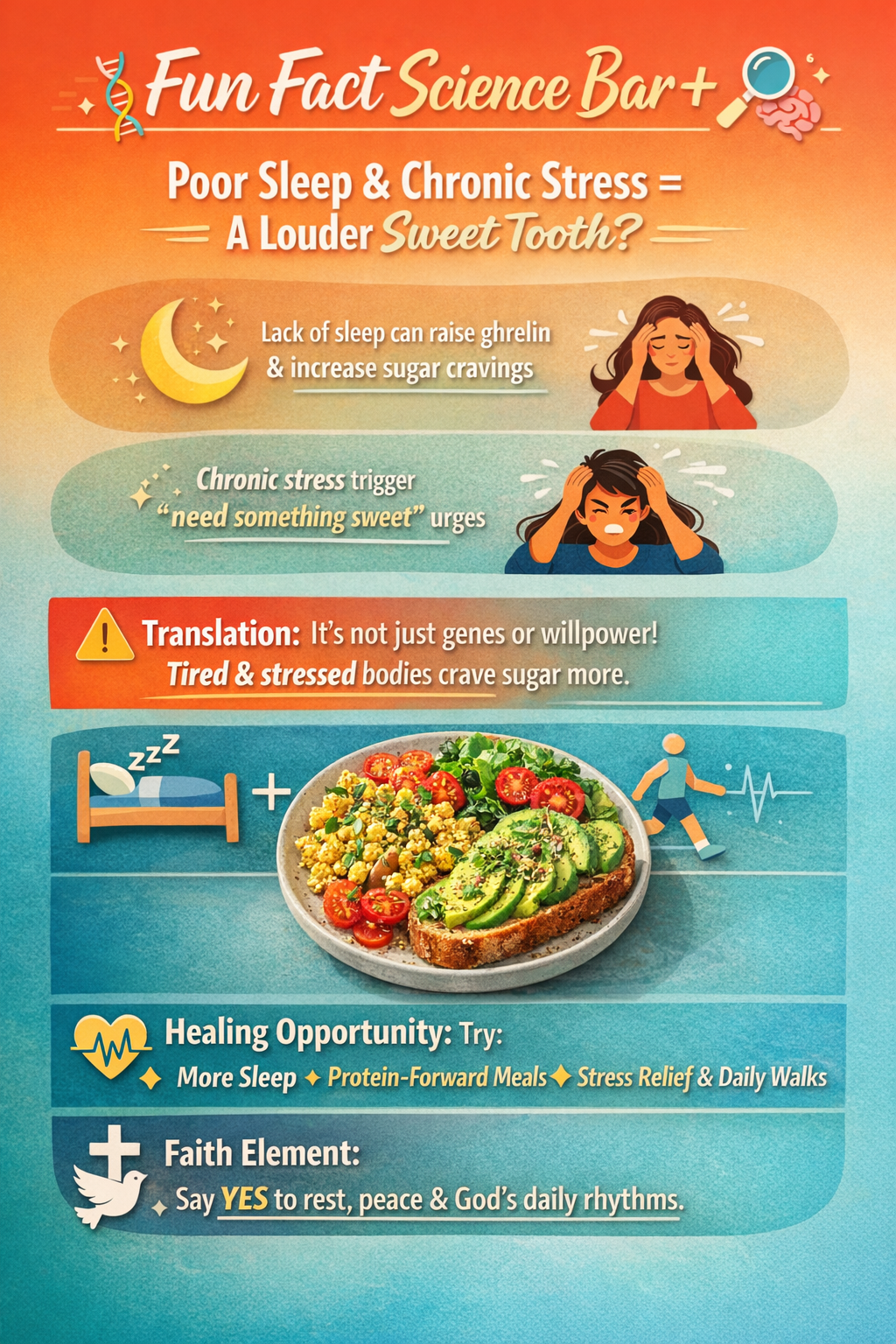
🔬Fun Fact Science Bar+
Did you know poor sleep and chronic stress can make a sweet tooth louder—even before you factor in genetics? Research shows sleep restriction can shift appetite signalling in a way that tends to raise ghrelin and reduce satiety signalling such as leptin, while also increasing food reward and cravings for sweeter, more energy-dense foods. Chronic stress is also linked with stronger food cravings and reward-driven eating, especially when the body starts using palatable foods as quick relief.
👉🏾 Translation: Your cravings may not just be about taste genes or willpower. A tired, stressed body can become more vulnerable to a “need something sweet now” loop—especially if you’re already dealing with Metabolic Chaos®, hormone shifts, or reward-seeking tendencies.
✨ Healing Opportunity: Before assuming you need more discipline, ask whether you need more sleep, steadier meals, and better stress buffering. A protein-forward breakfast, balanced meals, a consistent bedtime rhythm, and a 10-minute walk or nervous-system downshift after meals can help reduce the physiological volume on cravings before they become a nightly negotiation.
✝️ Faith Element: Honour the body’s need for rest. Sometimes temperance is not just saying no to the sweet—it is saying yes to the sleep, peace, and daily rhythms God designed to help keep appetite and mind steadier. 🙌🏾
In plain English:
If DNA Mind® shows a pattern consistent with fast COMT, that may help explain why sweets can function as more than food. They may become a quick dopamine nudge. A fast comfort. A fast reward. A fast coping mechanism.
And once you understand that, the conversation changes.
It is no longer: “Why am I so bad with sugar?”
It becomes: “What support does my brain and nervous system need so I’m not constantly looking to sugar to do that job?”
That is a much better question.
🔍 Why DNA Health® + DNA Mind® Work So Well Together
This is exactly why I love these two tests together.
DNA Health® can help highlight the taste, food-responsiveness, and broader metabolic side of the sweet-tooth story.
DNA Mind® helps highlight the reward, behaviour, stress, and mood-related side of the story.
Together, they can help us explore questions like:
Is taste perception part of why certain foods are more appealing to me?
Is my sweet tooth partly connected to reward pathways and stress coping?
Does my nervous system tend to seek quick comfort through food?
Am I working against my wiring with generic wellness advice?
Where are the real healing opportunities here?
For the woman who has been Googling, scrolling, asking friends, reading labels, and still feeling like she is missing the full picture, this kind of testing can be incredibly validating.
Because sometimes your sweet tooth is not “just you being extra.”
Sometimes your biology is part of the story.
🧪 What About the Other Functional Tests?
Other functional tests can still be useful. Depending on the person, tools such as GI-MAP, MRT food sensitivity testing, Functional Blood Chemistry Analysis, or DUTCH may help round out the picture by exploring gut function, inflammation, food reactivity, blood sugar patterns, or hormone-related influences. DNALife also notes that DNA Health and DNA Mind can be used alongside other testing to help personalise recommendations more effectively.
But for this blog, let me keep it plain:
If I really want to advertise and highlight the tests that help explain the deeper why behind a sweet tooth—especially from the angle of taste preference, reward patterns, behaviour, and predisposition—then DNA Health® and DNA Mind® are the clear stars.
They help move the conversation upstream.
And I am very here for that.
🌿 A Faith-Based Pause: Stewardship Over Shame
From a faith-rooted perspective, I do not think the sweet-tooth conversation should be built on shame.
Yes, temperance matters.
Yes, discipline matters.
Yes, wisdom matters.
But stewardship works best when it is informed.
God designed the body intelligently. He did not ask us to ignore patterns, suppress symptoms, and pretend biology is not relevant. He calls us to wisdom, discernment, and care. Sometimes what people call a “lack of self-control” is actually a body and brain asking for better support.
And with a gentle nod to Seventh-day Adventist common sense: the foundations still matter. Whole food. Rest. Fresh air. Movement. Water. Simplicity. Nervous system steadiness. Trust in God. Functional testing does not replace those principles. It helps personalise them.
That is a much more grace-filled way to approach health than internet punishment disguised as wellness.
💛 Your Sweet Tooth Is Not a Moral Failure — It May Be a Clue
If you have been quietly wondering why sweets seem to have a stronger pull on you than they “should,” please hear me:
This does not automatically mean you are lazy.
It does not mean you are weak.
It does not mean you are failing.
It may mean there is more going on beneath the surface.
Your DNA Health® results may reveal food-responsiveness patterns, including bitter taste genetics that shape how your palate responds. Your DNA Mind® results may reveal reward-related or dopamine-related tendencies that help explain why stress, comfort, or compulsion show up around sweets more than you expected.
That is the beauty of testing, not guessing.
Not because a test becomes your identity.
But because it can give language to patterns you have been living with for years.
And once you understand the pattern, you can start supporting it properly.
📞 Ready to Stop Guessing and Start Looking at the Bigger Picture?
If this blog felt like it was reading your browser history a little too accurately, that may be your sign.
Inside my practice, I help women take a more personalised, root-cause look at the deeper patterns behind cravings, energy dips, food struggles, mood shifts, and Metabolic Chaos®. And when appropriate, DNA Health® and DNA Mind® can be powerful tools for understanding the bigger picture—especially when sweet cravings seem tied to taste perception, reward pathways, stress, and behavioural patterns.
✨ Call to Action
Book a consultation with Leaves from the Tree of Life LLC to explore whether DNA Health® and DNA Mind® testing may be the right next step for you. Let’s move beyond generic advice, identify your healing opportunities, and build a more personalised strategy—one that works with your biology instead of constantly fighting it.
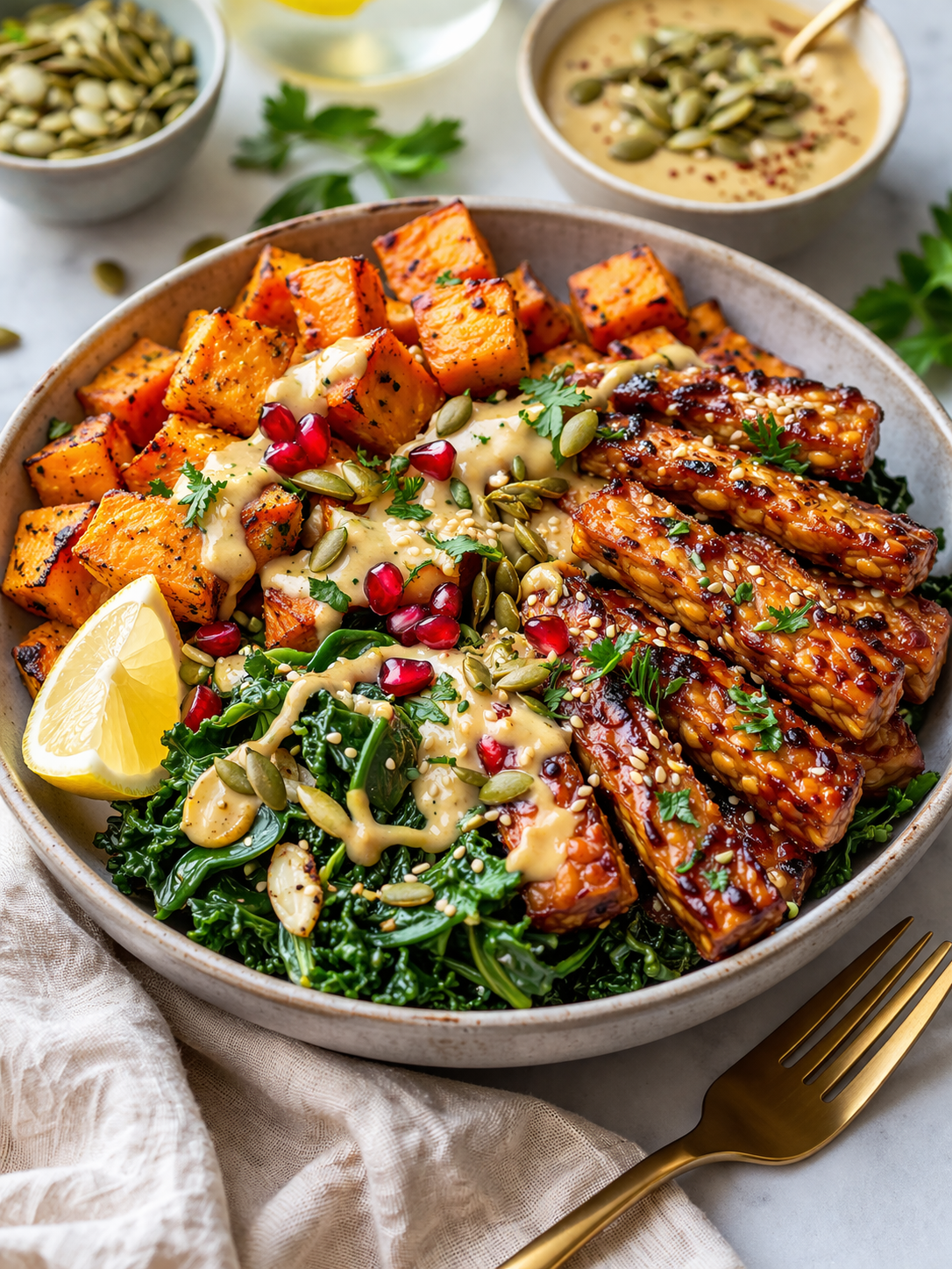
🍠🥗 Maple-Miso Glazed Tempeh with Cinnamon Roasted Sweet Potatoes, Garlicky Greens & Crunchy Pumpkin Seed Drizzle
This meal fits the blog beautifully because it is built around the idea of steady satisfaction rather than chasing a sugar hit. It gives you protein, fibre, healthy fats, slow carbs, and flavour so the body feels nourished and the brain doesn’t start begging for dessert an hour later.
It’s rich, savoury, slightly sweet, deeply comforting, and very “I eat like a grown woman with discernment… but also taste buds.”
⏰ Time
About 45 minutes total
Prep: 15 minutes
Cook: 30 minutes
🍽️ Servings
2–3 servings
🛒 Ingredients
For the roasted sweet potatoes
2 medium sweet potatoes, peeled and cubed
1 tbsp avocado oil or olive oil
1 tsp cinnamon
½ tsp smoked paprika
¼ tsp sea salt
Pinch of black pepper
For the maple-miso tempeh
1 block tempeh, sliced into strips or cubes
1 tbsp extra virgin olive oil or avocado oil
1 tbsp white miso
1 tbsp pure maple syrup
1 tbsp tamari or coconut aminos
1 tsp Dijon mustard
1 tsp apple cider vinegar
1 small garlic clove, minced
½ tsp grated fresh ginger
2–3 tbsp water to thin
For the garlicky greens
4 cups kale or baby kale
2 cups spinach
1 tsp olive oil
2 garlic cloves, minced
Pinch of sea salt
Squeeze of lemon
For the crunchy pumpkin seed drizzle
3 tbsp pumpkin seeds
1 tbsp tahini or sunflower seed butter
1 tsp lemon juice
1 tsp maple syrup
1–2 tbsp warm water
Pinch of sea salt
Pinch of chilli flakes, optional
Optional finishing touches
Fresh parsley
Pomegranate seeds
Extra squeeze of lemon
A tiny sprinkle of sesame seeds
👩🏾🍳 Step-by-Step Instructions
1. Roast the sweet potatoes 🍠
Preheat your oven to 200°C / 400°F.
Add the sweet potato cubes to a baking tray. Toss with the oil, cinnamon, smoked paprika, sea salt, and black pepper until everything is evenly coated.
Spread them out in a single layer and roast for 25–30 minutes, flipping halfway through, until golden at the edges and soft in the middle.
Why they belong here:
Sweet potatoes give you a naturally sweet element without turning the meal into a sugar bomb. They help satisfy that “I want something sweet” feeling while still bringing fibre and steadier energy.
2. Make the maple-miso glaze 🥣
In a small bowl, whisk together:
miso
maple syrup
tamari
Dijon
apple cider vinegar
garlic
ginger
water
It should be glossy and pourable, not too thick.
Why this matters:
This glaze gives you sweet, salty, umami depth so the meal feels indulgent and satisfying. Sometimes a sweet tooth needs flavour complexity, not just sugar.
3. Cook the tempeh 🍽️
Heat 1 tablespoon oil in a skillet over medium heat.
Add the tempeh and cook for 3–4 minutes per side until lightly golden.
Pour in the glaze and let it bubble for another 2–3 minutes, turning the tempeh so it gets sticky and coated.
Remove from heat when glossy and caramelised.
Why tempeh is a star:
Tempeh gives you satisfying plant protein plus texture, which helps this meal feel substantial. That matters when you’re trying to avoid the “meal was cute, but now I need a snack immediately” problem.
4. Toast the pumpkin seeds 🎃
In a dry pan over low-medium heat, toast the pumpkin seeds for 2–3 minutes until fragrant.
Set aside.
Why they matter:
Pumpkin seeds bring crunch, healthy fats, minerals, and that chefy little finish that makes the meal feel magazine-worthy instead of merely practical.
5. Make the drizzle ✨
Whisk together the tahini or sunflower seed butter, lemon juice, maple syrup, warm water, and salt until smooth.
Stir in or top with the toasted pumpkin seeds.
If you like a little sass, add chilli flakes.
Why this works:
A creamy drizzle adds richness and satiety. Meals that include healthy fats tend to feel more complete, which can help reduce that prowling-for-sweets energy later.
6. Sauté the greens 🌿
In a skillet, heat 1 teaspoon olive oil.
Add the garlic and cook for about 30 seconds until fragrant.
Add the kale and spinach with a pinch of sea salt. Cook for 2–4 minutes until wilted but still vibrant.
Finish with a squeeze of lemon.
Why greens belong on this plate:
They bring bitterness, freshness, and balance. Since your blog talks about taste perception and sweet preference, this is a lovely symbolic nod to teaching the palate to enjoy depth and contrast.
7. Assemble like you have standards 😌
Divide the garlicky greens between bowls or plates.
Add the roasted sweet potatoes and glazed tempeh.
Drizzle over the pumpkin seed sauce.
Top with parsley, pomegranate seeds, sesame seeds, or extra lemon if using.
Serve warm and dramatically.
🌟 Health Benefits of Each Ingredient
🍠 Sweet Potatoes
Naturally sweet, which can help satisfy the palate in a more nourishing way
Provide fibre for fullness
Contain beta-carotene for skin and immune support
Offer slower, steadier energy than sugary snacks
🍱 Tempeh
Rich in plant protein for satiety
Fermented, which can be easier for some people to tolerate than other soy foods
Helps make the meal satisfying enough that you are less likely to keep hunting for sweets
🧄 Garlic
Adds bold flavour without needing extra sugar-heavy sauces
Supports overall wellness and makes everything taste less sad
🌿 Kale + Spinach
Rich in fibre and phytonutrients
Add minerals and volume to the meal
Their slight bitterness helps balance the palate so every meal is not training your taste buds to expect sweet
🎃 Pumpkin Seeds
Provide healthy fats, crunch, and minerals
Help make the meal more satisfying and textured
Add a lovely savoury richness
🍋 Lemon
Brightens the whole dish
Balances the sweeter notes from the sweet potato and maple
Makes the plate taste fresh and layered
🍁 Maple Syrup
Used in a small amount for flavour balance, not to turn dinner into dessert
Helps create that glossy, mouth-watering finish that makes this meal feel special
🫚 Ginger
Adds warmth and depth
Works beautifully with the sweet-savoury theme
Makes the glaze taste more alive and less flat
🍶 Miso
Gives deep umami flavour
Helps the dish feel comforting and satisfying
A little goes a long way in making healthy food taste luxurious
📚 References
🧬 DNA Health®, DNA Mind® & Nutrigenomics
DNA Life — DNA Health®
👉🏾 https://www.dnalife.healthcare/products/dna/dna-health
DNA Life — DNA Mind®
👉🏾 https://www.dnalife.healthcare/products/dna/dna-mind
NIH / PMC — Nutrigenomics, the Microbiome, and Gene-Environment Interactions
👉🏾 https://pmc.ncbi.nlm.nih.gov/articles/PMC7829062/
👅 Taste Genetics, TAS2R38 & Food Preference
NIH / PMC — Rare Haplotypes of the Gene TAS2R38 Confer Bitter Taste Responsiveness in Humans
👉🏾 https://pmc.ncbi.nlm.nih.gov/articles/PMC4574037/
NIH / PMC — TAS1R3 and TAS2R38 Polymorphisms Affect Sweet Taste Perception
👉🏾 https://pmc.ncbi.nlm.nih.gov/articles/PMC9101038/
🧠 COMT, Dopamine & Reward Patterns
NIH / PMC — COMT Val158Met Genotype Is Associated With Reward Learning
👉🏾 https://pmc.ncbi.nlm.nih.gov/articles/PMC4891272/
Europe PMC — COMT Val(158)Met Genotype Determines the Direction of Cognitive Effects Produced by Catechol-O-Methyltransferase Inhibition
👉🏾 https://europepmc.org/article/pmc/3314969
😴 Sleep, Stress, Appetite & Cravings
NIH / PMC — Sleep Deprivation and Central Appetite Regulation
👉🏾 https://pmc.ncbi.nlm.nih.gov/articles/PMC9783730/
NIH / PMC — Connecting Insufficient Sleep and Insomnia With Metabolic Dysfunction
👉🏾 https://pmc.ncbi.nlm.nih.gov/articles/PMC9839511/
Blog Disclaimer
The health information on this blog is for general educational purposes only and is not intended to diagnose, treat, cure, or prevent any disease. It should not be used as a substitute for professional medical advice. Always consult a qualified healthcare provider before making any health-related decisions
This blog may contain affiliate links, meaning Leaves from the Tree of Life LLC may earn a small commission if you purchase a product or service through these links—at no additional cost to you. Your support helps us continue to provide valuable content. Thank you!
