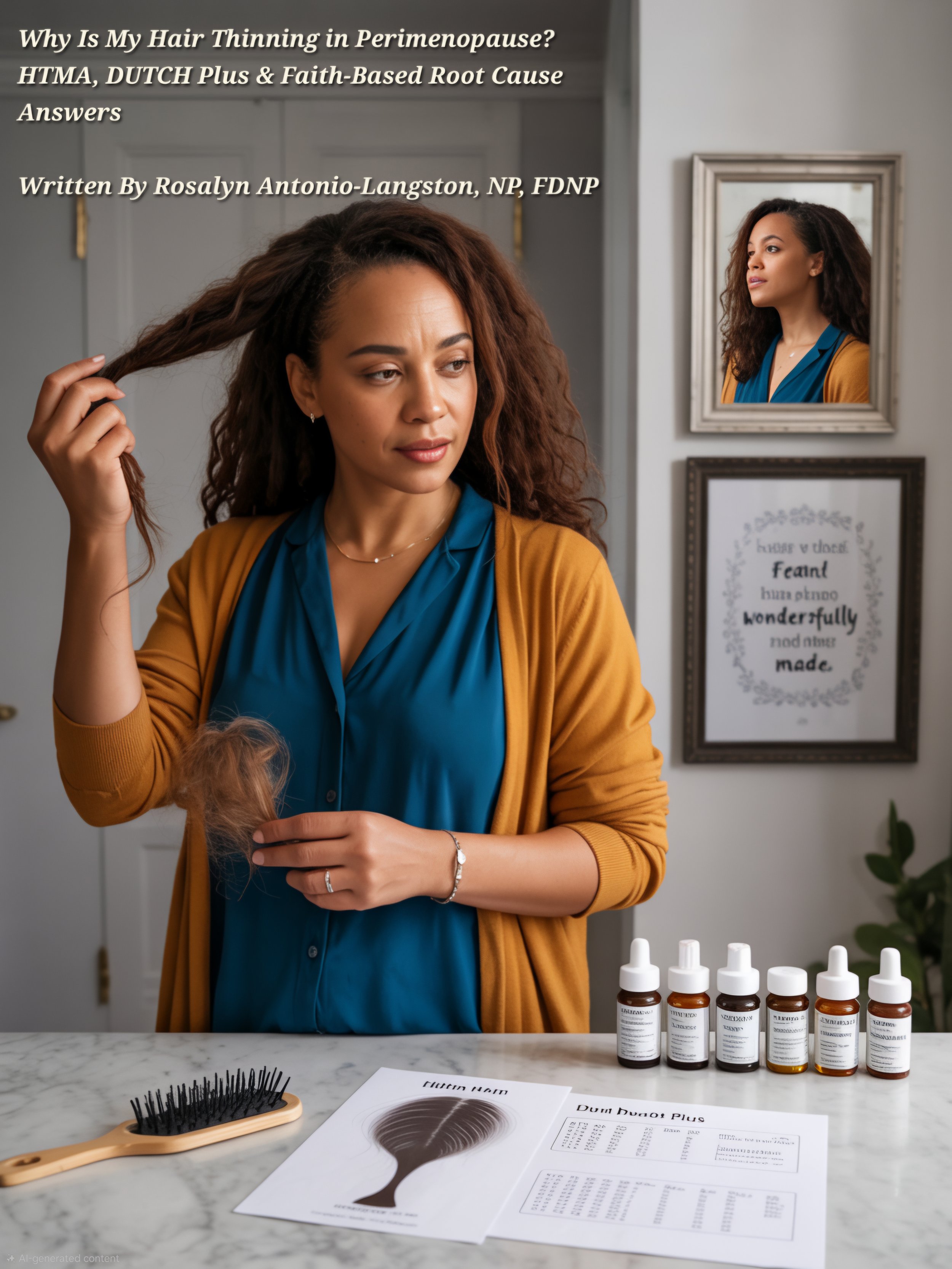
Why Is My Hair Thinning in Perimenopause? HTMA, DUTCH Plus & Faith-Based Root Cause Answers
💇🏾♀️ When Your Ponytail Shrinks: You’re Not Crazy (or Vain)
You’re in the shower, cleaning the drain again, noticing more hair in your brush, and your once-full ponytail now feels… thin. You’ve Googled, you’ve DuckDuckGo’d, you’ve tried the “hair growth” vitamins and maybe a random serum Instagram swore would fix everything.
And yet—your gut says something deeper is going on.
As a Traditional Naturopath and Functional Diagnostic Nutrition® Practitioner, I want you to hear this clearly:
Hair thinning in perimenopause is not just a vanity issue.
It’s often a data point in a bigger story of Metabolic Chaos®.
Your hair is one of the body’s “status reports.” When internal systems are stressed—hormones, thyroid, iron, gut, nutrition—your body will prioritise organs of survival over organs of appearance (like hair, skin, nails). That shedding can be a healing opportunity if we listen instead of just hiding it under headwraps and hats.
Let’s decode what might be happening—and what you can actually do about it.
🧬 Hormones & Hair Follicles: When Estrogen Steps Back & Androgens Step Forward
During perimenopause, levels of estrogen and progesterone become more erratic, then gradually decline. Hair follicles have hormone receptors, so they “feel” these shifts. When estrogen and progesterone drop, their protective effects on the hair growth cycle diminish.
At the same time, you can end up with relatively higher androgens (like testosterone and DHT), especially if sex hormone–binding globulin (SHBG) falls. That can mean:
More shedding and thinning on the scalp
Sometimes, more chin or facial hair (fun times 🙃)
This pattern often shows up as:
Widening part
Thinner ponytail
More hair in the sink, but not necessarily bald patches
This isn’t “all in your head”—it’s hormone signalling plus Metabolic Chaos® in real time.
Where BHRT might fit in
Bio-identical hormone replacement therapy (BHRT) uses hormones structurally similar to those your body makes. For some women, appropriately prescribed estrogen and progesterone can help stabilise symptoms of menopause—including hair changes—by supporting a more favourable hormone environment for the follicle.
But BHRT is not:
A magic shampoo in a capsule
A one-size-fits-all fix
Something to start from a Facebook group recommendation
BHRT is a tool that may be considered after a thorough assessment of your symptoms, history, risks, and lab data, ideally in partnership with a knowledgeable prescriber. It works best as part of a wider plan that also addresses blood sugar, gut health, micronutrients, stress, and sleep.
🩸 Iron, Anemia & Low Ferritin: When Your Hair Is Competing With Your Blood
One of the most overlooked drivers of hair loss in women—especially in midlife—is iron deficiency and low ferritin (your iron-storage protein).
Hair follicles are highly sensitive to iron status; when ferritin is low, hair can shift out of the active growth phase and into shedding. Women with nonscarring hair loss frequently show lower ferritin, and optimising ferritin often improves hair outcomes.
Why this matters in perimenopause:
You may still be menstruating (often heavily)
You might be stressed, under-eating, or skipping iron-rich foods
Your gut may not be absorbing iron well (hello, gut dysbiosis, low stomach acid, or past GI infections)
Clues iron/ferritin may be involved:
Hair shedding that feels “diffuse” (all over)
Fatigue, breathlessness, palpitations, restless legs
Brittle nails, feeling cold all the time
This is a huge healing opportunity: if we don’t look at ferritin (not just “iron on the CBC”), we’re guessing. And your hair is too precious for guesswork.
🦋 Thyroid, Metabolism & Your Hair
Your thyroid is like your internal thermostat and fuel management system. When thyroid hormones are off—either hypothyroid (low) or hyperthyroid (high)—hair growth can suffer.
Thyroid dysfunction often causes diffuse thinning across the scalp. Hair may be dry, coarse, or brittle, and you may see loss at the outer third of the eyebrows. Underactive thyroid is also known for dry skin, fatigue, constipation, and weight gain; overactive thyroid can cause weight loss, anxiety, and palpitations.
Why thyroid issues often surface in perimenopause:
Estrogen changes affect thyroid-binding proteins
Chronic stress and under-eating lower T3 (your active thyroid hormone)
Autoimmune thyroid disease (Hashimoto’s, Graves’) is more common in women, especially in midlife
Red flags for thyroid-related hair loss:
Thinning hair plus fatigue, weight changes, constipation, feeling cold, low mood, or anxiety
Loss of the outer third of the eyebrows
Dry skin, hoarse voice
Again, this is where test, don’t guess is crucial. A simple TSH doesn’t give the full picture.
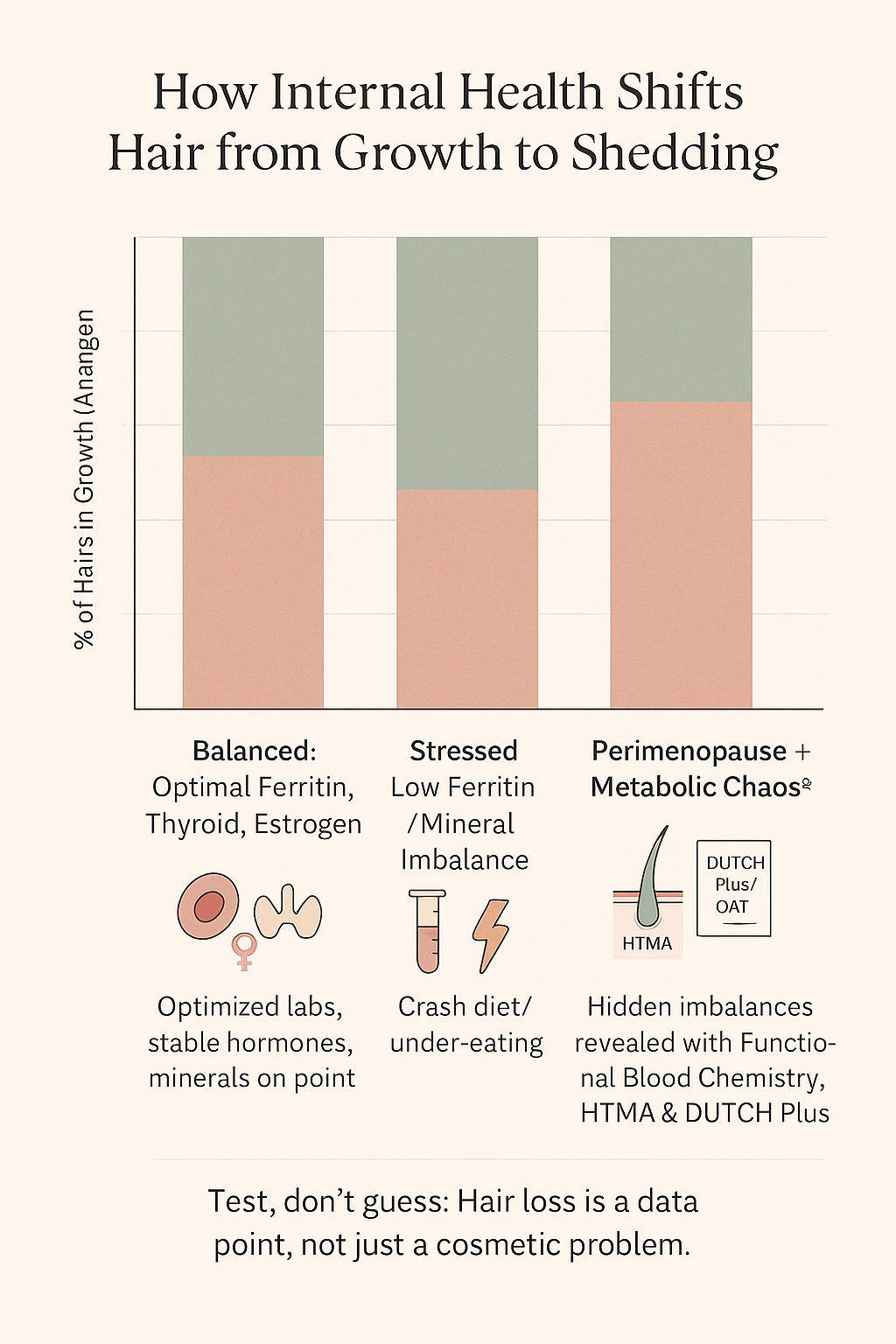
🔬Fun Fact Science Bar+
Did you know that your scalp is running a 24/7 “hair audit” on your internal health—and that things like low ferritin (iron storage), sluggish thyroid, and dropping estrogen in perimenopause can quietly push more hairs from growth mode (anagen) into shedding mode (telogen) all at once? That’s why 2–3 months after a big stressor, heavy period, crash diet, or hormone shift, you suddenly notice more hair in the brush and a shrinking ponytail.
👉🏾 Translation: That “out of nowhere” hair thinning is rarely random or “just age.” It’s your hair follicles reporting back on deeper Metabolic Chaos®—blood sugar swings, hidden anemia, mineral imbalances, thyroid drag, hormone detox issues, and nervous system overload. Tools like Functional Blood Chemistry Analysis, HTMA, and DUTCH Plus (with OAT markers) help connect the dots so we see why the follicles bailed early instead of just blaming your shampoo.
✨ Healing Opportunity: Support your hair by supporting your systems:
Optimise ferritin, B12, vitamin D, zinc, and thyroid (test, don’t guess).
Build protein-rich, mineral-dense meals and stabilise blood sugar.
Use HTMA to spot mineral stress patterns and DUTCH Plus to see hormone + cortisol rhythm and nutrient strain via OAT markers.
When you correct the internal chaos, more hairs can stay in that juicy anagen (growth) phase longer—meaning fuller volume and less panic at the drain.
✝️ Faith Element: Your hair is part of the “temple care” assignment God has given you (1 Corinthians 6). Instead of fighting your body in frustration, you can partner with Him—using wisdom, testing, and temperance—to restore balance. A simple prayer like, “Lord, help me read these signs wisely and care for this body You designed,” can turn hair loss from pure anxiety into a Christ-centered journey of stewardship and trust. 🙌🏾
🥗 Malnutrition in a Well-Fed World: Protein, Micronutrients & Hair
You can eat three times a day and still be malnourished at the cellular level—especially if you’re:
Skipping meals
Living on “snack plates” and caffeine
Eating highly processed or low-protein meals
Over-restricting (keto, very low fat, very low calorie, etc.)
Hair follicles are among the fastest-growing cells in the body and depend on adequate protein, iron, zinc, B vitamins (especially B12), and vitamin D to stay in growth mode. Deficiencies in these nutrients are classically linked with hair changes.
At the same time, over-supplementation of certain nutrients (like selenium, vitamin A, and vitamin E) has actually been associated with hair loss in some studies.
So no, the answer is not “just take a handful of random hair vitamins.”
Instead, we want to ask:
Are you getting enough protein (usually at each meal)?
Are you low in iron, ferritin, B12, vitamin D, zinc?
Is your gut absorbing what you eat—or is Metabolic Chaos® in the gut impacting nutrient status?
🧪 Test, Don’t Guess: FBCA, HTMA & DUTCH Plus for Hair Loss
You’re not a walking shampoo commercial—you’re a whole person with interconnected systems.
Here’s how I think about smart testing for hair thinning from a functional lens, including Functional Blood Chemistry Analysis, HTMA, and DUTCH Plus with OAT markers.
🧾 Functional Blood Chemistry Analysis (FBCA)
A functional read of your labwork (beyond “within range”) can reveal patterns that conventional “normal” sometimes misses.
Key markers I often consider for hair + energy + hormones:
CBC, ferritin, iron, transferrin saturation
B12, folate, homocysteine
Vitamin D
Comprehensive metabolic panel (liver, kidney, glucose)
Lipids (for hormone and metabolic context)
Thyroid panel: TSH, Free T4, Free T3 ± antibodies (TPO, TG)
Inflammatory markers (CRP, sometimes ESR)
We’re looking for suboptimal trends and patterns of Metabolic Chaos®, not just red-flag end-stage disease.
🧲 HTMA (Hair Tissue Mineral Analysis)
Since we’re talking hair, let’s talk about the data literally growing out of your scalp.
HTMA looks at mineral levels and ratios in the hair over the past few months, including:
Calcium, magnesium, sodium, potassium – linked to adrenal and thyroid patterns
Zinc, copper – crucial for hair, skin, and hormone balance
Trace minerals and potential heavy metal trends
Why this matters for hair and perimenopause:
Low zinc or imbalanced zinc:copper can affect both hormone metabolism and hair growth
Chronic stress and adrenal patterns show up as altered sodium/potassium ratios
Mineral patterns can hint at why you’re not tolerating certain supplements or why you feel “wired and tired”
HTMA doesn’t replace bloodwork—but it adds another layer to your Metabolic Chaos® map, especially around stress, minerals, and hair integrity.
🧬 DUTCH Plus (with OAT Markers)
You may have heard of the DUTCH Complete; the DUTCH Plus goes further by adding:
Salivary cortisol awakening response (CAR)
Additional layers of HPA-axis insight
Organic Acid Test (OAT) markers, which can reflect aspects of:
B-vitamin status
Neurotransmitter metabolites
Oxidative stress and detox pathways
Some gut-related metabolic patterns
For hair and perimenopause, DUTCH Plus helps us see:
How you’re actually using estrogen, progesterone, and androgens
Whether androgens/DHT might be contributing to hair thinning
How stressed your system is (cortisol rhythm + CAR)
Whether OAT markers suggest nutrient depletion or detox overload that could impact hair follicles
Combine FBCA + HTMA + DUTCH Plus, and we start seeing the same story from multiple angles—blood, hair, urine/saliva—rather than guessing based on symptoms alone.
That’s the heart of functional work:
Test, don’t guess.
Turn random hair panic into targeted healing opportunities.
💊 Remedies & Support: From BHRT to Everyday Habits
Let’s talk about what you can actually do—keeping in mind this is educational, not personalised medical advice.
🧴 1. Treat Your Scalp Like Skin, Not Just Hair
Use gentle, low-toxin shampoos and conditioners
Avoid tight hairstyles and excessive heat
Consider scalp massage with nourishing oils if appropriate for your hair type
Keep an eye on dandruff, itchiness, or scaling—these can signal inflammation or fungal overgrowth that may need proper treatment
🥭 2. Nourish from the Inside Out
Think hair-building meals, not just hair products:
Adequate protein (beans, lentils, tofu/tempeh, nuts, seeds, or high-quality animal protein if you use it)
Iron-rich foods paired with vitamin C (leafy greens, lentils, pumpkin seeds, blackstrap molasses, etc.)
Healthy fats (avocado, olive oil, flax, chia, walnuts)
Zinc and B vitamin–rich foods (legumes, seeds, whole grains, nutritional yeast)
If labs show deficiencies, targeted supplementation may be helpful—under guidance—to correct low ferritin, B12, vitamin D, or zinc.
⚖️ 3. Balance Stress & Blood Sugar (Your Hair Hears Both)
Chronic stress and blood sugar swings wreak havoc on hormones and hair.
Use lifestyle frameworks like:
Think:
Regular meals with protein and fibre (to avoid sugar crashes)
Daily movement that supports circulation (walking, light strength training)
Deep breathing, prayer, and nervous system regulation
Respecting bedtime and honouring your circadian rhythm
🌸 4. Considering BHRT Wisely
If symptoms are significant—hot flashes, sleep disruption, mood swings, and hair changes—BHRT/HRT may be one part of a comprehensive plan. For some women, supporting estrogen and progesterone (at the right time, with the right route and dose) can create a more hair-friendly internal climate.
However:
It should be individualised, not “my friend takes this dose so I will too”
You need a thorough discussion of risks, benefits, timing, family history, and contraindications
It works best alongside addressing underlying Metabolic Chaos®—not instead of it
If BHRT is something you’re curious about, functional testing (FBCA, HTMA, DUTCH Plus) can give you and your prescriber a clearer map.
🙏🏾 Faith, Hair & Hope: Your Crown Still Matters to God
As a Seventh-day Adventist Christian, I see the body—including your hair—as part of the temple God entrusted to you (1 Corinthians 6). Your hair may not be your salvation issue, but it is part of your story, your identity, and your confidence.
Scripture describes hair as a woman’s “glory”—her crown. When that crown starts thinning, it’s okay to feel sadness, frustration, even grief. God isn’t offended by your tears over hair loss.
At the same time, He invites you into:
Rest – carving out true Sabbath space in a world that burns women out
Temperance – avoiding extremes (over-work, over-restriction, over-supplementation)
Trust – doing your part (testing, lifestyle, wise treatment) while trusting Him with what you can’t control
I like to tell my clients:
We bring the labs, the lifestyle, and the obedience. God brings the outcomes.
📩 Ready to Look for Healing Opportunities, Not Just New Shampoos?
If you’ve read this far, you’re not someone who wants a quick fix. You’re the woman who:
Knows something deeper than “just aging” is happening
Feels that combo of fatigue, hair loss, mood changes, and gut issues
Is tired of being told “your labs are normal” while your life feels anything but normal
This is exactly where Metabolic Chaos® shows us there are healing opportunities—in your hormones, iron status, thyroid, minerals, gut, and lifestyle rhythms.
If you’d like support:
To decode your labs through Functional Blood Chemistry Analysis
To explore whether HTMA and DUTCH Plus (with OAT markers) could clarify your next steps
To create a faith-rooted, evidence-informed plan that honours both your physiology and your walk with God
…then this is your invitation.
✨ Next step: Book a consultation and let’s turn your hair changes from a source of anxiety into a roadmap for healing opportunities—body, mind, and spirit.
Your hair is telling a story.
Let’s find out what it’s actually saying. 💚
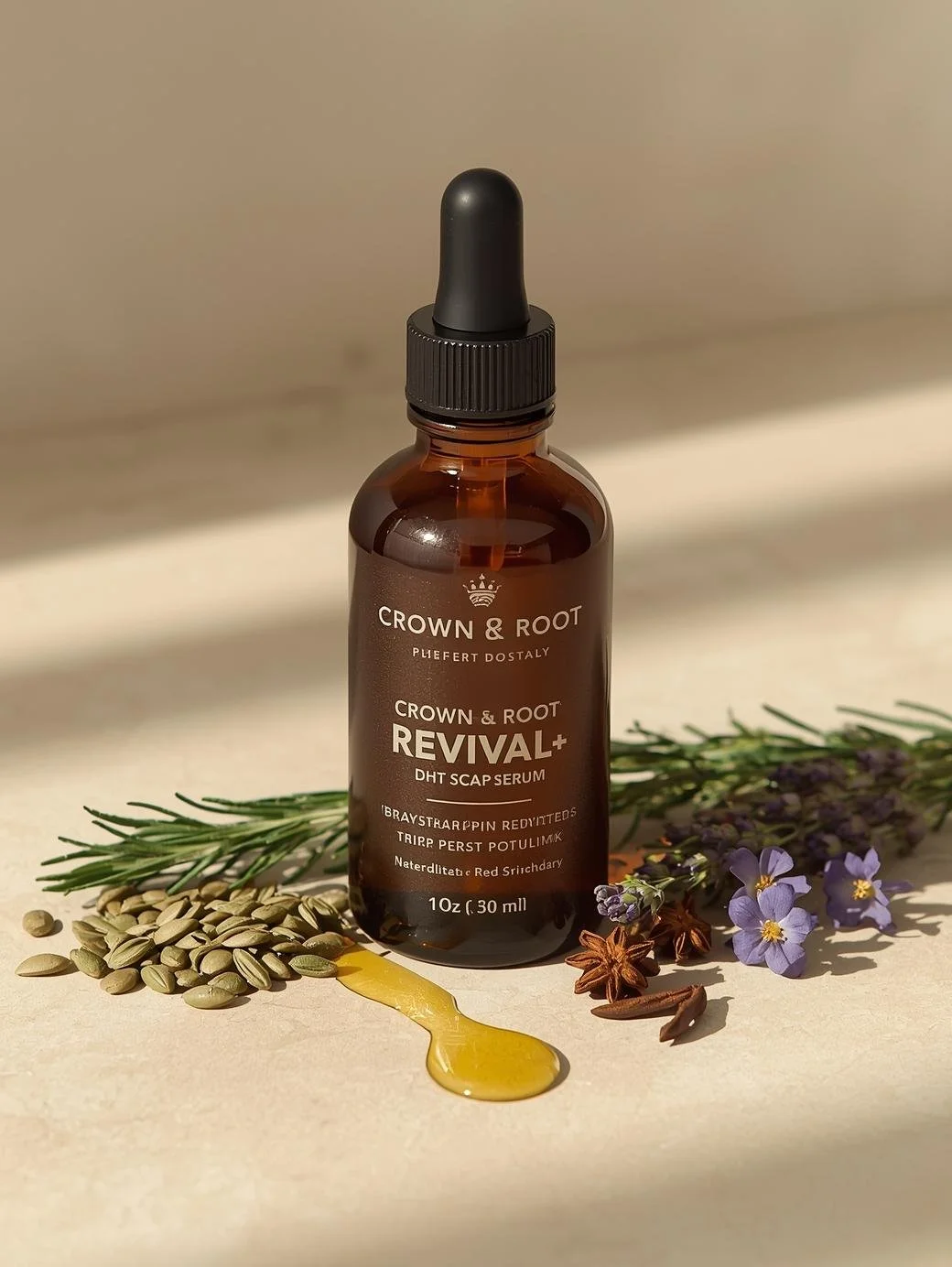
🌿 “Crown & Root Revival+” DHT-Savvy Scalp Serum
A soothing, circulation-boosting scalp serum to support perimenopausal hair, inspired by your lab work, not just the beauty aisle.
🧺 Updated Ingredients (30 ml / 1 oz glass dropper bottle)
Carrier base
🥥 Organic fractionated coconut oil – 1 tbsp (15 ml)
🧡 Pumpkin seed oil (cold-pressed) – 2 tsp (10 ml)
🍵 Green tea–infused jojoba oil – 1 tsp (5 ml)
(Instructions for infusion below 👇🏾)
Actives & essential oils (low, scalp-friendly dilution)
🌿 Rosemary essential oil – 6 drops
💜 Lavender essential oil – 4 drops
🌱 Peppermint essential oil – 2 drops
🌰 Clove bud essential oil – 1 drop (very strong; 1 drop max)
🍃 (Optional) Vitamin E oil – 4–6 drops
🔔 Safety note (important):
Essential oils are potent—this blend is ~2% dilution for a 30 ml bottle, which is generally considered a reasonable upper limit for scalp use in adults. Patch test first (inside forearm, 24 hours). Discontinue if burning, rash, or irritation. Avoid in pregnancy/breastfeeding, on broken skin, or on children without guidance from a qualified practitioner. Keep away from eyes. If it gets in, flush with carrier oil, not water.
🍵 How to Make Green Tea–Infused Jojoba Oil
Place 1 tsp organic green tea leaves (or 1 cut-open tea bag) in a small clean glass jar. 🍃
Add 2–3 tbsp jojoba oil, making sure the leaves are fully covered.
Set the closed jar in a warm (not hot) spot (like near a sunny window) for 24–48 hours, gently shaking once or twice a day.
Strain through a fine mesh or coffee filter into a clean container.
Use 1 tsp of this infused oil for your serum; store the rest in a dark, cool place.
🧴 Step-by-Step: Assembling the Serum
Prep your bottle
Wash and dry a dark glass 30 ml dropper bottle. Optionally rinse with a little rubbing alcohol and let it air dry completely.
Add carrier oils
Using a small funnel, pour in:
1 tbsp fractionated coconut oil 🥥
2 tsp pumpkin seed oil 🧡
1 tsp green tea–infused jojoba oil 🍵
Add vitamin E (optional)
Add 4–6 drops of vitamin E oil 🍃 to help stabilise the blend and nourish the scalp.
Add essential oils
Carefully add:
6 drops rosemary 🌿
4 drops lavender 💜
2 drops peppermint 🌱
1 drop clove bud 🌰
Blend & label
Cap tightly and roll between your palms to combine.
Label: “Crown & Root Revival+ DHT Scalp Serum – [Date]”.
Store in a cool, dark place and use within 3–4 months.
💆🏾♀️ How to Use
Scalp Treatment (1–3x/week)
Start with dry or slightly damp hair.
Part hair in sections; apply a few drops directly to the scalp in each part.
Massage gently for 3–5 minutes—small circular motions, focusing on thinning areas (part line, temples, crown).
Leave on for 30–60 minutes, or overnight if tolerated (pillow protected).
Shampoo and condition with gentle, low-toxin products.
Pro tip: Pair your massage time with prayer, gratitude, or breathwork—supporting nervous system calm while the serum boosts circulation. ✝️🕊️
🧪 Ingredient Deep-Dive (DHT & Growth Support)
🧡 Pumpkin Seed Oil
Why it’s here:
Naturally rich in phytosterols and zinc, traditionally used to support healthy DHT balance around the hair follicle.
Nourishes the scalp barrier with vitamin E and fatty acids—ideal in perimenopause dryness.
🍵 Green Tea–Infused Jojoba Oil
Why it’s here:
Green tea (especially EGCG) is often used to gently modulate DHT activity and support follicle health.
Jojoba mimics natural scalp sebum, helping distribute catechins through the scalp without heaviness.
Adds antioxidant support against oxidative stress—one of the quiet saboteurs in Metabolic Chaos®.
🌿 Rosemary Essential Oil
Why it’s here:
Supports microcirculation around follicles, encouraging nutrients and oxygen delivery.
Early research suggests rosemary oil may perform comparably to low-dose minoxidil for certain hair concerns over time—without the drug’s classic “shed when you stop” rebound.
💜 Lavender Essential Oil
Why it’s here:
Calms and soothes the scalp, which is helpful if stress is high and your nervous system is broadcasting 24/7 alerts.
Its relaxing aroma supports rest-and-digest mode, which indirectly helps hormone balance and hair growth.
🌱 Peppermint Essential Oil
Why it’s here:
Creates a mild cooling/tingling sensation that reflects increased local circulation.
Can help some users feel more “awake” at the scalp—nice if things feel dull or sluggish up top.
🌰 Clove Bud Essential Oil (micro-dose)
Why it’s here:
Powerhouse antioxidant with strong warming and circulation-supporting properties.
Used cautiously (just 1 drop in 30 ml) to avoid irritation while still lending its stimulating, protective edge to the blend.
🥥 Fractionated Coconut Oil
Why it’s here:
Light, non-greasy carrier that helps the serum spread easily and improves penetration of actives.
Offers gentle antimicrobial support for a balanced scalp environment.
🍃 Vitamin E
Why it’s here:
Antioxidant shield for both the oils and your scalp.
Helps protect delicate hair shafts from free radical damage and environmental stressors.
You can drop this straight into your blog as a “Topical Ritual to Pair with Your Labs” section—something like:
“While HTMA, DUTCH Plus, and Functional Blood Chemistry help us address root causes from the inside, this simple ‘Crown & Root Revival+’ serum gives your follicles a little external love while God and your biochemistry do the deeper rebuilding.” 💚
📚 References
📖 Research & Studies
Rinaldi F. The Menopausal Transition: Is the Hair Follicle “Going Through Menopause?” — Review on how fluctuating/declining sex hormones in menopause affect hair follicle cycling and density.
👉🏾 https://pmc.ncbi.nlm.nih.gov/articles/PMC10669803/
Treister-Goltzman Y et al. Iron Deficiency and Nonscarring Alopecia in Women: Systematic Review and Meta-Analysis — Evaluates the relationship between iron deficiency, ferritin, and nonscarring female alopecia.
👉🏾 https://pmc.ncbi.nlm.nih.gov/articles/PMC8928181/
Rushton DH. Iron deficiency and hair loss—Nothing new? — Discusses low ferritin and its association with female pattern hair loss and telogen effluvium.
👉🏾 https://www.jaad.org/article/S0190-9622(11)00245-3/fulltext
Kantor J et al. Decreased Serum Ferritin Is Associated With Alopecia in Women — Observational data linking lower ferritin with hair loss in women.
👉🏾 https://www.sciencedirect.com/science/article/pii/S0022202X15304942
Hussein RS et al. Impact of Thyroid Dysfunction on Hair Disorders — Comprehensive review of how hypo- and hyperthyroidism contribute to diffuse hair shedding and structural changes.
👉🏾 https://pmc.ncbi.nlm.nih.gov/articles/PMC10492440/
Aboalola D et al. An Update on Alopecia and its Association With Thyroid Autoimmune Disease — Explores mechanisms connecting autoimmune thyroid disease and hair loss.
👉🏾 https://pmc.ncbi.nlm.nih.gov/articles/PMC10769472/
Bargujar P et al. Hair loss in hypothyroidism — Case report highlighting diffuse alopecia and altered anagen/telogen ratio in hypothyroidism.
👉🏾 https://casereports.bmj.com/content/17/7/e260925
Almohanna HM et al. The Role of Vitamins and Minerals in Hair Loss: A Review — Details links between deficiencies in iron, zinc, vitamin D, and B vitamins and various alopecias, plus risks of over-supplementation.
👉🏾 https://pmc.ncbi.nlm.nih.gov/articles/PMC6380979/
Guo EL & Katta R. Diet and Hair Loss: Effects of Nutrient Deficiency and Supplement Use — Reviews how deficiencies (zinc, iron, protein, essential fatty acids) and excessive nutrients may drive hair loss.
👉🏾 https://pmc.ncbi.nlm.nih.gov/articles/PMC5315033/
Harvard Health Publishing. Vitamins, minerals, and hair loss: Is there a connection? — Overview of nutrient deficiencies and hair loss, with caution about excessive vitamin A, selenium, and biotin.
👉🏾 https://www.health.harvard.edu/diseases-and-conditions/vitamins-minerals-and-hair-loss-is-there-a-connection
Cleveland Clinic. Female Pattern Baldness: Symptoms and Treatment — Describes female pattern thinning, role of hormones (including DHT), and prevalence after menopause.
👉🏾 https://my.clevelandclinic.org/health/diseases/24943-female-pattern-baldness
📘 Clinical Guides, Menopause & Hair
Dr Louise Newson. Hair loss: are perimenopause and menopause to blame? — Explains how changing levels of estradiol, progesterone, and testosterone in the menopausal transition impact hair shedding and density.
👉🏾 https://www.drlouisenewson.co.uk/knowledge/hair-loss-are-perimenopause-and-menopause-to-blame
London Hormone Clinic. Hormonal hair loss and thinning in menopause — Clinician overview of how falling oestrogen and rising androgens shrink follicles and change hair texture during menopause.
👉🏾 https://www.londonhormoneclinic.com/journal/hormonal-hair-loss-menopause
Dr Louise Newson. Testosterone and hair during menopause — Discusses nuanced roles of testosterone, DHT, and menopause in scalp hair gain/loss.
👉🏾 https://www.drlouisenewson.co.uk/knowledge/testosterone-and-hair-during-menopause
British Thyroid Foundation. Hair loss and thyroid disorders — Patient-friendly summary of how prolonged hypo- and hyperthyroidism cause diffuse scalp hair loss and regrowth after treatment.
👉🏾 https://www.btf-thyroid.org/hair-loss-and-thyroid-disorders
NICE CKS. Female pattern hair loss — Investigations — Recommends checking thyroid function, full blood count, ferritin, and vitamin D in women with suspected telogen effluvium or pattern hair loss.
👉🏾 https://cks.nice.org.uk/topics/female-pattern-hair-loss-female-androgenetic-alopecia/diagnosis/investigations/
NHS. Menopause – Treatment — Outlines evidence-based use of HRT for perimenopausal and menopausal symptoms and when it may be considered.
👉🏾 https://www.nhs.uk/conditions/menopause/treatment/
Menopause Care. HRT & Hair Loss: Can It Help? — Clinical blog on how HRT may stabilise or improve menopause-related hair loss in some women, while emphasising individualised prescribing.
👉🏾 https://www.menopausecare.co.uk/blog/hrt-hair-loss
🧪 Functional Testing, OAT, DUTCH Plus & HTMA
MosaicDX. Organic Acids Test (OAT) — Describes OAT as a comprehensive assessment of metabolic pathways, including B-vitamin status, mitochondrial function, and gut-related markers.
👉🏾 https://mosaicdx.com/test/organic-acids-test/
Mindful Functional Medicine (blog). Organic Acids Test (OAT) interpretation — Explains how OAT markers can reflect B-vitamin status, energy production, and detox pathways relevant to fatigue and hair health.
👉🏾 https://mfm.au/blog/organic-acids-test/
Precision Analytical (DUTCH). ORGANIC ACID TESTS – Provider Information Sheet — Details how DUTCH OAT markers act as functional indicators of vitamin B12, B6, and glutathione status.
👉🏾 https://dutchtest.com/api/files/file/Product-Info-Sheet_DUTCH-OATs_RevA3-06272022.pdf
Precision Analytical. DUTCH Plus™ — Official overview of DUTCH Plus, including sex hormones, adrenal hormones, cortisol awakening response (CAR), organic acids, melatonin, and oxidative stress markers.
👉🏾 https://dutchtest.com/dutch-plus
NutritionDiets (UK). DUTCH Plus Complete Test + Cortisol Awakening Response — Practitioner description of DUTCH Plus with CAR and organic acid markers (sleep, melatonin, nutrient and metabolic insights).
👉🏾 https://nutritiondiets.co.uk/product/dutch-plus-complete-test-cortisol-awakening-response/
Nutritionist Resource. What is a hair mineral analysis (HTMA) test and is it valid? — Explains HTMA as a non-invasive way to assess mineral trends and toxic metals over ~3 months via hair tissue, with discussion of benefits and limitations.
👉🏾 https://www.nutritionist-resource.org.uk/articles/what-is-a-hair-mineral-analysis-htma-test-and-is-it-valid
The Ki Clinic. Hair Mineral Analysis (HTMA) — Describes HTMA as a soft-tissue mineral biopsy, measuring nutrient minerals, toxic metals, and mineral ratios that can reflect longer-term body stores.
👉🏾 https://thekiclinic.co.uk/hair-mineral-analysis/
Mineral State. Hair Mineral Analysis UK — Practical overview of hair mineral analysis as a screening tool for trace elements and heavy metals using hair samples.
👉🏾 https://www.mineralstate.co.uk/
🧷 General Nutrient Status & Deficiency
Verywell Health. 11 Warning Signs You're Not Getting Enough Essential Nutrients — Lists clinical signs like brittle/dry hair, nail changes, and fatigue as possible clues to iron, zinc, B-vitamin, and vitamin D deficiencies.
👉🏾 https://www.verywellhealth.com/nutrient-deficiency-11795198
Blog Disclaimer
The health information on this blog is for general educational purposes only and is not intended to diagnose, treat, cure, or prevent any disease. It should not be used as a substitute for professional medical advice. Always consult a qualified healthcare provider before making any health-related decisions
This blog may contain affiliate links, meaning Leaves from the Tree of Life LLC may earn a small commission if you purchase a product or service through these links—at no additional cost to you. Your support helps us continue to provide valuable content. Thank you!
