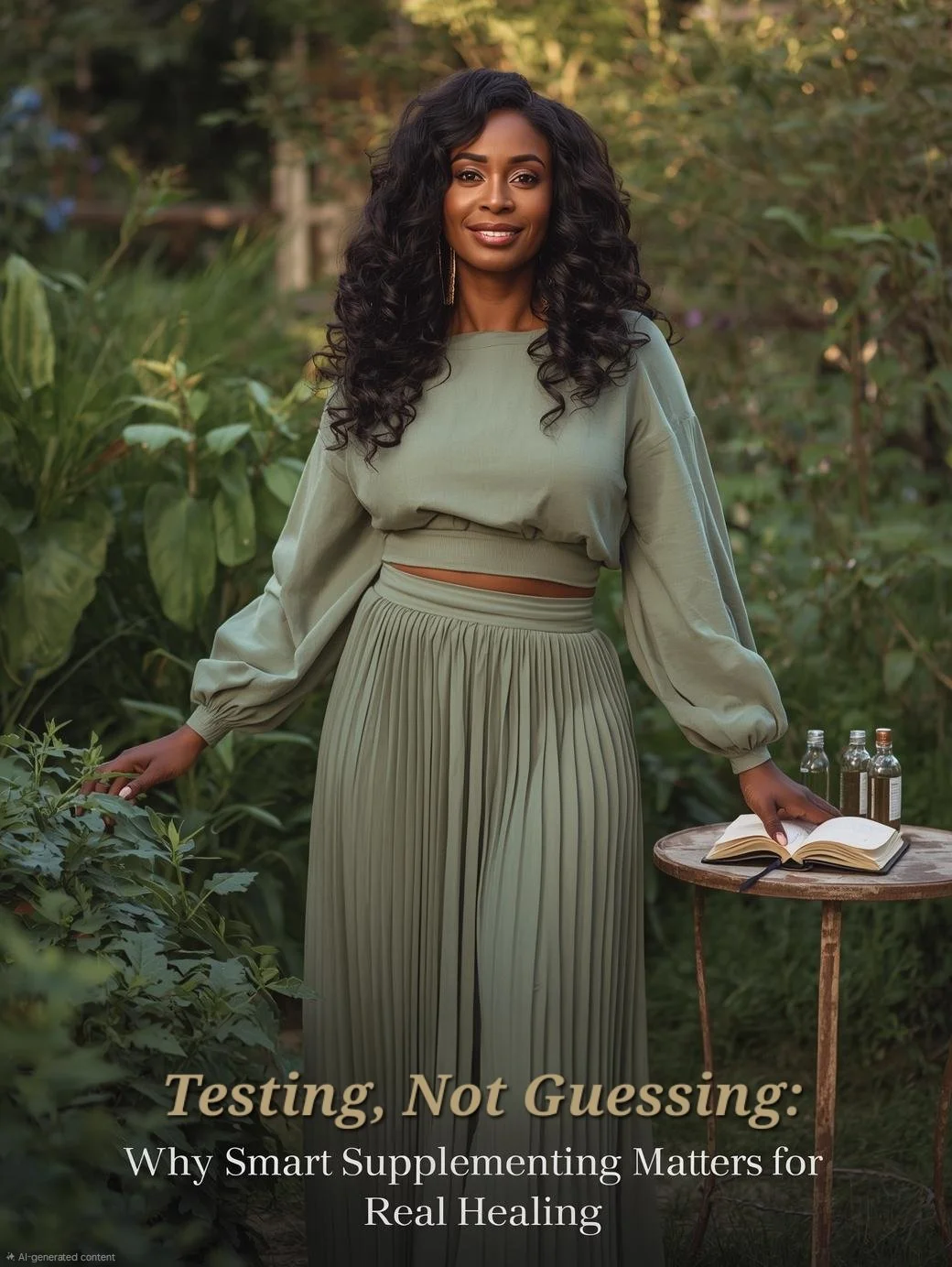
Testing, Not Guessing: Why Smart Supplementing Matters for Real Healing
Testing, Not Guessing: Why Smart Supplementing Matters for Real Healing
🌿 “I’m Taking All the Things… So Why Don’t I Feel Better?”
If you’ve ever stared at your supplement shelf thinking,
“I’m doing everything right… so why do I still feel off?”
…you’re in the right place.
Maybe you’ve:
Googled and DuckDuckGo’d your way through magnesium, omega-3s, probiotics, adaptogens
Stacked vitamins based on podcasts, reels, and “must-have” lists
Tried to fix fatigue, brain fog, bloating, and perimenopausal symptoms with another capsule
…and you’re still:
Tired but wired
Bloated or “puffy”
Moody, anxious, or foggy
Feeling like your body is not fully on your side
It’s not that supplements are “bad” or that you’re doing something wrong. It’s that supplements without strategy can turn into noise instead of nourishment.
As a Traditional Naturopath and Functional Diagnostic Nutrition® Practitioner, I see women every week who are doing a lot of “healthy things” and are still living in a state of Metabolic Chaos®—that tangled place where hormones, gut, nervous system, detox, and blood sugar all start talking over each other at once.
Your body isn’t broken.
But it is asking for a more precise, faith-aligned, data-informed approach.
That’s where testing, not guessing comes in.
💊 Supplements Are Tools, Not Tiny Saviors
Let’s reset expectations.
Supplements are not:
Magic pills that erase years of stress and burnout
A replacement for sleep, boundaries, or prayer
A way to out-supplement ultra-processed food and chronic anxiety
Supplements are:
Targeted tools that support specific healing opportunities in your body
Concentrated nutrients your system may need more of due to life stage, genetics, meds, or environment
Helpful “sidekicks,” not the main hero of your story
And here’s the reality check:
In our modern world, a few things are true at the same time:
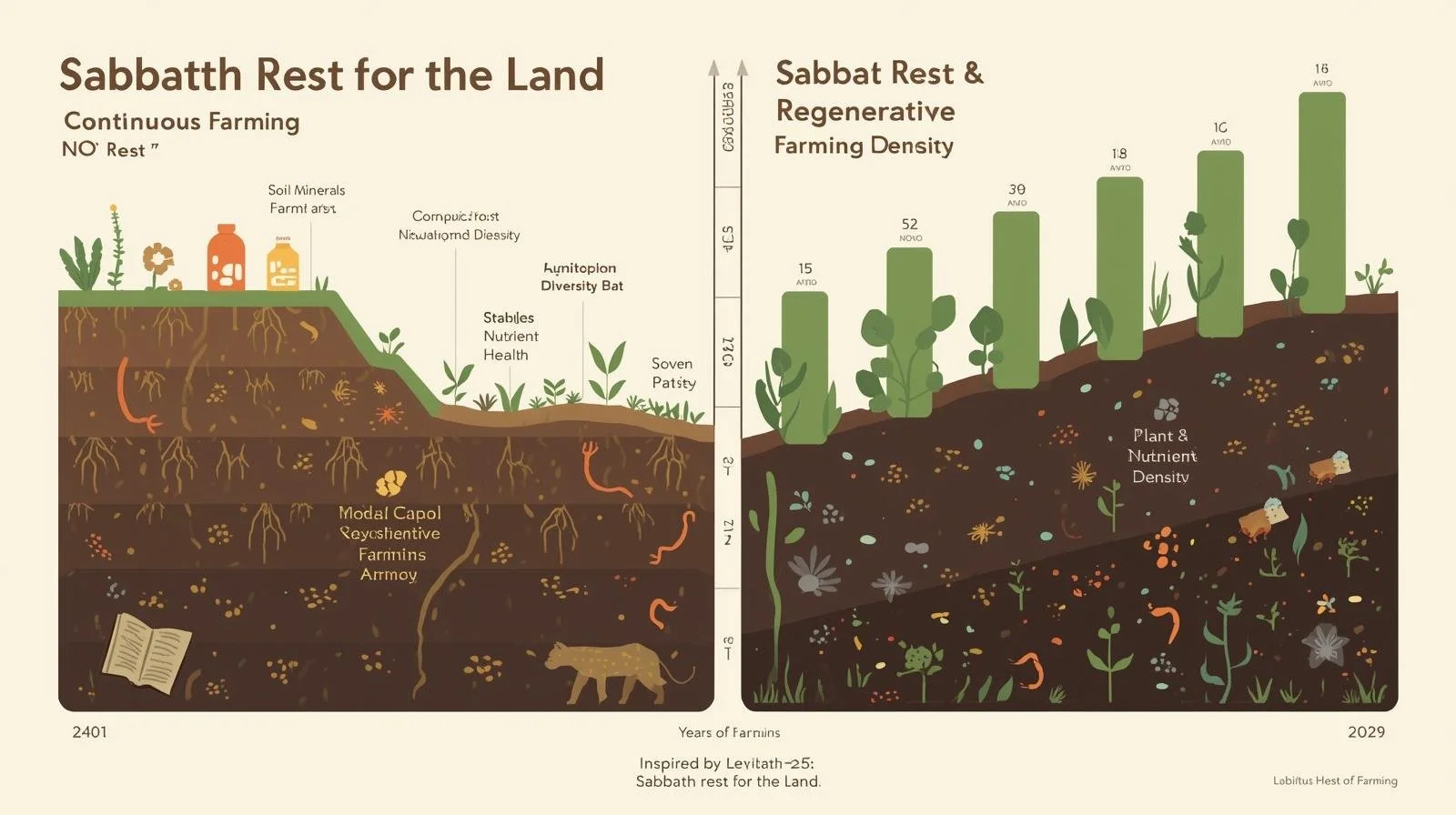
Soil depletion is real. For generations now, much of our land has been pushed into continuous production—season after season, year after year—without true “Sabbath rest.” In Scripture, God instructed that the land itself should rest every seventh year (Leviticus 25), allowing it to recover and renew. When that rhythm is ignored, the soil gradually loses minerals and organic matter. Over time, even beautifully grown food can contain less magnesium, zinc, selenium, and other key minerals than it did decades ago.
Our bodies are under more demand. Chronic stress, poor sleep, screens late at night, and blood sugar swings burn through nutrients at a faster rate.
Medications can drain nutrients. Common prescriptions—like PPIs, metformin, and hormonal birth control—can deplete specific vitamins and minerals.
Midlife and perimenopause increase the load. Your adrenals, thyroid, liver, and gut all work harder in this season, increasing the need for targeted support.
So even if you’re eating “clean” and doing your best with whole foods (which absolutely is foundational), food alone often isn’t enough to fully replenish what your body is using—and what depleted soil is no longer consistently providing.
Thoughtful, data-driven supplementation becomes a way of filling in the gaps, while we also advocate for more sustainable, creation-honoring farming practices that respect God’s original design for the land and for us. 🌿
🔄 Metabolic Chaos® 101: Why Guessing Backfires
What you feel—fatigue, heavy periods, anxiety, bloating, weight changes, insomnia—is usually the end result of deeper, upstream imbalances.
Behind the scenes, Metabolic Chaos® might be affecting:
Blood sugar balance
Thyroid and adrenal function
Gut health and microbiome diversity
Detox and liver pathways
Nervous system regulation and stress response
Inflammation and oxidative stress
If we respond to those symptoms with random supplements, we might:
Take iron for fatigue when the real issue is inflammation, gut malabsorption, or poor stomach acid
Use generic probiotics when your gut actually needs particular strains—or less histamine, or more gut-lining support first
Throw down high-dose B vitamins when your detox pathways are congested and can’t handle the “push”
Grab adaptogens when what your body truly needs is mineral repletion, blood sugar balance, and nervous system safety
This is how women end up spending a small fortune on supplements and still feel like,
“Something is missing. I’m not actually getting better.”
It’s not that supplements don’t work. It’s that they’re not matched to your unique pattern of Metabolic Chaos® and healing opportunities.
🧪 Testing, Not Guessing: Your Supplement GPS
This is where functional testing comes in. Think of it as spiritual discernment, but for your biochemistry. Instead of guessing, we gather data; then we pray, think, and plan with clarity.
🩸 Functional Blood Chemistry Analysis (FBCA)
This isn’t just “Are you in the lab range?”
It’s:
“What story is your blood telling about how your body is coping?”
With a functional lens, we look at:
Blood sugar patterns (fasting glucose, insulin, HbA1c)
Iron status (ferritin, iron, TIBC, transferrin saturation)
Thyroid health (TSH, Free T4, Free T3, sometimes antibodies)
Inflammation (CRP), liver and kidney function
Nutrient markers like B12, folate, vitamin D (and how they relate to each other)
So instead of:
“Take vitamin D because everyone online is low”
We can say:
“Your vitamin D is low, calcium and PTH look like this, and inflammation looks like that—so here’s a safe, personalized plan to correct it… and a timeline to retest.”
🧬 Functional Labs: Deeper Healing Opportunities
Depending on your case, we may layer in:
Hormone testing (like DUTCH)
To guide magnesium, B vitamins, liver support, adaptogens, and other hormone-support nutrients
Comprehensive stool analysis
To decide whether you need spore-based probiotics, Akkermansia, antimicrobials, digestive enzymes, or gut-lining repair
Organic acids / metabolomics
To see mitochondrial stress, detox bottlenecks, neurotransmitter precursors, and nutrient needs
HTMA (Hair Tissue Mineral Analysis)
To assess mineral status and ratios over time—key for energy, mood, thyroid, and adrenal patterns
Now your supplement strategy isn’t based on trends or fear. It’s based on your labs + your story + your values.
🔬 Fun Fact Science Bar+
Did you know the Bible’s instruction to let the land rest isn’t just “spiritual poetry”—it’s smart soil science? In Leviticus 25, God tells Israel to give the land a Sabbath year every seventh year. Modern research shows that when land isn’t constantly ploughed, sprayed, and cropped, the soil microbiome has time to recover, rebuild structure, and store more minerals and organic matter.
When farmers push land into continuous production without rest or regenerative practices, the soil gradually loses key nutrients like magnesium, zinc, and selenium, and the microbes that help plants absorb those nutrients decline. So even when you’re eating “healthy” whole foods, they may contain less mineral power than they did decades ago—one more reason why smart, targeted supplementation is often truly needed today.
👉🏾 Translation: God’s agricultural blueprint was about nutrient density and long-term health, not just crop rules. Rested, covered, and well-managed soil grows plants with deeper roots and richer mineral content. Overworked soil can grow food that looks the same but is quietly lower in minerals. Some of your fatigue, cramps, brittle nails, or hormone symptoms may be tied not only to what you eat—but to what’s missing from the soil it came from.
✨ Healing Opportunity: When possible, support regenerative and organic farms (cover crops, minimal tilling, compost, crop rotation—modern echoes of “Sabbath rest for the land”). Fill your plate with mineral-rich foods (leafy greens, seeds, legumes, nuts, sea vegetables), then use functional testing plus wise supplementation to “top up” what food and soil can’t fully provide. Think of supplements as nutrient insurance in a world of tired soil, not a replacement for food.
✝️ Faith Element: God built rhythms of work and rest for both humans and the land. Honouring those rhythms—choosing food grown with care and using supplements to wisely support the body-temple—is one way of aligning with His wisdom. When you take your minerals or whole-food-based supplements, you can simply pray, “Lord, thank You for the food and the helpers that support this body while creation waits to be restored.” 🌱
🧰 From Kitchen Sink to Custom Fit: How to Build a Smarter Stack
Let’s move you from “one more supplement can’t hurt” to:
“Every supplement I take has a job, a timeline, and a purpose.”
Here’s how a smart, faith-aligned plan can look:
1. Start with the foundations
Real, whole food (as close to the garden as you can reasonably get)
Hydration
Sleep and circadian rhythm
Gentle movement
Nervous system support
Faith rhythms: prayer, Scripture, fellowship, and Sabbath rest 🕊️
Supplements work better when the terrain is cared for.
2. Clarify your main goals
You can’t fix everything at once without overwhelming your body or your budget.
Is your top priority energy? Gut? Hormones? Brain?
We sequence support so your system feels safer and more stable.
3. Test with intention
We choose labs strategically—starting with Functional Blood Chemistry Analysis and layering in others as appropriate—to identify healing opportunities instead of chasing every symptom.
4. Match supplements to patterns, not just symptoms
Examples:
Fatigue + low ferritin + heavy periods
Gentle iron + minerals + liver support + address the heavy bleeding
Anxiety + poor sleep + blood sugar swings
Nervous system support + magnesium + inositol in the context of protein- and fiber-rich meals
Bloating + constipation + skin issues
Gut support tailored to your microbiome and motility, not just a random probiotic
5. Start low, go slow
Especially in perimenopause or with sensitive systems, we:
Titrate up gradually
Watch your body’s feedback
Adjust as needed
This is stewardship—over your body, your mind, and your resources.
6. Retest and refine
Healing is dynamic, not static.
We re-evaluate:
What’s improved?
What’s still stuck?
What do the follow-up labs say now?
Then we adjust your supplement plan so you’re not stuck on a “forever stack” that no longer fits.
🙏🏾 Faith, Stewardship, and Supplements
From a faith lens, I don’t see supplements as something to idolize—or to fear. I see them as part of stewardship.
As a Christian with a Seventh-day Adventist health perspective, I believe:
Your body is a temple of the Holy Spirit, worth caring for with intention, not neglect or panic.
God is the ultimate Healer. We’re not trying to outsmart Him—we’re cooperating with His design.
The simple “laws of health” still matter: fresh air, sunlight, pure water, whole plant-rich foods, rest, movement, and trust in God.
Even the biblical idea of letting the land rest reflects God’s wisdom for sustainability and nutrient density. When that rhythm is ignored, supplements can help fill in nutritional gaps while we work toward more creation-honoring practices.
So we use supplements:
Not as a shortcut around obedience to health principles
But as tools to support healing processes God already built into your cells, your hormones, your gut, your brain
Data + discernment. Science + Scripture. Labs + listening to the Holy Spirit. That’s the harmony I aim for.
🧭 How I Use Supplements with Clients
In my practice as a Traditional Naturopath + Functional Diagnostic Nutrition® Practitioner, I don’t start with:
“Here, buy this generic hormone/gut/energy bundle.”
Instead, we:
Walk through your story, symptoms, lifestyle, and spiritual context
Audit your current supplement stack: what’s working, what’s redundant, what might be stressing your system
Use Functional Blood Chemistry Analysis and other selected functional labs to map your Metabolic Chaos®
Identify true healing opportunities across systems (gut, hormones, detox, nervous system, blood sugar)
Build a phased, personalized plan—including supplements, lifestyle shifts, and faith-based rhythms
The goal isn’t to have you on 25 products indefinitely.
The goal is clarity and alignment:
“These are the key products my body actually needs right now, and here’s why, for how long, and with what lifestyle/foundation alongside them.”
🌟 Ready to Stop Guessing and Start Healing on Purpose?
If you’ve been:
Collecting supplements like they’re a hobby
Half-convinced you’re “unfixable” because they aren’t working
Feeling in your spirit that there must be a more precise, God-honoring way…
…this is your invitation. 💌
You don’t have to:
Keep guessing and hoping something sticks
Keep spending money on products that aren’t matched to your body
Keep trying to DIY your way out of deep Metabolic Chaos® without a roadmap
You can:
Partner with a practitioner who reads labs through a functional and faith-informed lens
Identify real healing opportunities in your body
Build a supplement strategy that respects your physiology, your beliefs, and your budget
📅 Your next step:
Book a functional consultation where we’ll:
Review your health story and current supplement stack
Identify the most strategic tests (not all the tests)
Map out a testing-not-guessing plan tailored to you
Because your body isn’t random.
Your symptoms are not an accident.
And your supplements should be doing more than just sitting pretty on a shelf.
Let’s turn confusion into clarity—and turn supplement chaos into a Christ-centered, data-informed healing plan. 🌿✨
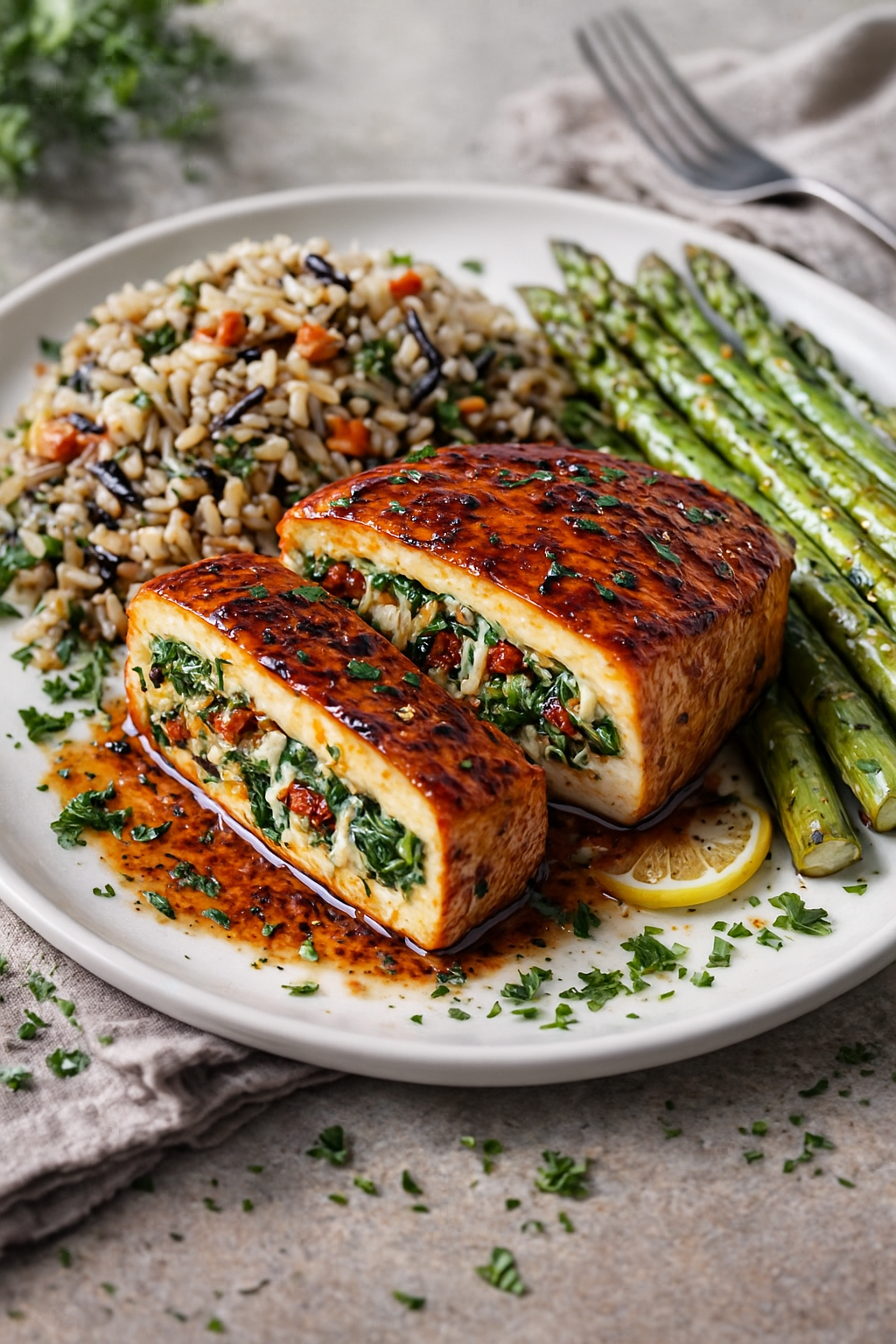
🧀🌿 Glazed Kale & Cream Tofu Cutlets with Garlicky Wild Rice & Lemony Asparagus
Crispy glazed stuffed tofu “steaks,” garlicky wild rice, and bright asparagus. It’s giving Sabbath dinner meets functional foodie—balanced in carbs, protein, healthy fats, and fiber.
🕒 Time
Active prep: 30–35 minutes
Marinating: 30 minutes (or overnight for deeper flavour)
Cooking: 30 minutes
Total: ~1 hour (plus marinating time)
Serves: 3–4
🧺 Ingredients
🌾 Garlicky Wild Rice
1 cup wild rice blend, rinsed
2¼ cups low-sodium vegetable broth or water
1 small shallot or ½ small onion, finely diced
3 cloves fresh garlic, minced
1 small carrot, finely diced
1 tbsp avocado oil
½ tsp dried thyme
Sea salt to taste
🧴 Smoky Glaze Marinade (for tofu)
3 tbsp avocado oil
2 tbsp tamari or coconut aminos
1 tbsp apple cider vinegar
1 tsp smoked paprika
½ tsp garlic powder
½ tsp onion powder
1 tsp nutritional yeast
½ tsp maple syrup (optional, for a little caramelisation)
🧀 Kale & Cream Stuffing
⅓ cup plant-based cream cheese
¼ cup vegan parmesan-style shreds
½ cup finely chopped kale (lightly steamed or massaged if tough)
1–2 tbsp finely chopped sun-dried tomatoes (oil-free if possible)
½ tsp garlic powder
Pinch of sea salt
🍱 Stuffed Tofu Cutlets
2 blocks (400–450 g total) extra-firm tofu, well pressed
All of the smoky glaze marinade
All of the kale & cream stuffing
🌿 Lemony Asparagus
1 large bunch asparagus, woody ends snapped off
1 tbsp avocado oil
Juice of ½ lemon
Sea salt & pepper to taste
👩🏾🍳 Step-by-Step Instructions
1️⃣ Prep & press the tofu
Drain tofu and press for at least 15–20 minutes to remove excess water.
Once pressed, slice each block horizontally to create 2 thick cutlets (4 total).
Lay a cutlet flat and carefully cut a deep pocket into the long side with a small sharp knife (just like in the screenshots), without cutting through the back. Repeat for all cutlets.
2️⃣ Make the smoky glaze marinade
In a shallow dish, whisk together avocado oil, tamari, apple cider vinegar, smoked paprika, garlic powder, onion powder, nutritional yeast, and maple syrup.
Place the tofu cutlets into the dish, turning so they’re well coated on all sides.
Marinate for at least 30 minutes, turning once or twice. For extra flavour, cover and marinate overnight in the fridge.
3️⃣ Start the garlicky wild rice
In a medium pot, warm 1 tbsp avocado oil over medium heat.
Add shallot and carrot; sauté 3–4 minutes until softened.
Stir in fresh garlic and cook 30 seconds until fragrant.
Add wild rice and thyme, stir to coat.
Pour in broth/water, add a pinch of salt, bring to a boil.
Reduce to low, cover, and simmer 35–40 minutes until rice is tender and liquid absorbed.
Turn off heat and let sit covered 5 minutes, then fluff with a fork.
4️⃣ Make the kale & cream stuffing
In a bowl, combine plant-based cream cheese, vegan parmesan shreds, chopped kale, sun-dried tomatoes, garlic powder, and a pinch of salt.
Mix until everything is well combined and spreadable. Adjust salt to taste.
5️⃣ Stuff the tofu
Remove tofu cutlets from the marinade (save leftover glaze).
Gently spoon the kale & cream stuffing into each pocket, pressing it in so the filling reaches the ends.
Use your fingers to pinch the edges closed as much as possible.
Brush or spoon a little extra marinade over the outside of the stuffed cutlets.
6️⃣ Cook the tofu & asparagus
You can bake or pan-sear + finish in the oven. Here’s a hybrid for max flavour.
Preheat oven to 200°C / 400°F. Line a baking tray with parchment.
Heat a large skillet over medium heat with 1–2 tsp avocado oil.
Sear each stuffed tofu cutlet for 2–3 minutes per side, until golden-brown.
Transfer seared cutlets to the lined baking tray.
On the same tray (or another), toss asparagus with 1 tbsp avocado oil, salt, and pepper.
Bake tofu and asparagus for 12–15 minutes, until asparagus is tender with a slight char and tofu is heated through with a sticky, caramelised glaze.
Squeeze lemon juice over asparagus as soon as it comes out.
7️⃣ Plate it up 💚
Spoon a generous scoop of garlicky wild rice onto each plate.
Top with a glazed stuffed tofu cutlet.
Add a side of lemony asparagus spears.
Garnish with extra chopped kale or parsley if you’d like.
Take a breath, give thanks, and enjoy. 🙏🏾✨
🧠 Nutrient & Healing Highlights (Ingredient-by-Ingredient)
Tofu 🍱 – High-quality plant protein with iron and calcium (if fortified). Supports muscle repair, bone health, and hormone production in perimenopause.
Kale 🥬 – Packed with vitamin K, vitamin C, carotenoids, and calcium; supports detox pathways, bones, and antioxidant protection.
Plant-Based Cream Cheese & Vegan Parmesan 🧀 – Provide satisfying fats and flavour; often fortified with B12 and calcium (check labels). Great for satiety and nervous system support in moderation.
Wild Rice 🌾 – Rich in fiber, magnesium, and antioxidants. Helps stabilize blood sugar, energy, and supports gut motility.
Asparagus 🌿 – Source of folate, vitamin K, and prebiotic fiber (inulin), which feeds beneficial gut bacteria and supports gentle detox.
Avocado Oil 🥑 – High in monounsaturated fats and vitamin E; supports heart, hormone, and skin health, and is stable at higher cooking temps.
Garlic 🧄 – Contains allicin, which supports immune function, cardiovascular health, and microbial balance in the gut.
Sun-Dried Tomatoes 🍅 – Concentrated lycopene and vitamin C for antioxidant and cardiovascular support.
Nutritional Yeast ✨ – Savory B-vitamin booster (often with B12), supporting energy production and stress resilience.
This plate feels indulgent but is strategically built: supporting blood sugar, hormones, gut health, and mineral intake—so your supplements become smart, targeted helpers rather than a desperate guess. 🌿💊
📚 References
📖 Research & Studies
Bhardwaj et al. — An Alarming Decline in the Nutritional Quality of Foods (review of long-term data showing significant declines in minerals like magnesium, calcium, copper in fruits and vegetables over decades, linked to agricultural practices and soil issues)
👉🏾 https://pmc.ncbi.nlm.nih.gov/articles/PMC10969708/
Mayer — Historical changes in the mineral content of fruit and vegetables (evidence for the “agronomic dilution effect” and soil trace-element depletion contributing to lower mineral content in crops)
👉🏾 https://www.tandfonline.com/doi/full/10.1080/09637486.2021.1981831
Scientific American — Dirt Poor: Have Fruits and Vegetables Become Less Nutritious? (summary of research linking soil depletion with lower vitamin and mineral levels in modern produce compared with decades past)
👉🏾 https://www.scientificamerican.com/article/soil-depletion-and-nutrition-loss/
Rosier et al. — From soil to health: advancing regenerative agriculture for human well-being (shows how cover crops, reduced tillage, and biomass retention increase soil organic matter and microbial diversity, improving long-term soil health)
👉🏾 https://pmc.ncbi.nlm.nih.gov/articles/PMC12576041/
Sher — Importance of regenerative agriculture: climate, soil health, biodiversity and socioecological impacts (review describing how regenerative practices can restore degraded soils and ecosystems)
👉🏾 https://link.springer.com/article/10.1007/s43621-024-00662-z
Ward — Addressing Nutritional Gaps with Multivitamin and Mineral Supplements (discusses how even with a varied diet, many people fall short on key micronutrients and how supplements can help fill gaps)
👉🏾 https://pmc.ncbi.nlm.nih.gov/articles/PMC4109789/
Blumberg et al. — The Evolving Role of Multivitamin/Multimineral Supplement Use in Personalized Nutrition (argues that targeted supplementation can support individuals at risk of inadequate intake without excess calories)
👉🏾 https://www.mdpi.com/2072-6643/10/2/248
Coates — The Evolution of Science and Regulation of Dietary Supplements (overview of dietary supplement science, regulation, and the move toward more personalized, evidence-based use)
👉🏾 https://www.sciencedirect.com/science/article/pii/S0022316624003560
Erdélyi et al. — The Importance of Nutrition in Menopause and Postmenopause (highlights needs for protein, calcium, vitamin D, B vitamins, and omega-3s in midlife women)
👉🏾 https://pmc.ncbi.nlm.nih.gov/articles/PMC10780928/
🌐 Websites & Practice Resources
Optimal DX — What is the Optimal Range? (explains how functional “optimal” blood ranges differ from broad laboratory reference ranges)
👉🏾 https://www.optimaldx.com/optimal-range
Nutrition Dynamics — Functional Blood Chemistry (describes using narrower functional ranges to identify early imbalances before disease develops)
👉🏾 https://nutritiondynamics.co.uk/functional-blood-chemistry/
Abundant Life Wellness Center — Functional Blood Analysis (consumer-friendly overview of functional vs pathological ranges and how labs guide lifestyle and supplement plans)
👉🏾 https://abundantlifewellnesscenter.com/functional-blood-analysis/
Functional Medicine Center — Functional Lab Ranges vs Pathological Ranges (explains using functional ranges to catch “pre-disease” patterns and guide preventive care)
👉🏾 https://www.functionalmedicinecenter.com/functional-lab-ranges-pathological-ranges/
Thriva Health Hub — What are optimal blood test ranges? (lay overview of optimal ranges, with vitamin D as an example)
👉🏾 https://thriva.co/hub/blood-tests/what-are-optimal-ranges
Better Health Channel (Victoria State Gov) — Vitamin and Mineral Supplements: What to Know (public-health guidance on when supplements are useful and why they don’t replace a healthy diet)
👉🏾 https://www.betterhealth.vic.gov.au/health/healthyliving/vitamin-and-mineral-supplements-what-to-know
Medical News Today — Are Supplements Really the Superheroes of Self-Care? (discusses multivitamins as tools for filling gaps rather than replacing real food)
👉🏾 https://www.medicalnewstoday.com/articles/are-supplements-really-the-superheroes-of-self-care
British Ecological Society — Regenerative Agriculture in the UK: Summary Report (evidence that regenerative systems can improve soils and biodiversity by reducing bare soil and keeping living roots year-round)
👉🏾 https://www.britishecologicalsociety.org/wp-content/uploads/2025/04/BES_Regenerative-agriculture-summary-report.pdf
Newson Health — Do I Need Supplements During Menopause? (practical guidance on vitamin D and other key nutrients in perimenopause/menopause)
👉🏾 https://www.drlouisenewson.co.uk/knowledge/do-i-need-supplements-during-menopause
My Menopause Centre — Peri-Menopause Supplements (overview of magnesium, calcium, omega-3s, and other key supplements for perimenopausal women)
👉🏾 https://www.mymenopausecentre.com/menopause-supplements/best-supplements-for-menopause/peri-menopause-supplements/
Blog Disclaimer
The health information on this blog is for general educational purposes only and is not intended to diagnose, treat, cure, or prevent any disease. It should not be used as a substitute for professional medical advice. Always consult a qualified healthcare provider before making any health-related decisions
This blog may contain affiliate links, meaning Leaves from the Tree of Life LLC may earn a small commission if you purchase a product or service through these links—at no additional cost to you. Your support helps us continue to provide valuable content. Thank you!
