
Perimenopause and the Bladder: The Symptoms Women Whisper About
🚽 Perimenopause and the Bladder: The Symptoms Women Whisper About
You have just sat down to a client call when the urge hits again. Perhaps you plan every outing around the nearest toilet. Maybe you leak when you laugh, wake several times a night to wee, or feel burning even though your last urine test was clear.
If this sounds familiar, you are not being dramatic. And you do not have to quietly rearrange your life around your bladder.
We talk about hot flashes, night sweats and brain fog, but bladder changes often remain a whisper. They can begin before periods stop. The useful question is not simply, “Is this perimenopause?” It is:
What is causing my symptoms, and what support fits the findings?

🧬 First Things First: Why Can Bladder Symptoms Change in Perimenopause?
The bladder stores urine, and the urethra carries it out. Nearby vaginal and urethral tissues respond to oestrogen. During perimenopause, oestrogen levels can fluctuate; as they decline, these tissues may become drier and more sensitive. Changes in the vaginal environment can also affect the microbes that live there.
The collection of genital and urinary changes associated with menopause is called genitourinary syndrome of menopause, or GSM. It can include vaginal dryness, irritation, pain with sex, urinary urgency, frequency, burning and recurring urinary tract infections (UTIs). Some women notice changes during perimenopause; others do not.
Think of your bladder, urethra, vagina and pelvic floor as neighbours. What happens in one area can affect another. But hormones are only part of the picture. Infection, constipation, pelvic floor tension, prolapse, bladder irritants, diabetes and certain medicines can cause overlapping symptoms.
That is why I do not want you to accept “It’s just your hormones” as the entire investigation. 😏
🔎 Which Bladder Conversation Are We Actually Having?
Urgency: You feel you need to go right now, sometimes with leakage before you reach the toilet.
Frequency or nocturia: You are urinating more often than usual or waking repeatedly during the night. Fluid timing, sleep and other health conditions may contribute.
Stress leakage: Urine escapes when you cough, sneeze, laugh, jump or lift. “Stress” here means physical pressure on the bladder—not that you need to calm down.
Burning or recurring discomfort: Possible causes include a UTI, GSM, irritation or another condition. Symptoms alone cannot reliably tell you which one it is.
Pelvic pressure, pain or difficulty emptying: These symptoms deserve assessment. More Kegels are not automatically the answer, especially if the pelvic floor is already tense.
Please seek prompt medical advice if urinary symptoms come with fever, pain in your side or back, vomiting, or feeling very unwell. Visible blood in the urine, difficulty passing urine, or symptoms that persist or keep returning also need medical assessment.
A supplement or light device should never delay care for a possible infection.
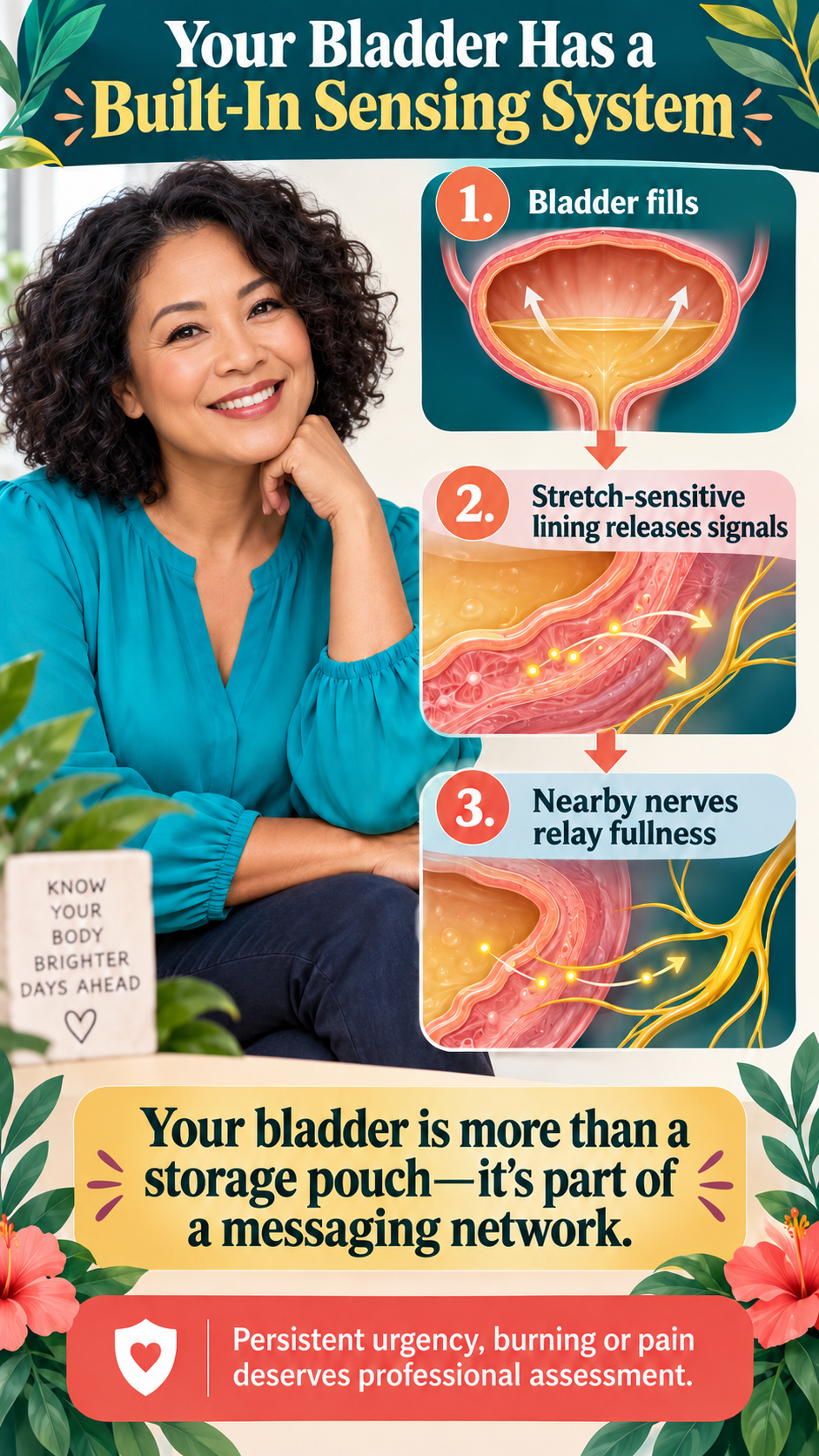
🔬 Fun Fact Science Bar+
Did you know your bladder has a built-in sensing system? As it fills, its stretch-sensitive lining can release chemical signals such as ATP, which communicate with nearby nerves and help your brain register fullness. Your bladder is more than a storage pouch—it’s part of a lively messaging network.
👉🏾 Translation: That “I need to go” feeling is a real signal traveling between your bladder and nervous system—not a personal failing. This science explains how bladder fullness is sensed; it does not identify the cause of persistent urgency, burning or pain. Those symptoms deserve proper assessment.
✨ Healing Opportunity: Notice changes in your bladder habits and discuss persistent or new symptoms with a healthcare professional. Understanding the signal is useful; finding out what is driving the symptoms matters too.
🧪 Testing: Start With the Question That Needs an Answer
When urinary symptoms recur, useful first steps may include a discussion of your symptoms, medicines and fluid habits; urinalysis and a urine culture when infection is suspected; and, where appropriate, an examination of the pelvic and vulvovaginal tissues. A bladder diary or pelvic floor assessment can add valuable clues.
Recurrent UTIs should be properly evaluated. NICE’s guidance on recurrent UTI includes women experiencing perimenopause and menopause.
As a Traditional Naturopath and Functional Diagnostic Nutrition® Practitioner, I also look at the wider picture. Targeted testing can help us explore healing opportunities involving nutrition, digestion, blood sugar, sleep and stress. But every test needs a clear purpose.
DUTCH: May contribute to a broader discussion of hormone patterns alongside your cycle history and symptoms. Hormone levels can fluctuate during perimenopause, so a single result may not tell the whole story.
DNAlife DNA Hormones: Can inform a discussion about genetic tendencies and long-term lifestyle choices.
FBCA (functional blood chemistry analysis): Can help organise a review of conventional blood results when fatigue, heavy bleeding or metabolic concerns occur alongside bladder symptoms. It is an interpretation framework, not a stand-alone bladder investigation.
GI-MAP: May be considered in a separate, symptom-led discussion when digestive concerns are present.
More testing is not automatically better. If burning and urgency are your main concerns, start with the appropriate urine testing and clinical evaluation. Functional testing may add context later, but it should answer a useful question.
That is how we work with Metabolic Chaos® thoughtfully—without treating every symptom as a hormone graph in disguise. 😂
💪🏾 Support Your Pelvic Floor, Bladder and Whole Body
Get an individual pelvic floor assessment. Supervised pelvic floor muscle training is a first-line option for stress or mixed urinary leakage. NICE recommends a programme lasting at least three months. A pelvic health physiotherapist can assess whether you need strengthening, relaxation, improved coordination or a combination. If contractions cause pain or worsen urgency, stop and ask for guidance.
Try a bladder diary. For three days, record what and when you drink, toilet visits, urgency and any leaks. Patterns are easier to spot when you write them down.
Ask about bladder training. For urgency, a clinician or pelvic health physiotherapist can help you gradually increase the time between toilet visits. NICE recommends at least six weeks of bladder training for urgency or mixed incontinence. It should be a guided process—not an instruction to ignore pain or hold urine for hours.
Strength train with good breathing. Resistance training supports whole-body strength and can be adapted to your symptoms. Start at an appropriate level, exhale during the effort, and avoid breath-holding and straining. If lifting brings on heaviness or leakage, ask a pelvic health physiotherapist about adjustments.
Keep bowel habits comfortable. Constipation can add pressure and aggravate pelvic symptoms. Increase fibre gradually with foods you tolerate, drink enough fluid, and give yourself an unhurried toilet routine. Drastically cutting water to avoid bathroom trips can leave urine concentrated and irritating.
Notice your own triggers. Coffee, fizzy drinks or acidic foods bother some women, but there is no universal “bad bladder foods” list. Use your diary to test one change at a time. Gentle, fragrance-free vulvar care and a vaginal moisturiser or lubricant may help with dryness.
🌺 Vaginal Oestrogen and Red Light: What Do We Know?
If your clinician identifies GSM, ask whether local vaginal oestrogen is suitable for you. NICE recommends offering it for menopause-related genitourinary symptoms, alone or with non-hormonal moisturisers or lubricants. It also recommends vaginal oestrogen when overactive bladder symptoms occur alongside GSM signs and symptoms, and advises considering it for recurrent UTI during perimenopause or menopause.
Your prescriber can review your medical history and preferences. Systemic hormone therapy is not recommended solely to treat urinary incontinence.
You may also have heard about vaginal red light therapy, sometimes called photobiomodulation. It is being studied, but the evidence has not established which devices and protocols work best or whether a consumer pelvic wand reliably relieves urgency, infections or GSM.
Red light therapy is different from vaginal laser procedures. NICE advises that vaginal laser treatment for GSM should be offered only as part of a randomised controlled trial.
If you are interested in a light device, speak with a qualified clinician first—particularly if you have bleeding, pain, a suspected infection or another condition that needs assessment. It should not replace evaluation or established treatment.
If you and your clinician decide it is appropriate, click here to view the pelvic light therapy wand. This product link is for information and shopping.
🌿 One Small Step You Can Take This Week
For three days, write down when symptoms happen, what you drink, your bowel movements, where you are in your cycle, any leakage and whether you feel burning. Bring those notes to your GP/ doctor or pelvic health appointment.
One page of honest observations can move the conversation further than another month of whispering, “Is this just my age?”
Scripture reminds me that we are “fearfully and wonderfully made” (Psalm 139:14, KJV). Caring for the body God entrusted to us includes rest, movement, nourishment and seeking skilled help when something changes. There is no shame in needing any of those things.
✨ Your Bladder Does Not Get to Run the Boardroom
At Leaves from the Tree of Life LLC, we help Businesswomen who are Hormonal, Anxious, and Bloated through Functional Nutrition Coaching + Labs.
As a Traditional Naturopath and Functional Diagnostic Nutrition® Practitioner, I can help you organise your health story, explore sensible nutrition and lifestyle steps, and recognise when medical or pelvic health referrals belong in your plan.
Ready to talk through your next step? Click here to book a Discovery Call.
Invest in your health, invest in you—because you deserve to walk into your next meeting with confidence.
🛍️ Shop Thoughtfully
Pelvic light therapy wand: Click here to view—and discuss suitability with your clinician.
United States supplements: Click here.
United Kingdom supplements: Click here for Amrita Nutrition. Use code KXCTGG
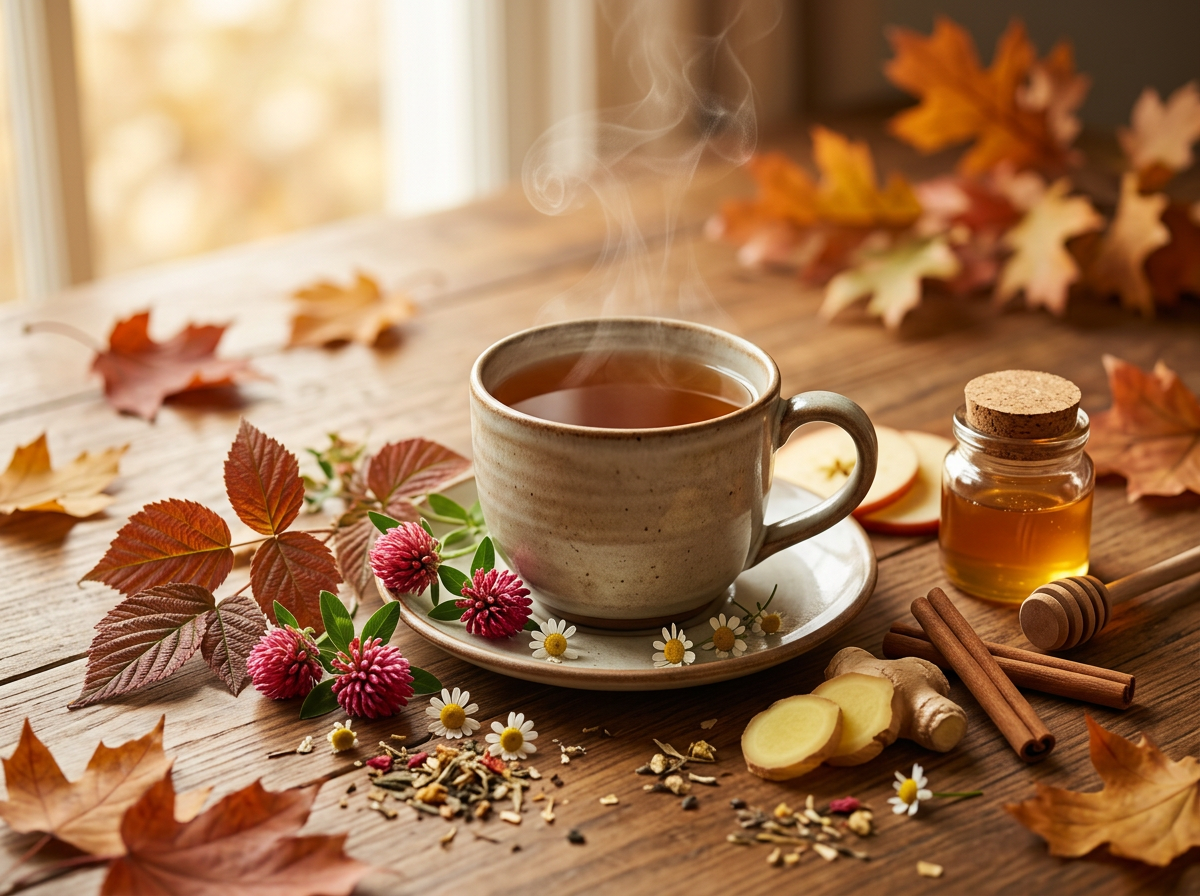
🍂Autumn Bladder-Comfort Herbal Tea
This warming herbal infusion is a cosy addition to your autumn routine. It is not proven to strengthen the bladder or treat urgency, leakage or UTIs.
⏱️ Time: 5 minutes to prepare | 10–12 minutes to steep
☕ Makes: 2 cups
🌿 Ingredients
2 cups freshly boiled water
1 teaspoon organic dried red raspberry leaf
½ teaspoon organic dried red clover blossoms
1 teaspoon organic dried chamomile flowers
2 thin slices of organic fresh ginger
1 small organic cinnamon stick
2–3 thin slices of organic apple
Optional: 1 teaspoon organic honey, maple syrup or another natural sweetener—or enjoy it unsweetened
🫖 Step-by-Step Instructions
Add the red raspberry leaf, red clover, chamomile, ginger, cinnamon and apple to a teapot or heatproof jar.
Pour in the freshly boiled water.
Cover and steep for 10–12 minutes.
Strain into mugs.
Taste before adding sweetener. The apple brings a little natural sweetness, so you may not need any.
🍎 Ingredient Notes
🌿 Red raspberry leaf: Adds a mild, earthy flavour and plant compounds such as tannins and flavonoids.
🌸 Red clover blossoms: Add a soft, meadow-like flavour. Red clover contains isoflavones, which are structurally similar to oestrogen.
🌼 Chamomile: Adds a gentle floral flavour and makes this blend lovely for a quiet evening routine.
🫚 Ginger: Brings warming spice and a bright, peppery note.
🍂 Cinnamon: Gives the tea its cosy autumn aroma.
🍎 Apple: Adds a mellow, fruity flavour and a touch of natural sweetness.
🍯 Honey or maple syrup: Optional sweeteners for flavour. The tea is lovely without them.
⚠️ A Gentle Safety Note
Red clover contains isoflavones, and herbal products can interact with medicines. Check with your clinician or pharmacist before using this tea regularly if you take medication, have a hormone-sensitive condition, or are pregnant or breastfeeding.
This is a comforting drink—not a treatment for bladder symptoms. New, persistent or worsening urgency, burning, pain or leakage deserves proper assessment.
📚 Selected Clinical Sources
Simon JA, Nappi RE, Chedraui P, et al. Genitourinary syndrome of menopause (GSM): recommendations from the Fifth International Consultation on Sexual Medicine (ICSM 2024). Sexual Medicine Reviews. 2026;14(1):qeaf055. doi:10.1093/sxmrev/qeaf055.
Publication Committee on Clinical Guidelines of the Korean Society of Menopause. The 2025 Menopausal Hormone Therapy Guidelines. Journal of Menopausal Medicine. 2025;31(2):53–84. doi:10.6118/jmm.25103.
European Association of Urology (EAU) Non-neurogenic Female LUTS Guidelines Panel. EAU Guidelines on Non-neurogenic Female Lower Urinary Tract Symptoms. 2025 edition. Arnhem, the Netherlands: EAU Guidelines Office; 2025. https://uroweb.org/guidelines/non-neurogenic-female-luts.
Carlson K, Andrews M, Bascom A, et al. 2024 Canadian Urological Association guideline: Female stress urinary incontinence. Canadian Urological Association Journal. 2024;18(4):83–102. doi:10.5489/cuaj.8751.
Christmas MM, Iyer S, Daisy C, et al. Menopause hormone therapy and urinary symptoms: a systematic review. Menopause. 2023;30(6):672–685. doi:10.1097/GME.0000000000002187.
Todhunter-Brown A, Hazelton C, Campbell P, et al. Conservative interventions for treating urinary incontinence in women: an overview of Cochrane systematic reviews. Cochrane Database of Systematic Reviews. 2022;(9):CD012337. doi:10.1002/14651858.CD012337.pub2.
Wu P-C, Lin H-H, Chen C-H, Kuo Y-S. Evaluation of photobiomodulation therapy for genitourinary syndrome of menopause: a single-center prospective study. PLOS ONE. 2026;21(6):e0351765. doi:10.1371/journal.pone.0351765.
Blog Disclaimer
The health information on this blog is for general educational purposes only and is not intended to diagnose, treat, cure, or prevent any disease. It should not be used as a substitute for professional medical advice. Always consult a qualified healthcare provider before making any health-related decisions
This blog may contain affiliate links, meaning Leaves from the Tree of Life LLC may earn a small commission if you purchase a product or service through these links—at no additional cost to you. Your support helps us continue to provide valuable content. Thank you!
