Mira + Functional Testing for Perimenopause: Track Your Stage, Find Your Root Causes (Without Guessing)
🌿 When “Normal Labs” Don’t Match How You Feel
If you’ve been Googling at 2am, scrolling social media for clues, asking your group chat, “Is this perimenopause or am I just unraveling?”—I see you.
Perimenopause can be deeply confusing because it’s not a single moment in time. It’s a transition, and transitions can be… noisy. Hormones fluctuate, symptoms overlap, and the medical system often relies on quick snapshots when what you actually need is a trend + context.
And that’s where tools like Mira can be genuinely helpful—not as a diagnosis button, but as a way to gather information that helps you feel less lost and more grounded.
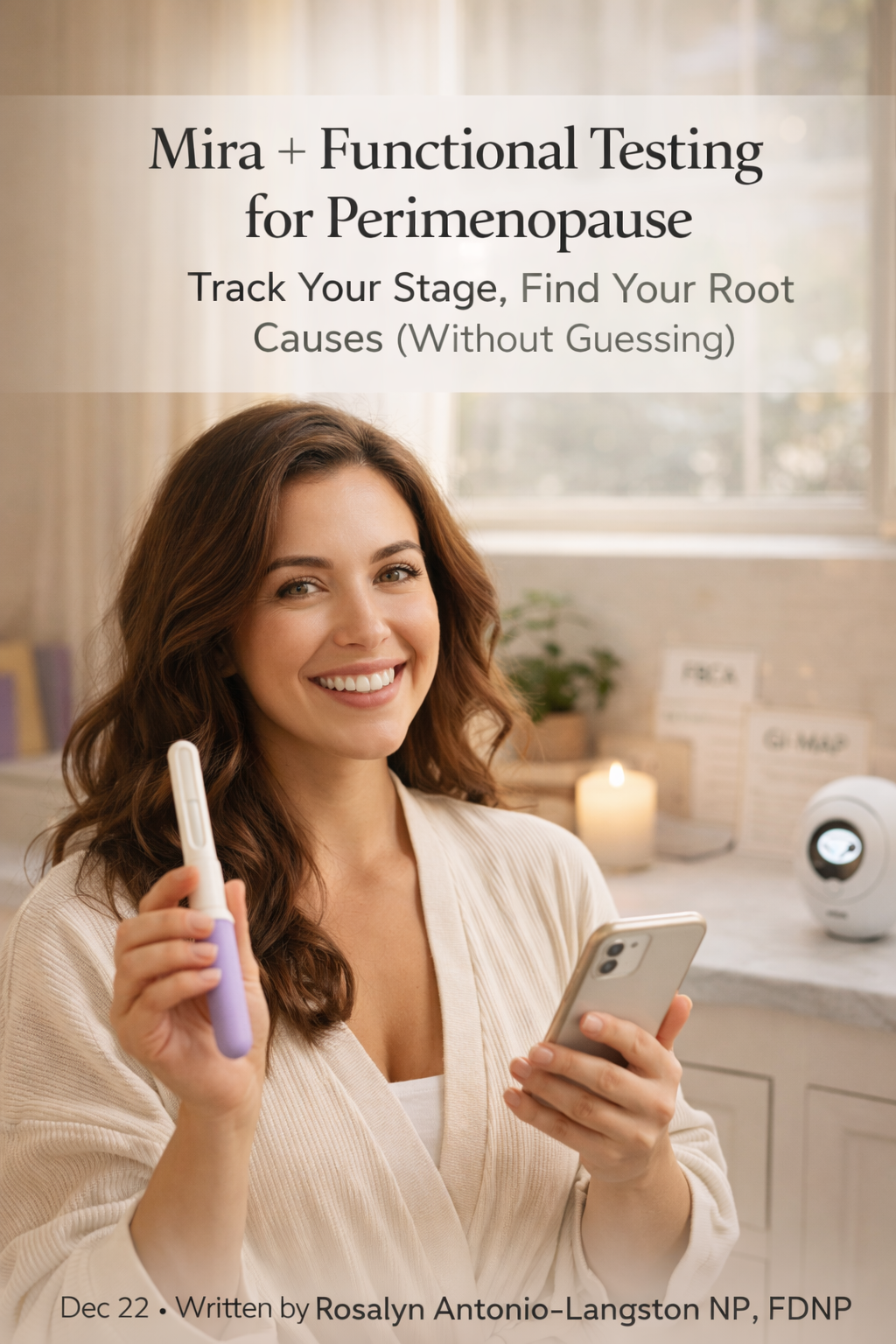
🧪 Mira at Home: Less Guessing, More Pattern-Spotting
Mira is an at-home hormone monitor that helps you track hormone trends over time. For many women in the peri/menopause transition, that’s a big deal because symptoms rarely show up in a neat, predictable way.
Why monitoring can be helpful
Instead of relying on a single lab draw (on a “good day” or a “weird day”), you can watch your body’s patterns more clearly—especially if you’re noticing things like:
cycles changing (shorter, longer, heavier, random)
mood shifts, anxiety spikes, irritability
sleep changes and night waking
hot flushes, brain fog, energy dips
weight changes that don’t match your effort
“I swear my body is speaking a new language” vibes
At-home monitoring can give you something many women are missing: clarity and calm—because when you can observe patterns, you stop blaming your character for what’s actually physiology.
Also: Mira is a tracking tool, not a medical diagnosis. A qualified healthcare professional is the one who confirms menopause stage. But tracking can still be a powerful support when used wisely.
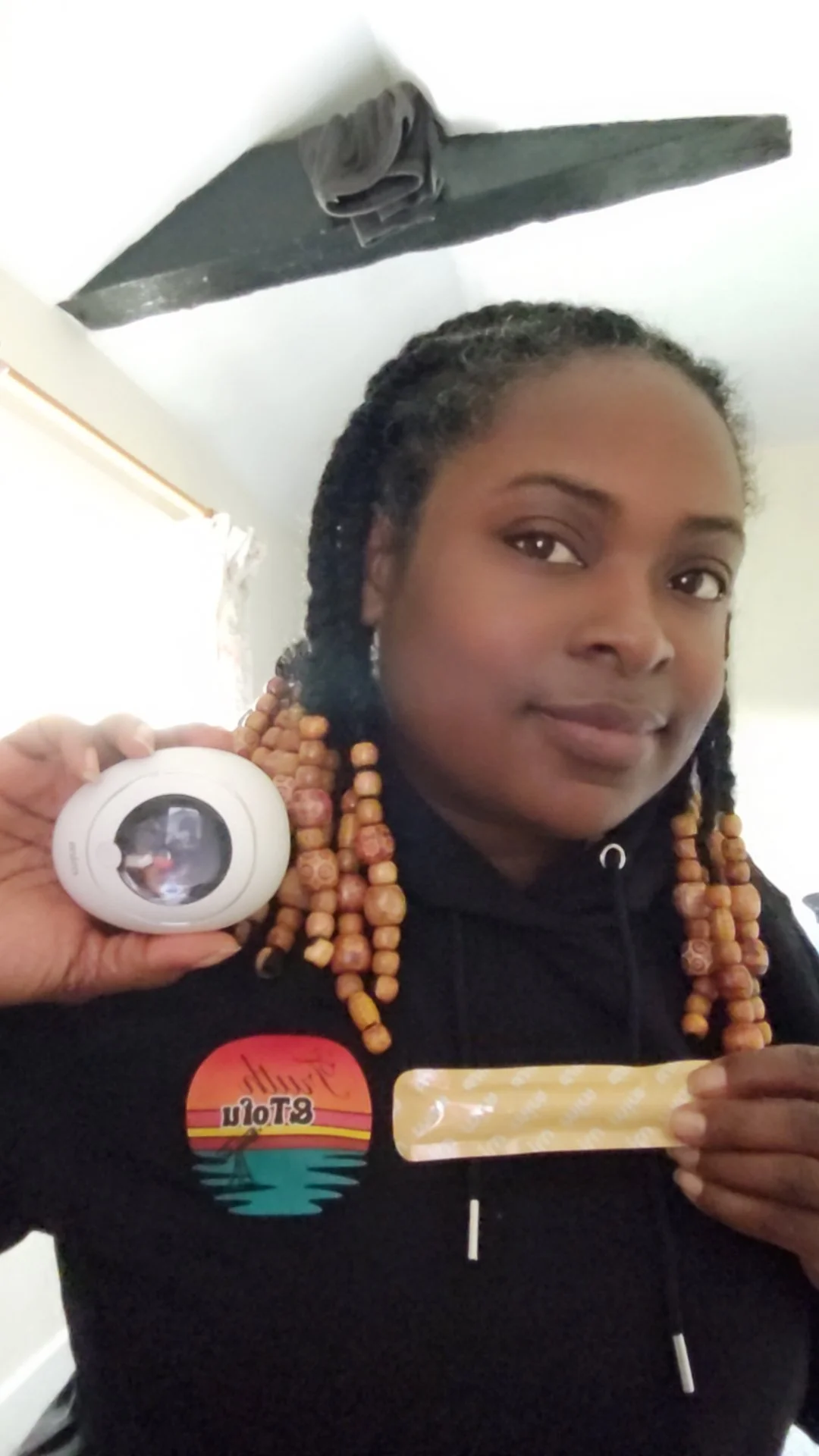
🧩 My Mini Testimony: Why I Used It Too (And What Changed)
I started using Mira because I was tired of guessing. My symptoms were real, but the usual “one-off” labs and generic advice weren’t giving me a clear picture—just more questions.
Tracking at home gave me clarity about what stage of the peri/menopause transition I was actually in. It helped me stop spiraling and start observing patterns—and that alone brought peace.
Then the “aha” moment came: when I paired that insight with functional testing (FBCA, HTMA, gut testing, and hormone-focused labs), the results finally made sense together. Instead of random numbers on paper, it became a story my body was telling—clear enough to act on.
Now I’m not just surviving this transitional stage—I’m supporting it on purpose. I’ve made targeted changes in my nutrition, stress rhythms, and supplementation to create real healing opportunities and reduce the Metabolic Chaos® that can sneak in during midlife.
And I want you to know this clearly: we’re in this together. 🤍
You’re not “too sensitive.” You’re not “crazy.” You’re not alone. We learn your body’s language one step at a time.
🔬Fun Fact Science Bar+
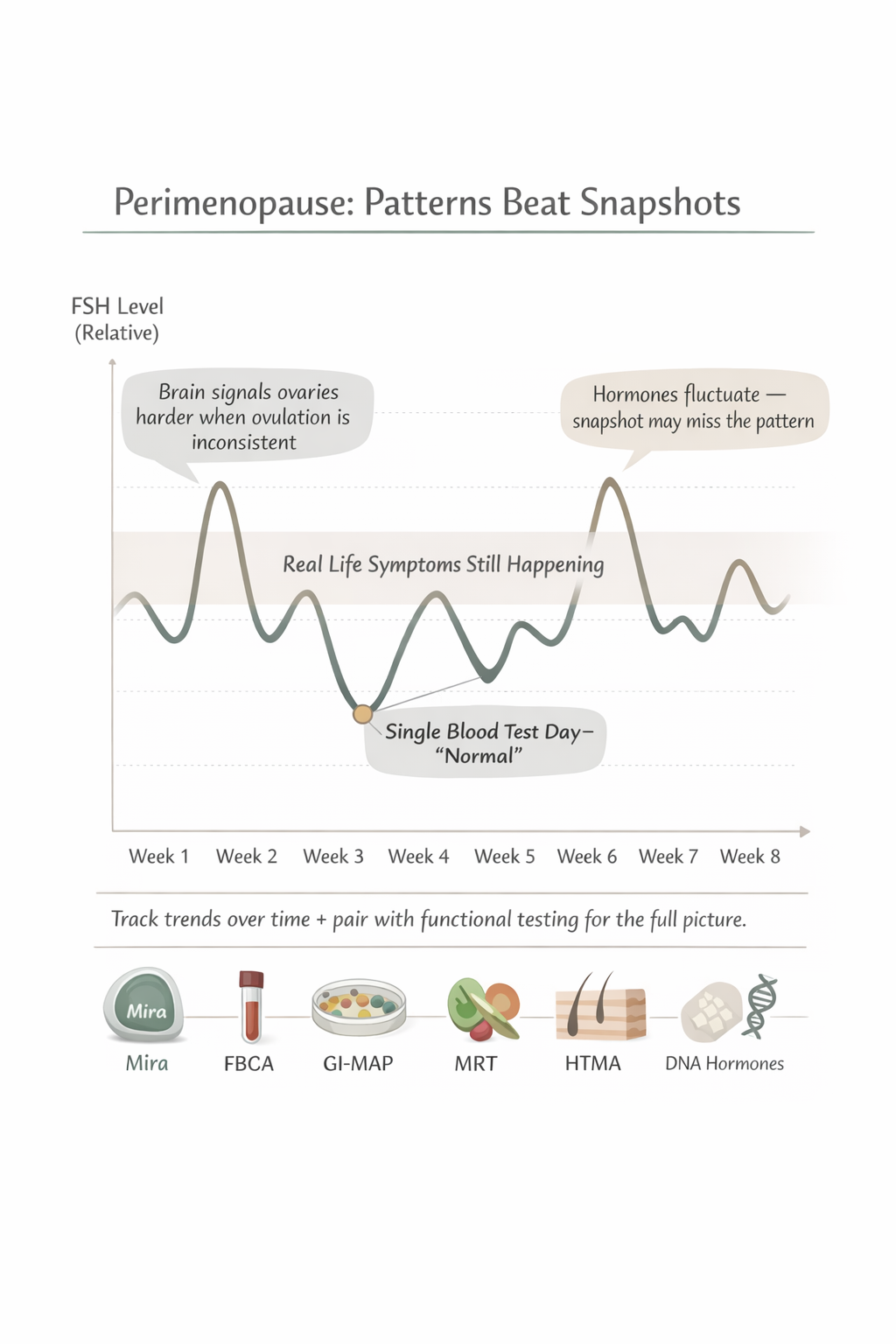
Did you know FSH can bounce around in perimenopause, which is why a single “hormone test” can look normal even when your symptoms are not? Your brain may crank out more FSH to “wake up” the ovaries, but those signals fluctuate—so one snapshot can miss the trend.
👉🏾 Translation: You’re not dramatic. You’re not imagining it. You just caught your hormones on a quiet day. In FDN® terms, that’s how Metabolic Chaos® sneaks in—hormone swings can amplify blood sugar swings, stress load, gut inflammation, sleep issues, and mood shifts.
✨ Healing Opportunity: Track trends (Mira) over several weeks/cycles, then pair with FBCA + GI testing + minerals + genetics for the full-body story. Patterns beat snapshots.
✝️ Faith Element: God is not the author of confusion (1 Cor. 14:33). Clarity is stewardship—and sis, we’re in this together. 🤍
🔬 The Bigger Picture: Mira + Functional Testing = Real Answers
Mira can help you track the “hormone weather.” Functional testing helps us understand the “whole-body climate.”
Here are brief, practical explanations of the functional tests I often use (depending on your symptoms, history, and goals):
🧬 DNA Hormones
A genetics-based look at how your body tends to process, metabolize, and clear hormones.
Why it matters: two women can have similar hormone levels but feel completely different based on how their bodies handle hormones and detox pathways.
💩 GI-MAP (Comprehensive Stool Test)
A deep look at gut microbes and key markers that can influence inflammation, immune activity, digestion, and overall gut function.
Why it matters: your gut impacts mood, nutrient absorption, estrogen balance, histamine load, and the inflammation that can amplify peri symptoms.
🍽️ MRT Food Sensitivity
Helps identify foods that may be triggering inflammatory responses in your body.
Why it matters: sometimes what feels like “hormone chaos” is actually inflammation and immune reactivity quietly turning the volume up.
🩸 FBCA (Functional Blood Chemistry Analysis)
A functional interpretation of standard blood labs—looking for patterns that can be missed when you’re told “everything is normal.”
Why it matters: blood sugar trends, iron patterns, thyroid clues, nutrient status, and inflammation markers can all affect mood, sleep, energy, and weight in midlife.
🧲 HTMA (Hair Tissue Mineral Analysis)
Looks at mineral patterns and possible toxic element trends over time.
Why it matters: minerals affect stress resilience, energy production, thyroid function, sleep quality, and nervous system regulation—things that often feel fragile during this transition. (I use it as one piece of the puzzle, not the whole story.)
👩🏽💼 A Client Story: “Something’s Missing… and I Can Feel It.”
Let’s call her Alicia (name changed).
Alicia found me the way many women do now—through social media—and then a friend said, “Talk to her. She actually connects the dots.”
She came in saying:
“My cycles are weird.”
“My sleep is trash.”
“My mood is not me.”
“My gut is bloated and unpredictable.”
“My doctor keeps saying I’m fine… but I’m not.”
She didn’t need a lecture. She needed a plan.
So we used a test-don’t-guess approach:
Mira to track trends (so we weren’t relying on one snapshot).
Functional tests (selected based on her symptoms) to see what else was contributing to the hormonal turbulence—gut patterns, inflammation triggers, mineral/nutrient needs, blood sugar stability, and stress physiology.
Her biggest breakthrough wasn’t just symptom relief—it was validation:
“I feel like I have receipts now.”
Exactly. Because when you understand what’s happening, you stop chasing random solutions and start making targeted changes that actually fit your body.
🕊️ A Faith-Rooted Note (Because You’re Not Just a Hormone Chart)
As a Seventh-day Adventist woman, I believe health is stewardship—and stewardship includes wisdom, rest, and rhythm.
This season may feel like a shaking, but it can also be a refinement. A reminder to slow down, listen, and return to the foundations that support the whole person: body, mind, and spirit.
The Sabbath principle is a weekly invitation to stop performing and start restoring. And sometimes, the most faith-filled move you can make is to seek understanding instead of silence.
🔗 Where to Find Mira
For the US:
https://leavesfromthetreeoflife.fdnstores.com/mira-hormone-monitor-menopause-transitions-kit.html
For the UK:
https://mira-fertility.pxf.io/xLBDxk
💛 If You’ve Been Searching for “The Missing Piece”… This Might Be It.
If you’re ready to move from confusion to clarity—without falling into panic, perfectionism, or random supplement roulette—there’s a gentle, grounded way forward.
Start with what you can observe (like trends), then zoom out and look at the full picture (gut, minerals, immune/inflammation, blood sugar, stress load, and hormone processing). That’s where the real healing opportunities live—and where we can calm the Metabolic Chaos® instead of just reacting to it.
And truly—we’re in this together. 🤍 One pattern at a time. One supportive change at a time. One restored, steadier step forward.
✨ Let’s Turn Your Mira Data Into a Real Plan
If you’re using Mira (or thinking about it) and you don’t want to interpret your results alone, this is exactly where working with me helps.
Together, we’ll:
connect your Mira trends to your real-life symptoms (sleep, mood, cycle shifts, energy, cravings)
decide which functional tests actually matter for your pattern (instead of testing everything or nothing)
build a personalised support plan so your body feels safer, steadier, and supported through this transition
Because Mira gives you data—but guidance turns data into results.
💛 If you’re ready for support, book a consultation and let’s map your next best steps with wisdom, clarity, and care.
💌 Bonus: Want Gentle, Guided Support for 5 Days?
If you’re the kind of woman who wants to understand what’s happening (without spiraling), I created a short 5-day email course to help you take your next steps with clarity and calm.
It’s bite-sized, supportive, and designed for the “I’ve been Googling forever but I still feel like something’s missing” season.
👉🏾 Sign up here: https://leaves-from-the-tree-of-life.kit.com/014d1022a6

🛁🌿 Perimenopause “Patterns & Peace” Bath Tea (Giant Tea Bag Soak)
A soothing, hormone-transition-friendly bath tea designed for the nights when your nervous system is loud, your sleep is fragile, and you’d like your body to stop acting like it’s in a group chat with cortisol. 😅
This is a gentle way to support the “we’re tracking patterns, not panicking” vibe from the Mira + functional testing topic—because your body needs data and deep exhale.
⏱️ Prep + Total Time
Prep time: 5–10 minutes
Steep time: 10–15 minutes
Bath time: 20–30 minutes
Total: ~35–55 minutes (mostly relaxing, not laboring)
🧺 Ingredients (1–2 baths)
Herbs (dry):
🌼 Chamomile — 3 tbsp
💜 Lavender buds — 2 tbsp
🍃 Lemon balm — 2 tbsp
🌹 Rose petals — 2 tbsp
🌾 Oat tops (or colloidal oats) — 3 tbsp (or ½ cup colloidal oats)
🧂 Epsom salt — 1 cup (optional but lovely)
🥥 Baking soda — ¼ cup (optional for silky water feel)
You’ll also need:
🫖 Giant reusable muslin tea bag (or nut milk bag)
🪢 Cotton string (if needed)
🥣 Mixing bowl
🫙 Airtight jar (if making ahead)
🌙 Why These Ingredients Help (Benefits by Ingredient)
🌼 Chamomile
Known for calming, soothing the skin, and supporting relaxation rituals (especially when stress is high).
💜 Lavender
Classic nervous-system relaxer by aroma; supports a “downshift” environment for bedtime routines.
🍃 Lemon Balm
Traditionally used for tension and restlessness; lovely when you feel wired-but-tired.
🌹 Rose Petals
Skin-soothing and emotionally comforting—rose is basically “gentle care” in plant form.
🌾 Oat Tops / Colloidal Oats
Superstar for itchy, sensitive, reactive skin—great for those peri moments of “why am I suddenly dry and irritated?”
🧂 Epsom Salt (Magnesium sulfate)
Supports muscle relaxation and that “melt into the tub” feeling after a long day.
🥥 Baking Soda
Softens bathwater and can feel soothing on the skin (especially if your water is harsh).
Note: Herbal baths are supportive, not a replacement for medical care. If you have ragweed allergy (chamomile), very sensitive skin, or are pregnant, skip/adjust accordingly. Avoid essential oils directly in water unless properly diluted.
🪜 Step-by-Step Instructions
1) 🧺 Make your “giant tea bag”
Add all dry herbs into your muslin tea bag.
If using colloidal oats, add them too (they can cloud the bath—that’s normal and soothing).
Tie the bag securely (double-knot).
2) 🔥 Pre-steep for maximum potency (recommended)
Bring 1–2 liters of water to a near-boil.
Turn off heat. Drop in the tea bag.
Cover and steep 10–15 minutes.
3) 🛁 Set up your bath like a nervous-system sanctuary
Run a warm bath (not scalding—peri skin can get cranky).
Pour the steeped “tea” water into the tub (and toss the tea bag in too).
Add Epsom salt + baking soda if using. Swirl to dissolve.
4) 😌 Soak + breathe (this is the protocol)
Soak 20–30 minutes.
Do a simple breathing pattern: inhale 4, exhale 6 for 2–3 minutes.
Optional: put one hand on your belly and pray a simple prayer like:
“Lord, bring order to my body and peace to my mind. Teach me wisdom in this season.” 🤍
5) 🧴 Aftercare
Rinse lightly (optional), pat dry, moisturize.
Bonus points for cozy socks + low light + screen-free wind-down.
🛒 Where to Buy (Easy Sources)
Herbs: Mountain Rose Herbs, Starwest Botanicals, iHerb, local herbal apothecaries, health food shops
Giant muslin tea bag / nut milk bag: Amazon, Etsy, iHerb, health stores
Colloidal oats: pharmacies/chemist (Aveeno-style), Amazon, iHerb
Epsom salt & baking soda: grocery stores, pharmacies, health stores
(If you want, tell me whether you want US-only, UK-only, or both and I’ll tailor store suggestions.)
🫙 Make-Ahead Option (Bath Tea Blend)
Mix the dry ingredients in a jar and label:
“Patterns & Peace Bath Tea”
Use ½ cup blend per bath + 1 cup Epsom salt.
Shelf life: 6–12 months (cool, dry storage).
✝️ Faith-Based Tie-In (SDA-friendly, gentle)
Perimenopause can feel like holy disruption—your body asking for new rhythms. This bath tea is a small act of temperance + stewardship: calming the nervous system so you can respond with wisdom, not just white-knuckle through metabolic chaos.
📚 References
🧪 Mira Hormone Monitor (At-Home Trend Tracking for Menopause Transitions)
Mira — Menopause Transitions Kit (FSH, LH, E3G, PdG + Menopause Mode) 👉🏾 https://mira-fertility.pxf.io/YROMOq
Mira — Menopause test kits + tracking four hormones over time 👉🏾 https://mira-fertility.pxf.io/7a4v4O
Your links (where readers can buy):
🌸 Perimenopause vs Menopause (Definitions + Symptom Reality)
NHS — Menopause (includes: perimenopause, symptoms, and “12 months without a period”) 👉🏾 https://www.nhs.uk/conditions/menopause/
NHS Inform (Scotland) — Menopause overview + postmenopause definition 👉🏾 https://www.nhsinform.scot/healthy-living/womens-health/later-years-around-50-years-and-over/menopause-and-post-menopause-health/menopause/
NHS England — Glossary: menopause reached after 12 months without a period 👉🏾 https://www.england.nhs.uk/long-read/supporting-our-nhs-people-through-menopause-guidance-for-line-managers-and-colleagues/
📈 Why “One Hormone Test” Can Miss It (FSH Fluctuations + Guidance)
NICE Quality Standard QS143 — FSH tests don’t help diagnose perimenopause/menopause in 45+ due to fluctuations 👉🏾 https://www.nice.org.uk/guidance/qs143/chapter/quality-statement-1-diagnosing-perimenopause-and-menopause
NICE CKS — Diagnosis of menopause/perimenopause (FSH context + not required routinely) 👉🏾 https://cks.nice.org.uk/topics/menopause/diagnosis/diagnosis-of-menopause-perimenopause/
NHS Lothian RefHelp — FSH testing: limitations + when it’s not useful (e.g., on certain hormones) 👉🏾 https://apps.nhslothian.scot/refhelp/guidelines/sexualreprohealth/menopause/fsh-testing-for-menopausecontraception/
💩 GI-MAP (Gut Microbiome + Inflammation Markers)
Diagnostic Solutions — GI-MAP test description (qPCR stool testing) 👉🏾 https://www.diagnosticsolutionslab.com/tests/gi-map
Diagnostic Solutions (PDF) — GI-MAP Interpretive Guide 👉🏾 https://www.diagnosticsolutionslab.com/assets/documents/gi-map-interpretive-guide.pdf
🍽️ MRT Food Sensitivity (Inflammatory Response Testing — Balanced View)
LEAP / MRT (provider) — What MRT measures (diet-induced sensitivity pathways) 👉🏾 https://www.nowleap.com/the-patented-mediator-release-test/
Verywell Health — MRT overview + limitations/controversy (not for diagnosing allergies) 👉🏾 https://www.verywellhealth.com/mrt-test-5498544
🧲 HTMA (Hair Tissue Mineral Analysis — Benefits + Limitations)
Namkoong et al., 2013 (PMC) — Inter-/intra-lab reliability concerns for hair mineral analysis 👉🏾 https://pmc.ncbi.nlm.nih.gov/articles/PMC3582931/
Frisch et al., 2002 (PMC) — Pitfalls/limitations of hair analysis in clinical practice 👉🏾 https://pmc.ncbi.nlm.nih.gov/articles/PMC1240808/
🧬 DNA Hormone Pathways (Nutrigenomics + Estrogen Metabolism Genes)
Cerne et al., 2011 (PMC) — Estrogen-metabolizing genes (e.g., CYP1B1, COMT, GST pathways) and metabolism concepts 👉🏾 https://pmc.ncbi.nlm.nih.gov/articles/PMC3152751/
AACR (Cancer Epidemiology Biomarkers & Prevention) — CYP/COMT and estrogen-related genetic variation (background) 👉🏾 https://aacrjournals.org/cebp/article/13/1/94/168594/Association-of-CYP17-CYP19-CYP1B1-and-COMT
🩸 FBCA (Functional Blood Chemistry Lens)
Functional reference limits (concept paper, PMC) — Functional reference limits: physiologic relationships, not just “in range” 👉🏾 https://pmc.ncbi.nlm.nih.gov/articles/PMC10151278/
NIH Office of Dietary Supplements — Magnesium: roles in nerve/muscle function + glucose regulation (relevant to “metabolic chaos” patterns) 👉🏾 https://ods.od.nih.gov/factsheets/Magnesium-HealthProfessional/
🛁 Bath Tea Ingredients (Skin-Soothing + Nervous System Support)
NCCIH (NIH) — Chamomile: usefulness + safety (topical/oral) 👉🏾 https://www.nccih.nih.gov/health/chamomile
NCCIH (NIH) — Lavender: usefulness + safety (anxiety evidence is limited but studied) 👉🏾 https://www.nccih.nih.gov/health/lavender
NCBI Bookshelf (NIH) — Lemon Balm (Melissa officinalis): traditional use for nervousness/insomnia + safety notes 👉🏾 https://www.ncbi.nlm.nih.gov/books/NBK600583/
American Academy of Dermatology — Colloidal oatmeal baths can help relieve dry, itchy skin 👉🏾 https://www.aad.org/public/diseases/eczema/childhood/itch-relief
National Eczema Association — Colloidal oatmeal bath: itch relief + practical guidance 👉🏾 https://nationaleczema.org/blog/colloidal-oatmeal-bath/
FDA (PDF) — OTC Skin Protectant Monograph: colloidal oatmeal labeling for itch/irritation relief 👉🏾 https://www.accessdata.fda.gov/drugsatfda_docs/omuf/monographs/OTCMonograph_M016SkinProtectantDrugProductsforOTCHumanUse09242021.pdf
Hospital for Special Surgery — Epsom salt baths: limited controlled evidence; warm bath itself may drive relaxation 👉🏾 https://news.hss.edu/are-the-widely-touted-benefits-of-epsom-salt-baths-legit/
Blog Disclaimer
The health information on this blog is for general educational purposes only and is not intended to diagnose, treat, cure, or prevent any disease. It should not be used as a substitute for professional medical advice. Always consult a qualified healthcare provider before making any health-related decisions
This blog may contain affiliate links, meaning Leaves from the Tree of Life LLC may earn a small commission if you purchase a product or service through these links—at no additional cost to you. Your support helps us continue to provide valuable content. Thank you!
