When Your Brain Has 42 Tabs Open: A Perimenopause & Menopause Guide to Getting Organized Again 🧠✨
🌸 Welcome to the “Why Did I Walk Into This Room?” Chapter
You opened the refrigerator and forgot what you wanted.
You scheduled the appointment but forgot to put it in the calendar.
Someone asked you a question during a Zoom meeting, and suddenly the English language temporarily left the building. 😩
Meanwhile, your phone has 42 tabs open, there are three sticky notes on the desk, another one mysteriously attached to your handbag, and you are absolutely certain you wrote down that important thing somewhere.
Welcome to midlife.
For some women, perimenopause and menopause arrive with hot flushes and changing periods. For others, the first clue is much more subtle:
“Why does my brain suddenly feel so disorganized?”
Brain fog, forgetfulness, difficulty concentrating, sleep disruption and mood changes are commonly reported during the menopause transition and can affect work, relationships, productivity and quality of life. Research suggests that small changes in memory performance can occur during perimenopause, although for most women these changes remain within normal cognitive ranges. In other words, brain fog does not automatically mean dementia or serious cognitive decline.
And while you cannot necessarily control every hormonal fluctuation, you can create systems around yourself that make this season much easier to navigate.
From a Traditional Naturopathic and Functional Diagnostic Nutrition® perspective, I like to think of these symptoms as information.
They may reveal healing opportunities involving hormones, sleep, stress resilience, nutrition, digestion, blood sugar regulation, nutrient status, movement or other pieces of what I call Metabolic Chaos®.
The goal isn't to become obsessed with every symptom.
The goal is to become a better detective.
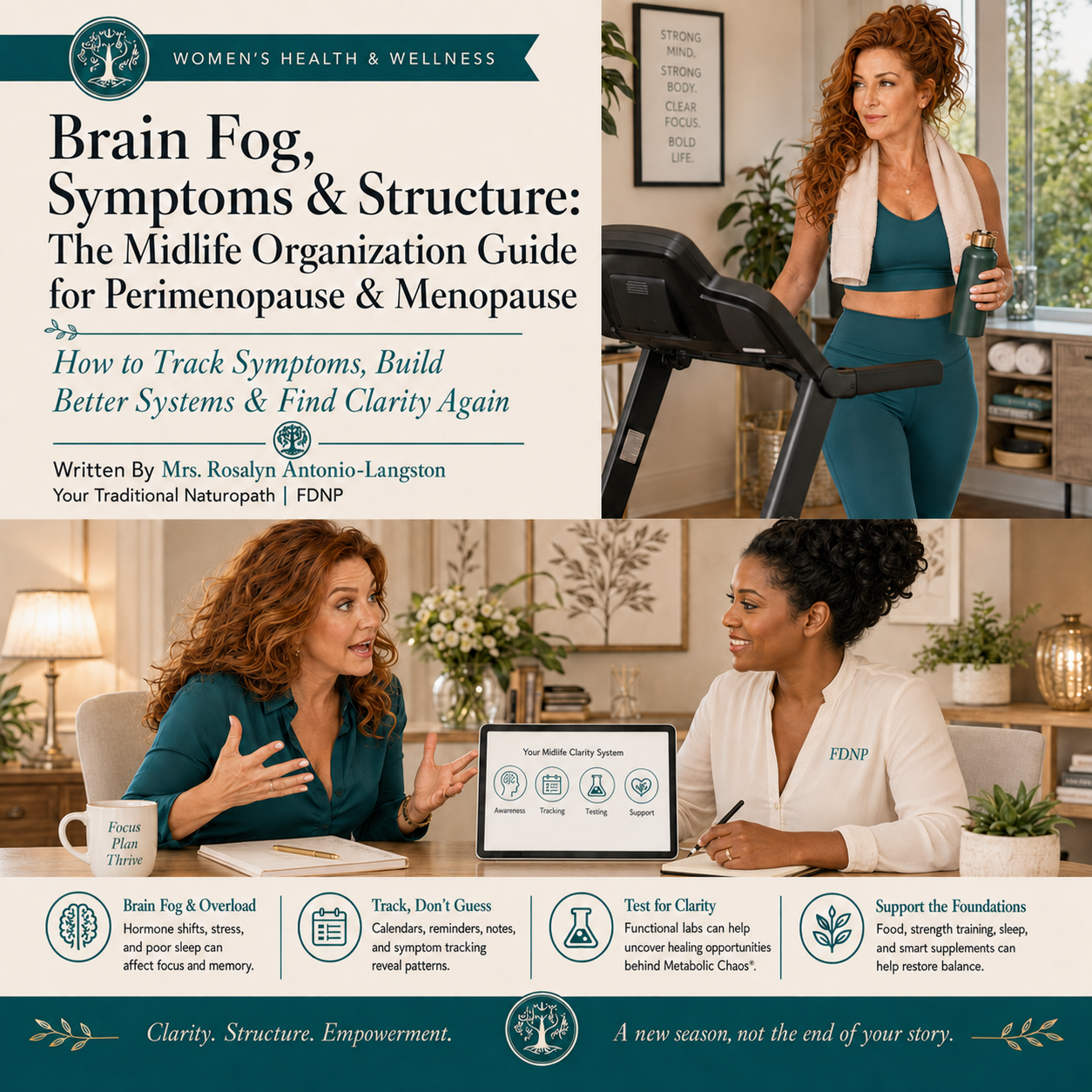
🔬 Brain Fog Science—Without Needing a Neuroscience Degree
The menopause transition is not simply about your ovaries.
Your brain is involved too.
Estrogen receptors are found throughout areas of the brain involved in cognition, including regions important for memory, attention and executive function. As estradiol becomes increasingly unpredictable during perimenopause and eventually declines after menopause, some women notice changes in:
🧠 Working memory
🧠 Word retrieval
🧠 Concentration
🧠 Mental processing speed
🧠 Attention
🧠 Multitasking
🧠 Executive function
An updated review of menopausal cognition found that cognitive complaints during perimenopause are real, although research varies depending on how menopause stage and cognition are measured.
But hormones rarely work alone.
Think of your brain as the CEO of a company.
Now imagine the CEO dealing with:
disrupted sleep
night sweats
fluctuating blood glucose
chronic stress
low iron or B12
thyroid dysfunction
anxiety
digestive problems
nutrient insufficiencies
a demanding career
ageing parents
relationships
and approximately 1847 notifications.
Of course productivity may suffer.
Sleep disturbance deserves special attention because poor sleep itself can impair attention, information processing and memory. NICE also recognizes sleep problems as an important menopause-associated concern and includes menopause-specific CBT among management options.
💬 Need additional emotional or therapeutic support? If brain fog, anxiety, overwhelm, sleep disruption or the emotional changes of perimenopause are beginning to feel difficult to manage alone, working with a qualified therapist can be a valuable part of your support team.
Leaves from the Tree of Life LLC is proud to partner with Purity Motsi Therapy, offering professional therapeutic support for women who may benefit from an additional layer of care.
👉🏾 Visit Purity Motsi Therapy:
https://www.puritymotsitherapy.co.uk/
🧠 Stop Using Your Brain as a Filing Cabinet
Here is your permission slip:
Write. Things. Down.
That is not weakness.
It actually has a scientific name: cognitive offloading.
Cognitive offloading means moving information that you would otherwise have to remember internally into an external system—such as a calendar, reminder, alarm, checklist or note.
Research shows that reminders and other external memory tools can improve our ability to remember future tasks, particularly when cognitive load is high.
Translation?
Your calendar is allowed to remember things so your brain doesn't have to.
That meeting.
That prescription refill.
Your strength-training session.
Your grocery order.
Your blood test.
Your friend's birthday.
Put it somewhere reliable and release it.
🗂️ Build Your Midlife “External Brain”
Please do not create eleven different organizational systems. That rather defeats the purpose. 😂
Keep it simple.
📅 1. ONE Main Calendar
Whether you use Google Calendar, Apple Calendar, Outlook or a paper diary, choose one primary calendar.
Use it for:
medical appointments
work deadlines
workouts
meal-prep days
social commitments
supplement reorders
lab testing
prescription reviews
bedtime reminders if needed
family obligations
protected recovery time
Colour coding can help, but please don't turn your calendar into the Sistine Chapel.
Three to five categories are plenty.
📝 2. ONE Capture Note
Create a note on your phone called something like:
“Brain Dump”
Every random thought goes there:
“Order B12.”
“Ask GP about ferritin.”
“Call Sarah.”
“Research standing desk.”
“Why did the dog look at me like that?”
Okay, perhaps not the last one.
Once or twice a week, review the list and either:
Do it. Schedule it. Delete it. Delegate it.
Otherwise your brain will spend precious energy repeatedly reminding you that you must remember not to forget something.
⏰ 3. Use Reminders Shamelessly
Set reminders for things that really matter.
Examples:
7:30 AM: Take supplements and BHRT
12:30 PM: Eat lunch before becoming a hangry executive
3:30 PM: Strength training
9:00 PM: Begin winding down
Friday afternoon: Prepare for Sabbath
A reminder should tell you what action to take, not merely that something exists.
“Take iron with vitamin C” is more useful than “Iron.”
🗒️ 4. Sticky Notes—With Boundaries
Sticky notes are helpful.
A sticky-note infestation is not. 😅
Try limiting your desk to your Top Three for the day.
TODAY:
☐ Finish report
☐ Call GP
☐ 30-minute walk
Everything else belongs in your master system.
🔬Fun Fact Science Bar+
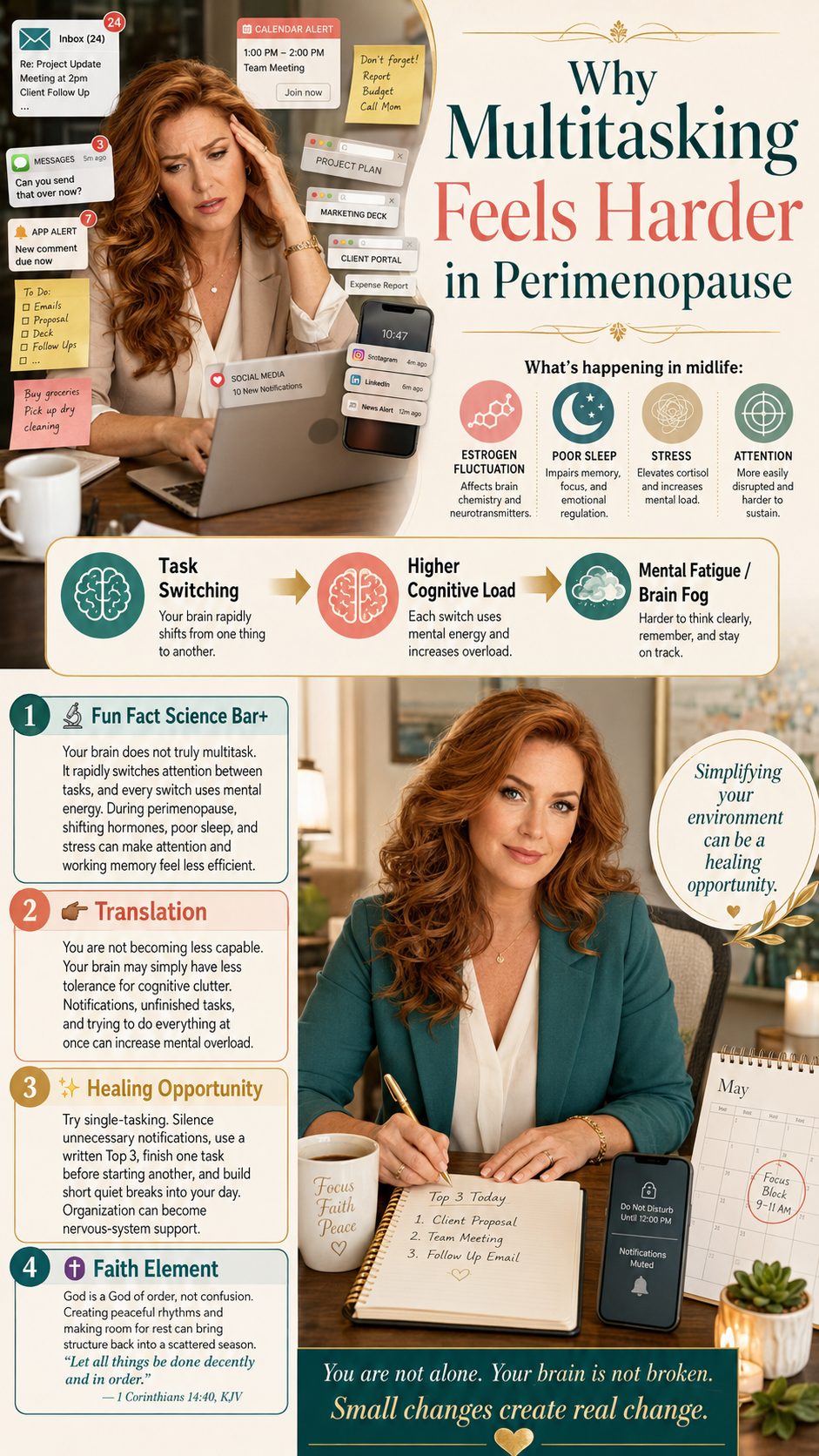
Did you know your brain does not truly “multitask”? It rapidly switches attention between tasks, and every switch requires mental energy. During perimenopause and menopause, changes in estrogen signalling—along with poor sleep, stress and vasomotor symptoms—may make attention, working memory and processing feel less efficient. Suddenly answering an email while listening to a meeting and remembering what you needed from the kitchen can feel like an Olympic event. 🧠😅
👉🏾 Translation: You may not be becoming less capable—your brain may simply have less tolerance for cognitive clutter. Constant notifications, unfinished tasks and excessive multitasking can pile additional demand onto an already taxed executive-function system.
✨ Healing Opportunity: Try single-tasking. Silence unnecessary notifications, finish one task before opening another, keep a written “Top 3” for the day and build short quiet breaks between demanding activities. Organization can become nervous-system support—not another thing to perfect.
✝️ Faith Element: God is a God of order, not confusion. Creating peaceful rhythms, simplifying responsibilities and making room for Sabbath rest can help bring structure back into a season that feels scattered. “Let all things be done decently and in order.” — 1 Corinthians 14:40, KJV 🌿
📊 Track It Before You Try to Fix It
Your symptoms may feel random until you start recording them.
Symptom monitoring has been associated with improved health awareness, goal-setting and patient-clinician communication, although the research base is still developing.
You do not need a spreadsheet worthy of NASA.
A two-minute daily check-in is enough.
Rate 0–3:
0 = none
1 = mild
2 = moderate
3 = significant
Track things such as:
🔥 Hot flushes/night sweats
🧠 Brain fog
😴 Sleep quality
😟 Anxiety/irritability
⚡ Energy
🍽️ Appetite/cravings
💩 Digestion/bloating/bowel patterns
💪 Exercise/recovery
🩸 Bleeding/cycle changes
🤕 Headaches
❤️ Palpitations
🌸 Vaginal/urinary symptoms
📈 Major stress that day
Then add one short note:
“What was different today?”
Maybe you slept five hours.
Skipped lunch.
Had a stressful presentation.
Started your period.
Changed a supplement.
Had three coffees before noon.
That context matters.
📱 Resource Spotlight: The Balance App
The Balance menopause app is one useful resource for women who prefer digital tracking.
It allows users to track symptoms, mood, periods and sleep and can generate a personal health report that can be shared with a healthcare professional.
👉🏾 Balance Resource:
https://link.balance-app.com/content/VgBdBn0L7m8oooxtV0WX97
You can also use:
📅 Your phone calendar
📝 Apple Notes/Google Keep/Notion
⏰ Phone reminders
📓 A paper menopause journal
🗒️ Sticky notes
📊 A simple spreadsheet
📱 A symptom-tracking app
The “best” system is the one you will actually use.
🧪 Testing: Turning a Pile of Symptoms Into an Organized Investigation
Testing can be incredibly helpful when used intelligently.
But here is where we need some grown-woman nuance.
Testing is not about ordering every panel available because you feel terrible.
Good testing asks a question.
For example:
“Could iron deficiency be contributing to my exhaustion?”
“Could thyroid dysfunction be contributing to these symptoms?”
“Are there metabolic patterns we need to address?”
“Are significant digestive symptoms suggesting we should investigate the gastrointestinal environment?”
That is very different from:
“I have brain fog. Order everything.” 😅
There is also an important distinction between diagnosing menopause and investigating factors that may influence how a woman experiences menopause.
Current NICE guidance states that otherwise healthy women aged 45 and older with appropriate symptoms can generally be identified as perimenopausal or menopausal without laboratory hormone testing, because reproductive hormone levels can fluctuate substantially during the transition. Blood count, thyroid tests and other investigations may still be appropriate when another explanation for symptoms is suspected.
Functional testing should therefore answer specific clinical or wellness questions, not be marketed as a requirement for proving menopause.
🩸 FBCA: Sometimes the “Basic” Blood Work Is Anything but Basic
Functional Blood Chemistry Analysis—FBCA—can help organize conventional laboratory data into patterns and trends.
Depending on history and symptoms, medically appropriate testing might include areas such as:
Full blood count/CBC
Ferritin and iron studies
B12
Folate
Vitamin D
Thyroid markers
HbA1c/glucose
Lipids
Liver markers
Kidney markers
Inflammatory markers when indicated
This becomes particularly useful when a woman says:
“Everything was normal, but nobody explained the numbers to me.”
Instead of looking at isolated results, longitudinal trends can help build a more organized picture.
For example, fatigue and brain fog might warrant asking whether heavy menstrual bleeding has affected iron status rather than simply assuming everything is hormonal.
Similarly, NICE specifically warns that symptoms of thyroid dysfunction can sometimes be confused with menopause symptoms.
The point is not to diagnose from a spreadsheet.
The point is to identify better questions.
🧬 DNAlife DNA Hormones: Your Genes Are the Blueprint—not the Dictator
DNAlife DNA Hormones evaluates genetic variants involved in areas such as sex-hormone metabolism, transport, steroidogenesis and biotransformation.
Because your DNA is relatively stable, this is generally a one-time terrain assessment, not a test you repeatedly take to see whether menopause has improved.
It may help organize questions around:
hormone metabolism
methylation pathways
oxidative stress
detoxification-related pathways
hormone transport
nutritional support
But DNA Hormones does not tell you what your estrogen level is today.
And it does not diagnose menopause.
Think:
genetic tendencies + environment + lifestyle + current physiology = the bigger picture.
Genes may load the gun.
Lifestyle and environment frequently influence whether—or how strongly—certain genetic tendencies are expressed.
🧠 DNAlife DNA Mind: When Mood, Stress and Cognition Join the Conversation
DNAlife DNA Mind evaluates variants across biological pathways involving areas such as serotonin, dopamine, inflammation and methylation.
This can provide another layer of information when exploring:
🧠 cognitive resilience
😟 stress vulnerability
🌧️ mood patterns
🔥 inflammatory tendencies
🧬 methylation-related pathways
Again, this is not a diagnosis of anxiety, depression, ADHD, dementia or another neurological condition.
It is genetic context.
That context may help a practitioner personalize conversations around nutrition, lifestyle, sleep, stress and nutrient support rather than randomly throwing supplements at symptoms and hoping something sticks.
Because that isn't precision wellness.
That's expensive roulette.
🦠 GI-MAP: Because Your Hormones Do Not Live in a Separate Apartment From Your Gut
If your menopause journey also involves:
significant bloating
constipation
diarrhoea
abdominal discomfort
unexplained digestive changes
food reactions
persistent gastrointestinal symptoms
then gastrointestinal assessment may become part of the conversation.
The Diagnostic Solutions GI-MAP uses quantitative PCR technology to evaluate DNA from selected bacteria, parasites, fungi and other microorganisms along with various gastrointestinal markers.
This may provide useful information in appropriately selected cases.
But everyone experiencing menopause does not automatically need a GI-MAP.
Testing should follow the history.
Otherwise we are simply collecting expensive data.
🍓 MRT: Food Investigation Without Blaming Every Food in the Refrigerator
MRT—Mediator Release Test—is used by some functional practitioners as part of a structured approach to suspected food-related inflammatory reactions.
The manufacturer describes it as measuring changes associated with mediator release from white blood cells in response to foods and food chemicals.
However, the independent evidence base for mediator-release testing is much more limited than for established allergy diagnostics, and older reviews have called for further validation.
Therefore, MRT is best approached as an adjunctive tool, interpreted alongside symptoms, food history and a structured elimination/reintroduction process—not as proof that dozens of foods are permanently “bad.”
The last thing a woman with brain fog needs is an unnecessarily restrictive diet containing six foods and emotional trauma around broccoli.
🧩 The Real Benefit of Testing? Reducing Guesswork
When used appropriately, testing can create structure.
Instead of:
“I feel terrible and have no idea where to start.”
You may begin asking:
What do we know?
What do we suspect?
What has been ruled out?
What needs medical referral?
What can we support through food and lifestyle?
What do we retest—and when?
That turns chaos into a plan.
And sometimes that is half the battle.
🥗 Feed the Brain, Muscle & Metabolism—Not Just the Cravings
Midlife is not the season for punishment dieting.
Your body is undergoing major physiological changes. It needs nourishment.
A predominantly whole-food, plant-forward Mediterranean-style eating pattern is associated with favorable cardiometabolic health and may support healthy ageing during and after menopause. Reviews in menopausal women have also examined benefits for cardiovascular, metabolic, bone and mental-health outcomes.
Build meals around:
🥬 Colourful vegetables — phytonutrients and fibre
🫐 Berries — polyphenols
🫘 Beans and lentils — protein + fermentable fibre
🌱 Tofu, tempeh and edamame — high-quality plant protein
🌾 Whole grains — fibre + steady energy
🥑 Avocado — monounsaturated fats
🌰 Nuts and seeds — minerals + healthy fats
🫒 Extra-virgin olive oil — Mediterranean-style fat source
🌱 Flax and chia — fibre + ALA omega-3
🥛 Fortified plant milks — useful for calcium/B12 depending on brand
Soy deserves special mention.
Despite persistent internet panic, a large 2025 meta-analysis of randomized trials found that soy isoflavones did not significantly increase several measures of estrogenicity in postmenopausal women.
So yes—your organic tofu can remain seated at the table. 😏
💪🏾 Strength Training: Because Muscle Is Midlife Currency
If you're not strength training yet, please allow this section to lovingly tap you on the shoulder.
Resistance training becomes increasingly important as women age.
A 2024 systematic review and meta-analysis found improvements in upper- and lower-body strength and other fitness measures in postmenopausal women participating in resistance training.
A practical starting point may be:
🏋🏾♀️ 2–3 full-body strength sessions per week
Think:
squats or sit-to-stands
rows
presses
deadlift/hip-hinge patterns
lunges or step-ups
carries
resistance bands
machines
body-weight exercises
Then progressively increase resistance as appropriate.
Add walking, cycling, hiking or other enjoyable aerobic activity around it.
Exercise does not need to become another full-time job.
Consistency beats punishment.
😴 Protect Your Sleep Like It Has Confidential Information
Poor sleep and brain fog are not exactly best friends.
Night sweats, anxiety, bladder symptoms, stress, caffeine, alcohol, sleep apnoea and other factors can all disrupt restorative sleep.
Try creating a predictable evening rhythm:
🌙 Keep wake/sleep times reasonably consistent
☀️ Get morning daylight
☕ Keep caffeine earlier in the day if sensitive
📱 Dim stimulation before bed
🌡️ Keep the bedroom comfortably cool
📖 Read something calming
🙏🏾 Pray, journal or meditate on Scripture
🛏️ Protect sufficient sleep opportunity
And if you are persistently exhausted despite apparently adequate sleep—especially with significant snoring, gasping, restless legs or morning headaches—do not simply assume “it's hormones.”
Talk with your healthcare professional.
💊 Supplements: Support Staff, Not the CEO
Supplements can be helpful.
But they are called supplements because they supplement the foundations.
Not replace them.
Depending on the individual, labs, diet and medical history, conversations might include:
☀️ Vitamin D
Especially when levels are low or bone-health risk is present.
🧬 Vitamin B12
Particularly important for women eating fully plant-based diets.
🩸 Iron
Potentially important with iron deficiency or heavy menstrual bleeding—but iron should ideally be guided by appropriate blood testing rather than taken indefinitely “just in case.”
🌱 Omega-3
Women following plant-based diets can obtain ALA from chia, flax, hemp and walnuts, while algae-derived DHA/EPA may be considered when appropriate.
💪🏾 Creatine Monohydrate
An emerging area of interest for midlife women.
A 2026 systematic review of randomized trials in postmenopausal women found that creatine—particularly when combined with resistance training—produced modest improvements in lean mass and strength. Evidence for cognitive benefits remains much less certain, so I would not market creatine as a menopause “brain-fog cure.”
That distinction matters.
More supplements are not automatically more functional.
Sometimes your supplement cabinet needs an intervention too. 😂
Need Professional-Grade Supplements?
For practitioner-grade supplement recommendations, please use the appropriate link below:
🇺🇸 Shop in the U.S.: Click here
🇬🇧 Shop in the U.K.: Click here Code KXCTGG
🙏🏾 And Then There Is Rest—The Kind God Actually Told Us to Take
Midlife can tempt women to respond to reduced capacity by pushing harder.
Work harder.
Organize harder.
Exercise harder.
Fix everything.
But Scripture presents another rhythm.
“Remember the sabbath day, to keep it holy.” — Exodus 20:8, KJV
The seventh-day Sabbath provides something modern culture desperately needs:
A boundary.
One day when productivity does not determine your worth.
A day for worship, nourishing food, family, community, nature, reflection and rest.
You do not have to scientifically optimize every moment of your existence.
Sometimes the wisest thing you can schedule is:
Nothing.
Rest is not quitting.
It is part of stewardship.
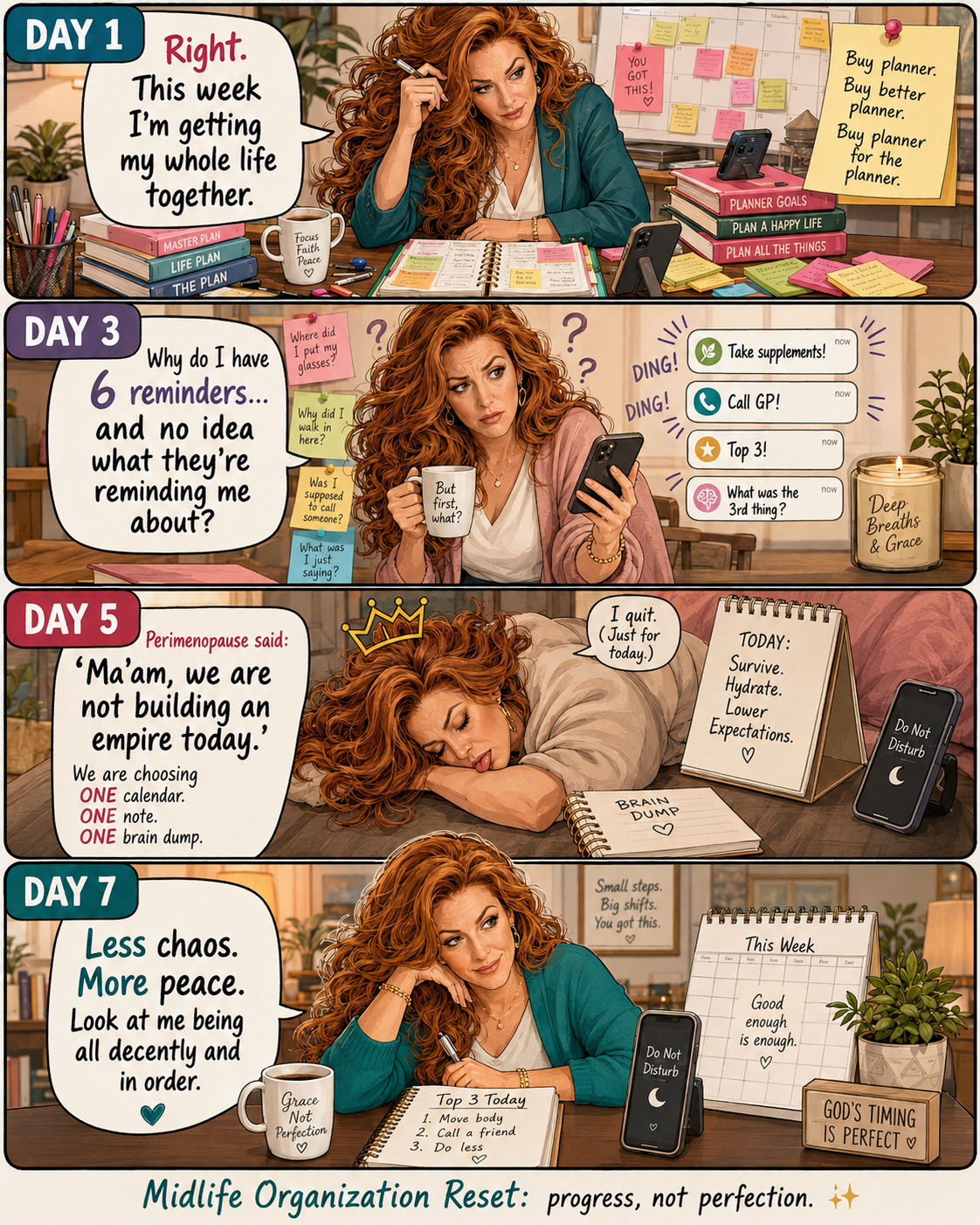
🌿 Your 7-Day Midlife Organization Reset
Feeling overwhelmed already?
Don't redesign your entire life this afternoon.
Start here.
This week:
✅ Pick ONE symptom tracker.
✅ Create ONE master calendar.
✅ Create ONE brain-dump note.
✅ Set reminders for your three most frequently forgotten tasks.
✅ Track symptoms for seven days without trying to “fix” them.
✅ Schedule two strength-training sessions.
✅ Plan several simple protein-, fibre- and phytonutrient-rich meals.
✅ Choose a realistic bedtime.
✅ Protect your Sabbath/rest rhythm.
Then review.
Not:
“Was I perfect?”
Ask:
“What patterns did I learn?”
That is useful information.
🚨 When Brain Fog Needs More Than a Planner
Menopause-related cognitive symptoms are common, but new cognitive or neurological symptoms should not automatically be blamed on menopause.
Seek medical assessment when symptoms are:
sudden
rapidly worsening
significantly interfering with normal functioning
accompanied by new weakness, facial drooping or speech changes
associated with fainting or seizures
associated with severe or unusual headaches
accompanied by other concerning neurological symptoms
Your planner is fabulous.
It is not a neurologist.
🌺 This Is a New Chapter—not the Closing Credits
Perimenopause can feel deeply disorienting.
You may not recognize your energy.
Your sleep changes.
Your body changes.
Your tolerance changes.
Even the way your brain handles a busy day may feel different.
But this transition does not erase who you are.
Perhaps this season is asking you to stop operating your body like the same machine you had at 25.
To simplify.
To nourish.
To build muscle.
To sleep.
To investigate intelligently.
To say no more often.
To ask better questions.
To honour the body's God-designed signals rather than bulldozing through them.
There may be healing opportunities hiding inside the Metabolic Chaos®.
And with the right information, testing, support and structure, the chaos can begin looking much more like a map.
🌳 Ready to Turn the Clues Into a Plan?
At Leaves from the Tree of Life LLC, we help Businesswomen who are Hormonal, Anxious, and Bloated through Functional Nutrition Coaching + Labs.
Rather than chasing symptoms one at a time, we look for patterns involving nutrition, digestion, lifestyle, stress, metabolism, nutrient status and other potential contributors—then help you organize those findings into practical next steps within our scope of practice.
Because you do not need another internet rabbit hole.
You need a strategy.
✨ A new season.
✨ A new chapter.
✨ Better information.
✨ Better systems.
✨ And support walking through it.
👉🏾 CLICK HERE to jump on a Discovery Call.
Invest in your health, invest in you.
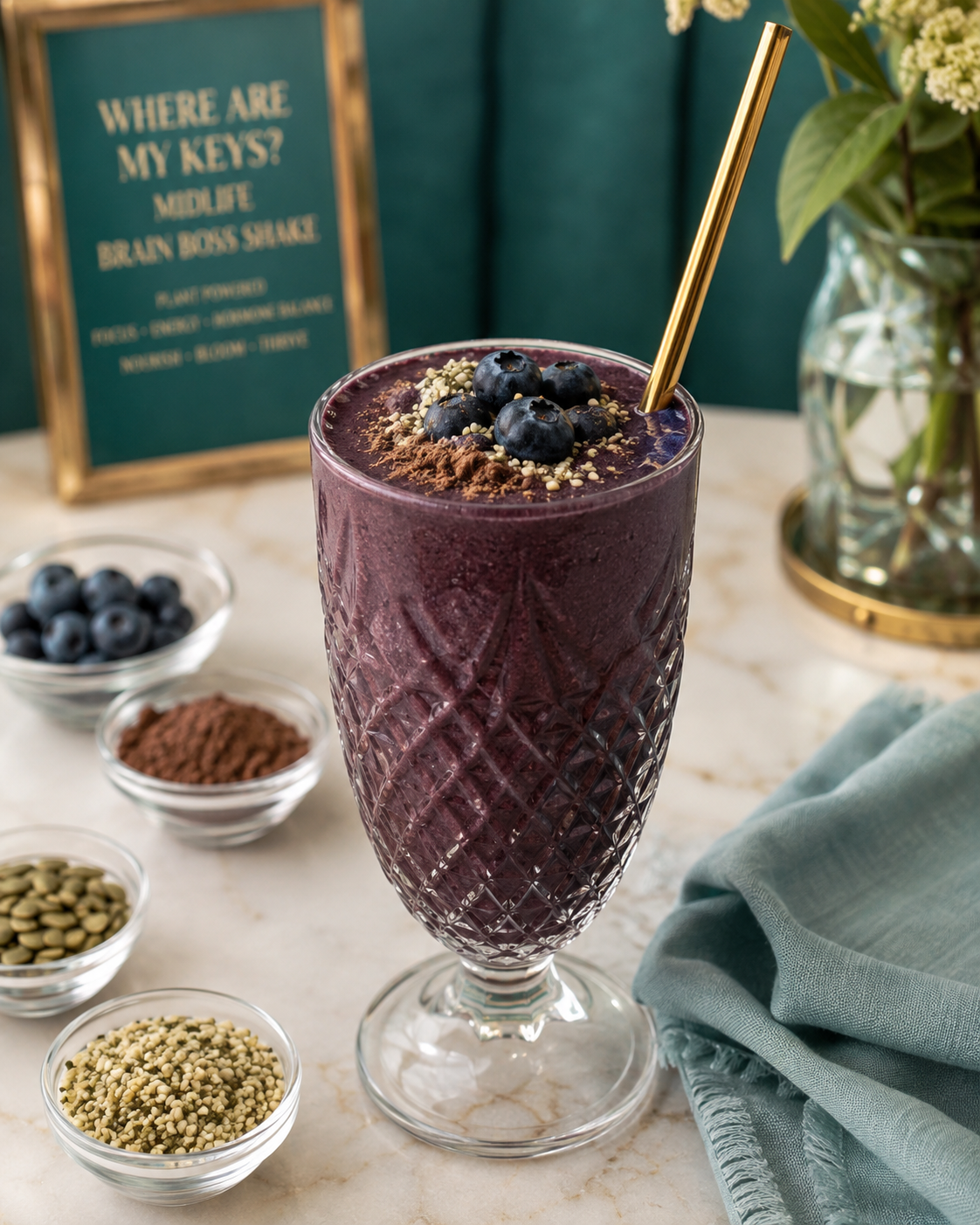
🧠✨ “Where Are My Keys?” Midlife Brain Boss Shake
A rich, creamy blueberry-cacao protein shake made with plant-based protein, polyphenols, healthy fats, and nutrient-dense ingredients to support the brain, muscles, and energy during midlife. Because sometimes brain fog needs more than another sticky note. 😏
Prep Time: 5 minutes
Serves: 1
Approx. Protein: 30–35g, depending on the protein brands used
🌱 DIY Brain Boss Protein Blend
Mix together:
100g organic pea protein
100g organic raw hemp protein
100g organic sprouted brown rice protein
100g organic pumpkin seed protein
100g organic hemp hearts
40g organic raw cacao powder
30g organic beetroot powder
30g organic wheatgrass powder
10–20g organic coconut sugar, optional
Transfer to an airtight glass container and store in a cool, dry place.
Use 40–45g of the finished protein blend per shake.
🫐 For One Brain Boss Shake
1 cup frozen organic blueberries
1 Medjool date, pitted
1¼ cups unsweetened organic soy milk
40–45g DIY Brain Boss Protein Blend
1 tbsp organic ground flaxseed
½ tsp pure vanilla extract
¼ tsp Ceylon cinnamon
Ice, optional
🥤 Instructions
Pour the soy milk into a high-speed blender.
Add the blueberries, Medjool date, protein blend, ground flaxseed, vanilla, and cinnamon.
Blend for 45–60 seconds until thick, creamy, and smooth.
Add a splash of additional soy milk if you prefer a thinner consistency.
Pour into your fanciest glass and enjoy. Midlife may occasionally be chaotic, but the glassware does not have to be. 💅🏾✨
🔬 Why These Ingredients Made the Cut
🫐 Blueberries: Rich in anthocyanins, plant compounds studied for their potential role in supporting vascular health, memory, and healthy cognitive ageing.
🍫 Raw Cacao: Provides cacao flavanols and magnesium and may help support healthy circulation and cerebral blood flow.
❤️ Beetroot: Naturally contains dietary nitrates that the body can convert into nitric oxide, helping support healthy blood flow.
🌱 Hemp Hearts & Hemp Protein: Provide plant protein, magnesium, essential fatty acids, and ALA omega-3 fats.
🎃 Pumpkin Seed Protein: Adds protein along with naturally occurring magnesium, zinc, and iron.
🌾 Pea + Brown Rice Protein: Combining complementary plant proteins provides a broader amino-acid profile than relying on only one source.
🥛 Organic Soy Milk: Provides complete plant protein and naturally occurring soy isoflavones while giving the shake a creamy texture.
🌿 Wheatgrass: Adds chlorophyll and a variety of plant phytonutrients. A little goes a long way—we want brain support, not lawn-flavoured breakfast. 😂
🌾 Ground Flaxseed: Provides fibre, lignans, and plant-based ALA omega-3 fatty acids.
🌴 Medjool Date: Naturally sweetens the shake while contributing fibre and minerals.
🤎 Ceylon Cinnamon: Adds natural sweetness and beneficial plant polyphenols without requiring loads of added sugar.
💡 Midlife Tip
This is not a magical “brain-fog cure.” The real win is combining protein + fibre + healthy fats + colourful polyphenols + micronutrients in one satisfying meal.
That gives your brain and muscles something substantially better to work with than coffee, skipped breakfast, and sheer determination. 😅🧠✨
📚 Selected References
NICE.Menopause: identification and management (NG23). Last updated April 15, 2026.
Williams M, Maki PM.A Review of Cognitive, Sleep, and Mood Changes in the Menopausal Transition: Beyond Vasomotor Symptoms. Obstetrics & Gynecology. 2025.
Maki PM, Jaff NG.Menopause and brain fog: how to counsel and treat midlife women. Menopause. 2024.
Furey RT, et al.Subjective versus objective cognition during menopause: A systematic review and meta-analysis. Journal of the International Neuropsychological Society. 2025.
Evaluating the Effects of Symptom Monitoring on Menopausal Health Outcomes: A Systematic Review and Meta-Analysis. 2021.
Burnett KL, Richmond LL.Meta-analytic investigations of the effect of cognitive offloading on memory-based task performance and interindividual variability. Memory & Cognition. 2026.
González-Gálvez N, et al.Resistance training effects on healthy postmenopausal women: a systematic review with meta-analysis. Climacteric. 2024.
Gonçalves C, Moreira H, Santos R.Systematic review of Mediterranean diet interventions in menopausal women. AIMS Public Health. 2024.
Cano A, et al.The Mediterranean diet and menopausal health: An EMAS position statement. Maturitas. 2020.
Viscardi G, et al.Effect of Soy Isoflavones on Measures of Estrogenicity: A Systematic Review and Meta-Analysis of Randomized Controlled Trials. Advances in Nutrition. 2025.
DNAlife.DNA Hormones – Nutrigenetic Assessment.
DNAlife.DNA Mind – Nutrigenetic Assessment.
Diagnostic Solutions Laboratory.GI-MAP® Gastrointestinal Microbial Assay Plus.
*Creatine monohydrate for lean mass, strength, and bone density in postmenopausal women: a systematic review and meta-analysis. 2026.
Blog Disclaimer
The health information on this blog is for general educational purposes only and is not intended to diagnose, treat, cure, or prevent any disease. It should not be used as a substitute for professional medical advice. Always consult a qualified healthcare provider before making any health-related decisions
This blog may contain affiliate links, meaning Leaves from the Tree of Life LLC may earn a small commission if you purchase a product or service through these links—at no additional cost to you. Your support helps us continue to provide valuable content. Thank you!
