
Histamine & Perimenopause: Itchy, Puffy, Wired?
🌿 Histamine and Perimenopause: Why You May Feel Itchy, Wired, Puffy, or Reactive
Perimenopause already has the audacity to show up like an uninvited group chat: irregular cycles, sleep drama, anxiety, hot flashes, bloating, fatigue, mood swings, and the occasional “why is my skin suddenly offended by everything?” moment.
But here is something many women are just now hearing more about: histamine may be part of the midlife symptom puzzle.
Recently, this topic has been trending because some women are using allergy medications and acid reducers for perimenopause-like symptoms. Experts have pointed out that there is real biology behind the estrogen–histamine relationship, but they also caution that this medication combo has not been well studied for perimenopause treatment and symptoms still deserve proper evaluation.
Translation: we do not want to slap a pharmaceutical Band-Aid over a deeper healing opportunity and call it a day.
As a Traditional Naturopath and Functional Diagnostic Nutrition Practitioner, I look at this through a root-cause lens: What is your body reacting to, why is it reacting now, and what systems need support?
Because sis, your body is not broken. It may simply be waving a very itchy little flag.
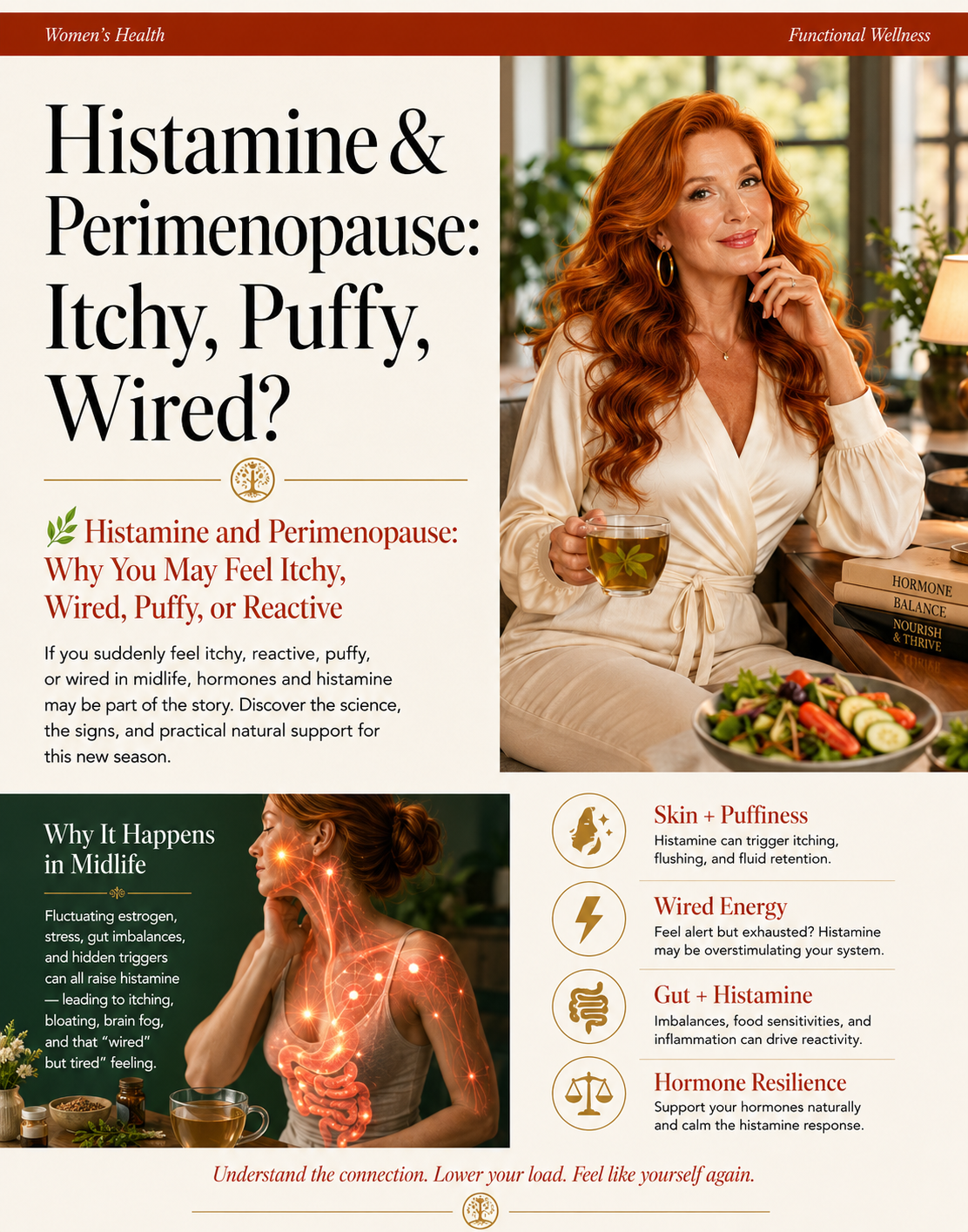
🔥 First, What Is Histamine Actually Doing?
Histamine is not the villain. Let’s not do her like that.
Histamine is a natural chemical messenger involved in immune defense, stomach acid signaling, inflammation, blood vessel dilation, wakefulness, and allergic-type responses. The problem is not histamine itself. The problem is when your body is making too much, clearing too little, or stacking too many triggers at once.
Histamine intolerance is often described as a situation where histamine builds up beyond the body’s ability to break it down, especially in the gut. Reported symptoms can include flushing, itching, hives, headaches, diarrhea, bloating, low blood pressure feelings, asthma-like symptoms, and heart-racing sensations after histamine-rich foods.
However, the science is still evolving, and low DAO alone is not considered a reliable stand-alone diagnosis.
So no, not every reaction is “just histamine.” But histamine can absolutely be part of the Metabolic Chaos® conversation.
💃🏽 The Hormone–Histamine Loop: Why Perimenopause Can Stir the Pot
During perimenopause, estrogen does not simply decline in a neat little graceful staircase. It can fluctuate wildly. FSH can also swing up and down, and ovulation becomes less consistent, which means progesterone output can become less reliable too.
This matters because mast cells, your immune “alarm bells,” have receptors for sex hormones. Estrogen can influence mast cell behavior and histamine release, while progesterone appears to have a calming influence on mast cell histamine secretion.
In plain English:
Estrogen surges may turn histamine volume up.
Lower progesterone may remove some of the calming influence.
DAO, the gut enzyme that helps break down food-derived histamine, may not keep up.
So the woman who could once enjoy avocado, spinach, kombucha, leftovers, or red wine without issue may suddenly feel itchy, puffy, wired, flushed, anxious, or bloated.
And then she wonders, “Am I allergic to life now?”
Not allergic to life, beloved. Possibly overloaded.
🪣 The Histamine Bucket: More In, Less Out
Think of histamine like water filling a bucket.
Your bucket fills from:
Hormone fluctuations
High-histamine foods
Fermented foods
Leftovers
Gut inflammation or dysbiosis
Stress and poor sleep
Alcohol
Certain medications
Seasonal allergies
Mold or environmental triggers
Nutrient insufficiencies
Your bucket empties through:
DAO activity in the gut
HNMT activity inside cells
Healthy gut lining
Liver and methylation pathways
Adequate nutrients
Bowel regularity
Nervous system regulation
The issue is rarely one food. It is often the stack.
Avocado at breakfast. Spinach salad at lunch. Kombucha in the afternoon. Leftovers for dinner. Stress all day. Poor sleep. Hormones swinging like they are auditioning for a drama series.
That is not wellness. That is a histamine pile-up with a cute glass bottle of kombucha on top.
🧬 When Your Body’s Alarm System Gets a Little Too Loud
DAO, or diamine oxidase, is one of the key enzymes responsible for breaking down histamine from food in the gut. Histamine-rich foods tend to include fermented, aged, cured, or stored foods because histamine levels can increase through microbial activity, fermentation, and storage time.
This is why leftovers can be a sneaky trigger. The longer food sits, especially protein-rich or fermented food, the more histamine can accumulate. Freshly prepared food is often better tolerated during a histamine reset.
Alcohol and certain medications may also complicate histamine clearance. Alcohol can encourage histamine release and may reduce histamine breakdown through DAO inhibition. Some NSAIDs have also been reported to potentially interfere with DAO activity in certain contexts.
This is why a functional approach does not ask only, “What food caused this?”
It asks:
What is increasing histamine?
What is reducing clearance?
What is irritating the gut?
What is happening hormonally?
What nutrients are missing?
What is your nervous system living under every day?
Because symptoms are not random. They are data.
🚩 Signs Histamine May Be in the Mix
Histamine-related patterns can look like:
Itchy skin, hives, flushing, or random rashes
Puffy face, swollen eyes, or water retention
Feeling wired but exhausted
Anxiety, irritability, or inner buzzing
Insomnia, especially waking around 2–4 AM
Headaches or migraines
Runny nose or postnasal drip after eating
Bloating, diarrhea, reflux, or nausea
Heart palpitations after certain foods
Feeling worse before your period or during hormone shifts
Reacting to “healthy” foods you used to tolerate
This does not mean you should self-diagnose. Histamine-type symptoms can overlap with allergies, thyroid issues, autoimmune conditions, endometriosis, gut disorders, mast cell disorders, medication reactions, and other concerns. That is why proper evaluation matters.
If you ever experience throat swelling, trouble breathing, fainting, severe hives, chest pain, or anaphylaxis-type symptoms, seek urgent medical care.
🥑 The “Healthy Foods” That Can Still Fill the Bucket
Some foods are genuinely nourishing but may be temporarily too much when your histamine bucket is overflowing.
Common higher-histamine or histamine-liberating foods include:
Fermented foods: sauerkraut, kimchi, kombucha, vinegar, soy sauce, miso, tempeh
Aged foods: aged cheese, cured foods, smoked foods
Alcohol, especially wine and beer
Leftovers stored for several days
Tomatoes, spinach, avocado, eggplant
Citrus, strawberries, dried fruit
Chocolate or cacao
Some nuts and legumes for sensitive individuals
A low-histamine diet is one of the most commonly used strategies in histamine intolerance management, but it should generally be short-term, structured, and followed by careful reintroduction.
The goal is not food fear. The goal is pattern recognition.
In other words: we are not breaking up with avocado forever. We are simply asking avocado to sit quietly while we investigate the chaos.
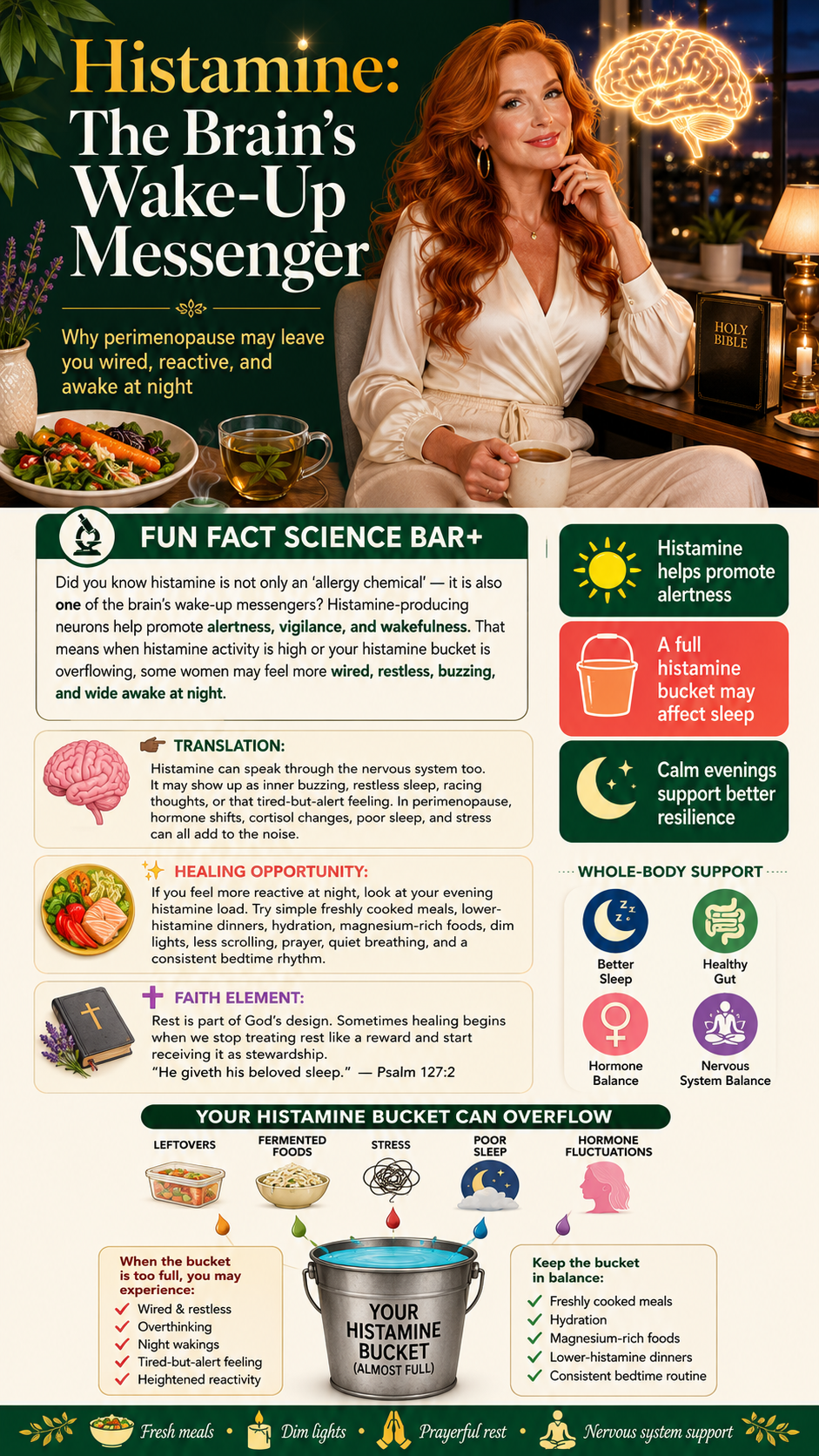
🔬 Fun Fact Science Bar+
Did you know histamine is not only an “allergy chemical” — it is also one of the brain’s wake-up messengers? Histamine-producing neurons in the brain help promote alertness, vigilance, and wakefulness. That means when histamine activity is high or your histamine bucket is overflowing, some women may feel less “sleepy and calm” and more “wired, restless, buzzing, and why am I awake at 3:17 AM thinking about emails, hormones, and that one awkward conversation from 2014?” 😅
👉🏾 Translation: That itchy, puffy, reactive feeling may not only show up in the skin or gut. Histamine can also speak through the nervous system. This is one reason histamine issues may feel like inner buzzing, restless sleep, racing thoughts, or that tired-but-alert feeling. In perimenopause, when sleep is already being challenged by hormone shifts, cortisol changes, night sweats, blood sugar dips, and life stress, histamine can add another “stay awake” signal to the mix. The body is trying to protect you, but sometimes the alarm system gets stuck on loud. Ma’am, we appreciate the security team, but we do not need a full siren at bedtime.
✨ Healing Opportunity: If you feel more reactive at night, look at your evening histamine load. Did dinner include leftovers, tomatoes, spinach, vinegar, fermented foods, chocolate, or a “healthy” snack that may be too stimulating for your current season? Try a simple, freshly cooked, lower-histamine evening meal, gentle hydration, magnesium-rich foods, dim lights, less scrolling, prayer, quiet breathing, and a consistent bedtime rhythm. In Functional Diagnostic Nutrition® language, this is where we look for the Metabolic Chaos® loop: poor sleep increases stress chemistry, stress chemistry increases reactivity, reactivity worsens sleep, and the cycle keeps spinning until someone lovingly interrupts it with wisdom, testing, and practical support.
✝️ Faith Element: Even God built rest into creation before man ever had a to-do list. Evening is not just the end of productivity; it is an invitation to surrender. Creating a calmer nighttime rhythm is not laziness — it is stewardship. Sometimes healing begins when we stop treating rest like a reward and start receiving it as part of God’s design. “He giveth his beloved sleep.” — Psalm 127:2 🙏🏾🌿
🧾 Step One: Start With a Two-Week Symptom Log
Before eliminating everything but air and anxiety, start with data.
Track:
What you ate
When symptoms appeared
Cycle day or bleeding pattern
Sleep quality
Stress level
Bowel movements
Supplements and medications
Leftovers vs freshly cooked foods
Skin, mood, digestion, and sleep changes
This is simple but powerful. Many women discover patterns like:
“I tolerate avocado after my period but not the week before.”
“Kombucha plus spinach plus leftovers is too much.”
“My symptoms are worse when I sleep poorly.”
“I react more when I am stressed and constipated.”
That is not failure. That is information.
And once we see the pattern, we can stop guessing and start identifying the healing opportunities your body has been pointing to all along.
🥗 Natural Support: Reduce the Load Without Living in Restriction
A histamine reset may include temporarily reducing high-histamine foods for 2–4 weeks, then reintroducing foods one at a time.
During a reset, focus on:
Freshly cooked meals
Simple whole-food ingredients
Gluten-free grains like rice, quinoa, millet, or oats if tolerated
Fresh vegetables that you personally tolerate
Fresh herbs
Adequate protein from tolerated plant-based sources
Hydration
Regular bowel movements
Freezing leftovers quickly instead of eating them days later
Batch cooking can still work, but histamine-sensitive women may do better freezing portions immediately rather than letting food sit in the fridge all week.
Because yes, “meal prep queen” can become “histamine bucket overflow queen” real quick.
💊 Supplements That May Help Support Histamine Balance
Supplementation should be individualized, especially during perimenopause when hormones, gut health, thyroid function, iron status, blood sugar, and stress chemistry may all be involved.
Potential supports may include:
Vitamin C: Vitamin C has been studied in relation to histamine levels, and lower vitamin C status has been associated with higher histamine levels in some research. Buffered vitamin C may be gentler for sensitive stomachs.
Quercetin and nettle: These are commonly used in natural health for seasonal allergy-type support and mast-cell calming, though quality and suitability matter.
Vitamin B6, copper, and zinc: DAO is a copper-containing enzyme, and nutrient status can influence enzyme function. But copper should not be supplemented casually. Test first, especially if you are dealing with inflammation, hormone issues, or mineral imbalance.
Probiotics: Be careful here. Not every probiotic is your friend in a histamine season. Some strains may produce histamine, while others may be neutral or potentially supportive. Strain selection matters.
This is where “natural” still needs wisdom. Natural does not mean random. We test, assess, and personalize.
🧪 Why Testing Matters: Don’t Guess Your Way Through Midlife
Testing is not about labeling you. It is about getting a baseline so we can stop blaming your willpower, your age, or your “sensitive personality.”
Helpful evaluation may include:
CBC, CMP, fasting glucose, fasting insulin, HbA1c
Iron panel and ferritin
Thyroid panel with antibodies
Vitamin D, B12, folate, magnesium, zinc, copper
Inflammatory markers such as hs-CRP
Hormone testing, including estrogen/progesterone patterns and cortisol rhythm
Stool testing for dysbiosis, inflammation, pathogens, H. pylori, or gut barrier stress
Organic acids or nutrient metabolism testing
DAO, plasma histamine, tryptase, or urinary histamine metabolites when appropriate
Important note: DAO testing can provide clues, but low DAO by itself is not diagnostic. This is why symptoms need context, clinical history, and appropriate ruling out of other causes.
That does not mean symptoms are fake. It means we need a better investigation.
Your symptoms are real. The question is: what system is asking for support?
🕊️ A Faith-Rooted Reframe: This Is Not the End of You
Perimenopause is not the end of your beauty, usefulness, clarity, or calling.
It is a new chapter.
From a faith-based wellness perspective, the body is fearfully and wonderfully made. God designed the body with rhythms, feedback loops, detoxification pathways, immune signals, rest needs, and repair mechanisms. Sometimes symptoms are not punishment. Sometimes they are invitations.
An invitation to slow down.
An invitation to nourish differently.
An invitation to stop overriding your limits.
An invitation to practice temperance, rest, simplicity, and trust.
The Seventh-day Adventist health message has long emphasized whole foods, water, rest, sunlight, movement, temperance, and trust in God. And honestly? That wisdom still holds. Especially when your nervous system and immune system are sending “ma’am, we need order” notifications.
“Beloved, I wish above all things that thou mayest prosper and be in health…” — 3 John 1:2
This season is not a decline into irrelevance. It is a refining. A recalibration. A chance to rebuild with wisdom.
🌱 Your Practical Histamine Reset Plan
Start here:
Track for two weeks before making major changes.
Reduce the obvious histamine stackers: fermented foods, leftovers, wine/alcohol, aged foods, vinegar-heavy foods, kombucha, and high-trigger foods.
Eat fresher and simpler for a short season.
Freeze leftovers quickly instead of eating them several days later.
Support bowels daily because histamine clearance and gut health are connected.
Review medications with your clinician, especially NSAIDs or acid reducers. Do not stop prescribed medication without guidance.
Test your baseline so you know whether hormones, gut inflammation, blood sugar, thyroid, iron, nutrients, or stress hormones are part of the picture.
Reintroduce foods slowly so you do not stay unnecessarily restricted.
Restriction is not the goal. Resilience is.
✨ Final Word: You Are Not “Too Sensitive”
If you are suddenly reacting to foods, smells, supplements, stress, leftovers, or hormone shifts, you are not being dramatic.
Your body may be overwhelmed.
Your bucket may be full.
Your hormones may be changing the immune conversation.
Your gut may need support.
Your nervous system may need safety.
Your labs may be telling a story no one has bothered to read yet.
And that is exactly where root-cause care shines.
At Leaves from the Tree of Life LLC, we help Businesswomen who are Hormonal, Anxious, and Bloated through Functional Nutrition Coaching + Labs.
We look for the patterns behind the symptoms, the stressors behind the Metabolic Chaos®, and the healing opportunities your body has been trying to reveal.
Because midlife is not the end of your glow.
It is your next chapter — with better boundaries, better data, better nourishment, and a little less histamine drama. 🌿
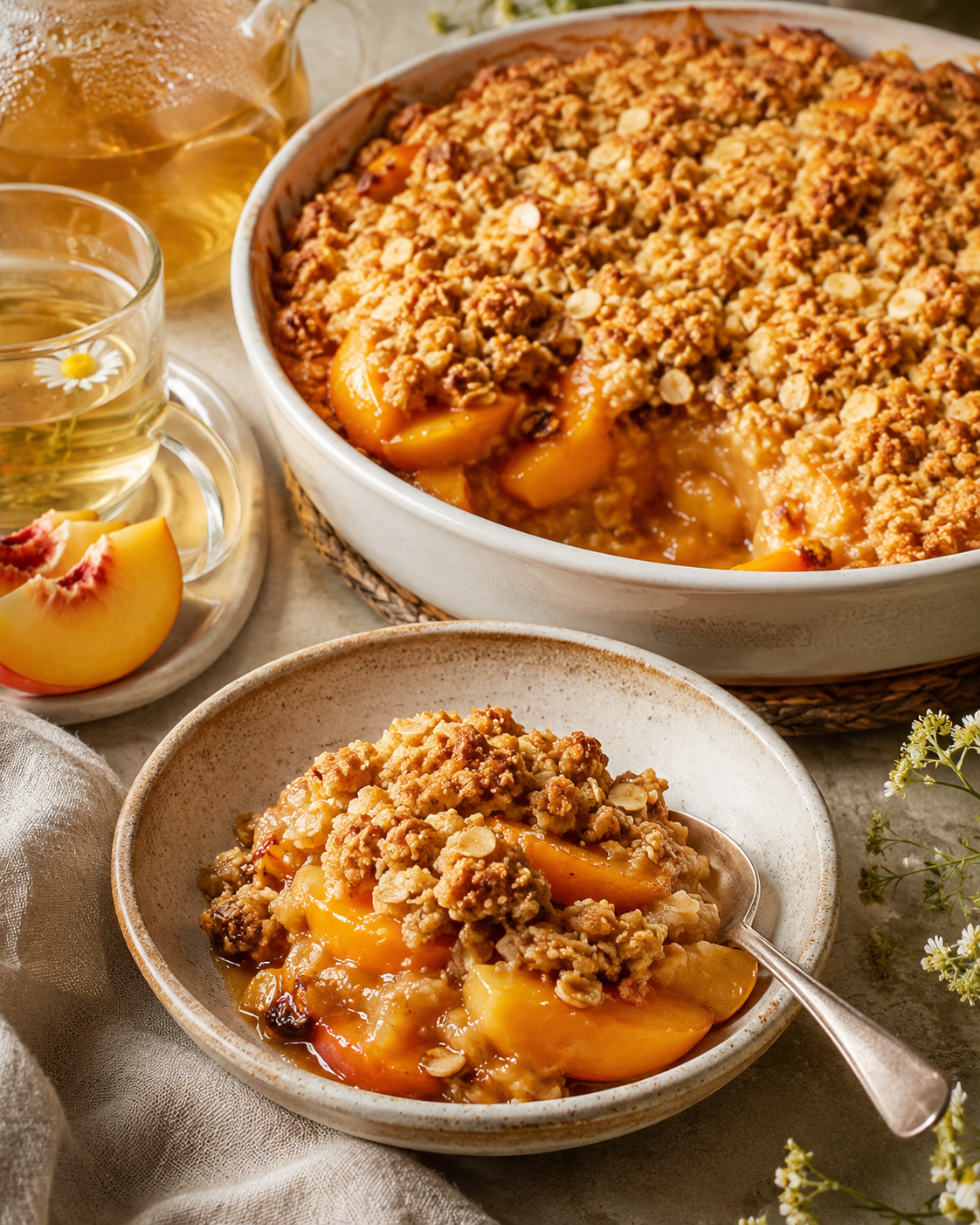
🍑 Peach Please! Golden Glow Low-Histamine Crumble Crisp
A decadent, cozy, fresh-baked dessert without the histamine drama
This is giving warm peach cobbler energy, but with a crisp, golden crumble topping and low-histamine-friendly swaps. Sweet, buttery, juicy, lightly spiced, and comforting without being overly complicated. Basically: dessert with boundaries. 😌🍑✨
Low-histamine tip: this is best enjoyed fresh the same day. Histamine can build in leftovers over time, so freeze extra portions once cooled rather than letting it sit in the fridge for days.
⏱️ Time Needed
Prep Time: 15 minutes
Bake Time: 35–40 minutes
Total Time: 50–55 minutes
Serves: 6
🛒 Ingredients
🍑 Peach Filling
6–7 fresh ripe peaches, sliced
2 tablespoons pure maple syrup
1 tablespoon arrowroot powder or tapioca starch
1 teaspoon pure vanilla extract
½ teaspoon ground cardamom
½ teaspoon ground ginger
¼ teaspoon sea salt
1 tablespoon filtered water, only if peaches are not very juicy
✨ Golden Crumble Topping
1 cup certified gluten-free rolled oats
½ cup oat flour
¼ cup tigernut flour or cassava flour
¼ cup pure maple syrup
¼ cup melted refined coconut oil or mild olive oil
2 tablespoons pumpkin seeds, optional
½ teaspoon vanilla extract
½ teaspoon cardamom
¼ teaspoon sea salt
Optional decadent finish:
1–2 tablespoons coconut sugar sprinkled on top before baking
Dairy-free vanilla cream or coconut-free oat cream for serving, if tolerated
👩🏾🍳 Step-by-Step Instructions
1. Preheat and prepare 🔥
Preheat your oven to 350°F / 175°C. Lightly grease an 8x8 baking dish or small casserole dish.
2. Make the peach filling 🍑
Add the sliced peaches to a bowl. Stir in maple syrup, arrowroot or tapioca starch, vanilla, cardamom, ginger, sea salt, and a splash of water if needed.
Mix gently until the peaches are glossy and coated. Pour into the baking dish.
3. Make the crumble topping ✨
In a separate bowl, combine gluten-free oats, oat flour, tigernut or cassava flour, pumpkin seeds if using, cardamom, and sea salt.
Add maple syrup, melted oil, and vanilla. Stir until the mixture becomes crumbly and slightly sticky.
4. Assemble the crisp 😍
Sprinkle the crumble topping evenly over the peaches. Do not pack it down too firmly. We want those crispy golden edges, not a sad little oat blanket.
5. Bake until golden 🍯
Bake for 35–40 minutes, or until the peaches are bubbling and the crumble topping is golden brown.
6. Rest before serving 🌿
Let it cool for 10–15 minutes before serving. This helps the peach filling thicken beautifully.
Serve warm and enjoy that cozy “I made dessert but still respected my body” moment. Amen. 🙌🏾🍑
🌿 Health Benefits of Each Ingredient
🍑 Fresh Peaches
Peaches provide vitamin C, potassium, fiber, and natural sweetness. They are hydrating and gentle for many people when eaten fresh. Freshness matters because older fruit or leftovers may be more problematic for histamine-sensitive individuals.
🍁 Maple Syrup
Maple syrup gives natural sweetness without relying on refined white sugar. It also adds a rich caramel-like flavor that makes the crumble feel decadent without needing much.
🌾 Certified Gluten-Free Oats
Oats provide soluble fiber, especially beta-glucans, which support gut health, bowel regularity, and steadier blood sugar. For sensitive clients, certified gluten-free oats are preferred to reduce gluten cross-contamination.
🌾 Oat Flour
Oat flour helps create a soft, cookie-like crumble texture while adding extra fiber. It also keeps the recipe gluten-free and simple.
🌰 Tigernut Flour
Despite the name, tigernut is not actually a nut. It is a small root vegetable that provides resistant starch, which may support beneficial gut bacteria and bowel regularity. It also gives a naturally sweet, nutty flavor without using nuts.
🌱 Cassava Flour
Cassava flour is a grain-free alternative that works well for sensitive diets. It gives the crumble structure and keeps the texture light.
✨ Arrowroot or Tapioca Starch
These help thicken the peach juices into a glossy filling. They are gentle, neutral-tasting, and useful for gluten-free baking.
🌿 Cardamom
Cardamom adds a warm, elegant flavor that makes the crisp feel special. It is also traditionally used to support digestion.
🫚 Ginger
Ginger brings warmth and a gentle zing. It is traditionally used for digestion, nausea support, and inflammatory balance.
🧂 Sea Salt
A little sea salt enhances sweetness and balances the flavors. It also helps the crumble taste richer and more bakery-style.
🎃 Pumpkin Seeds
Pumpkin seeds add crunch, magnesium, zinc, and plant-based minerals. If seeds are not tolerated during a histamine flare, leave them out.
🫒 Mild Olive Oil or Refined Coconut Oil
Oil helps the topping crisp and gives that buttery crumble texture. Mild olive oil is a good option if coconut is not preferred. Refined coconut oil has less coconut flavor than virgin coconut oil.
🌼 Vanilla Extract
Vanilla adds depth, warmth, and dessert-shop flavor. Use a simple, clean vanilla extract without unnecessary additives.
🍽️ Low-Histamine Serving Tips
Enjoy fresh and warm the same day.
Freeze leftovers in single portions once cooled.
Avoid letting it sit in the fridge for several days.
Pair with herbal tea instead of fermented drinks like kombucha.
Keep toppings simple during a histamine flare.
✨ Final Note
This Peach Please! Golden Glow Low-Histamine Crumble Crisp is proof that low-histamine eating does not have to feel like punishment.
It can be warm.
It can be cozy.
It can be decadent.
And yes, it can still taste like you love yourself properly. 🍑🌿
References
🧬 Histamine, Mast Cells & Hormonal Mechanisms
AAAAI. Histamine intolerance overview, symptoms, diagnostic uncertainty, and DAO limitations.
https://www.aaaai.org/allergist-resources/ask-the-expert/answers/old-ask-the-experts/diamine [1]
NIH/PMC. Female sex hormones and mast cell behavior — Sex Differences in Mast Cell–Associated Disorders.
https://pmc.ncbi.nlm.nih.gov/articles/PMC9524281/ [2]
PubMed. Progesterone and mast cell histamine secretion — Progesterone triggers selective mast cell secretion of 5-hydroxytryptamine.
https://pubmed.ncbi.nlm.nih.gov/2099339/ [3]
NIH/PMC. Histamine intolerance dietary management and low-histamine diet evidence.
https://pmc.ncbi.nlm.nih.gov/articles/PMC8308327/ [4]
NIH/PMC. DAO supplementation and histamine degradation — Recent advances in the application of microbial diamine oxidase.
https://pmc.ncbi.nlm.nih.gov/articles/PMC9547800/ [5]
NIH/PMC. Vitamin C and histamine research — Intravenous vitamin C in the treatment of allergies.
https://pmc.ncbi.nlm.nih.gov/articles/PMC6136002/ [6]
🌸 Perimenopause & Hormonal Transition
ReproductiveFacts.org (ASRM). Menopause transition and hormone fluctuation basics — Menopausal Transition (Perimenopause).
PEOPLE. Women using allergy medications and acid reducers for perimenopause-like symptoms, with expert caution that this use is not well studied.
No specific PEOPLE.com article located — search PEOPLE.com directly for "histamine perimenopause allergy medications" [8]
Blog Disclaimer
The health information on this blog is for general educational purposes only and is not intended to diagnose, treat, cure, or prevent any disease. It should not be used as a substitute for professional medical advice. Always consult a qualified healthcare provider before making any health-related decisions
This blog may contain affiliate links, meaning Leaves from the Tree of Life LLC may earn a small commission if you purchase a product or service through these links—at no additional cost to you. Your support helps us continue to provide valuable content. Thank you!
