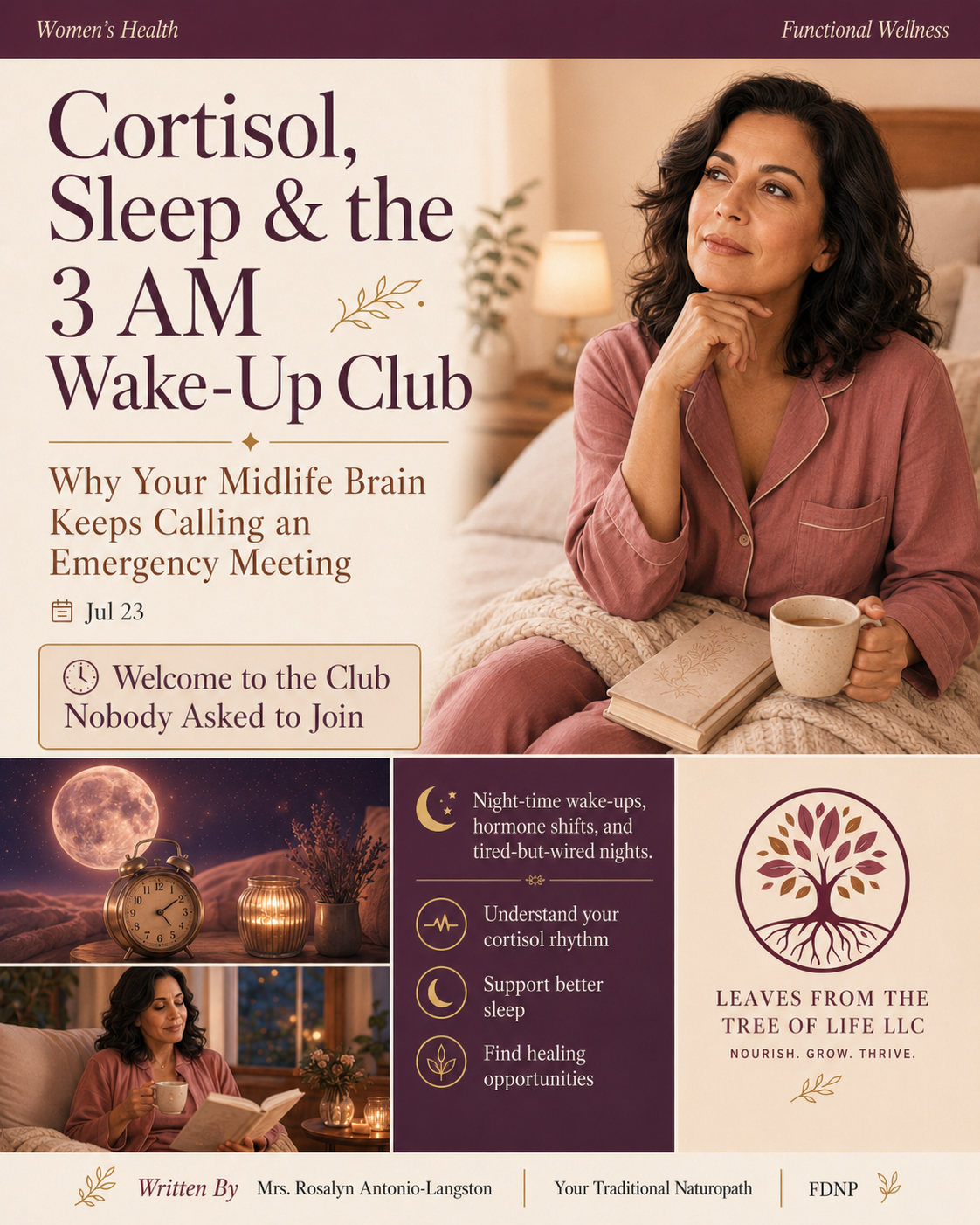
🕒 Welcome to the Club Nobody Asked to Join
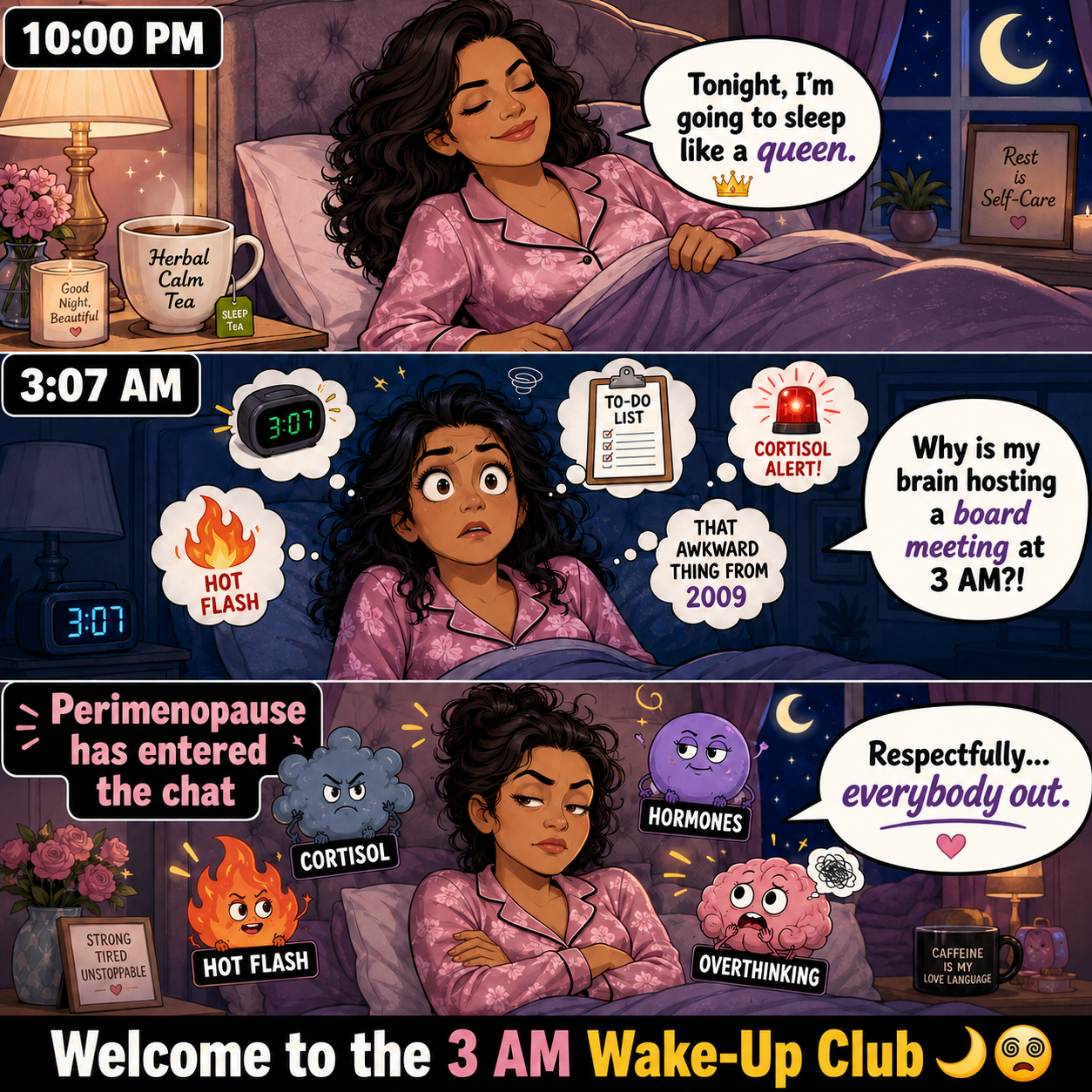
It is 3:07 AM.
Your eyes are wide open. Your brain has decided this is the perfect time to review tomorrow’s schedule, replay a conversation from 2009, calculate the household budget and wonder whether you remembered to send that email.
Meanwhile, your body is tired.
Very tired.
Yet sleep has apparently packed a suitcase and left the building.
For many women in perimenopause and menopause, falling asleep is not always the problem. It is staying asleep that becomes the nightly battle. You may fall asleep reasonably well, only to wake between 2:00 and 4:00 AM feeling hot, anxious, hungry, alert, sweaty, restless—or simply awake for no obvious reason.
Sleep problems, including difficulty falling asleep and staying asleep, are common during the menopause transition. Night sweats, mood changes, pain, bladder symptoms and hormonal fluctuations can all contribute.
And before somebody tells you to “just reduce your stress,” let us acknowledge something:
You are probably already trying.
You may be managing a business, a career, ageing parents, relationships, finances, church responsibilities, health concerns and the emotional labour of keeping everybody else’s world moving.
You are not failing at sleep.
Your body may be signalling that several biological systems are no longer coordinating as smoothly as they once did. This is where we begin looking for healing opportunities, rather than blaming the woman lying awake.
🚨 First Things First: Waking at 3 AM Does Not Automatically Mean “High Cortisol”
The internet loves a tidy explanation.
“You woke at 3 AM? Your cortisol is spiking.”
Possibly—but not necessarily.
A 3 AM awakening is a clue, not a diagnosis.
Cortisol follows a natural circadian rhythm. Under healthy conditions, it is generally lowest during the earlier part of the night, then gradually begins rising before morning to help prepare the body for waking.
That means your 3 AM awakening may occur around the time cortisol is beginning its natural climb. However, waking at that time does not prove that cortisol caused the awakening.
The trigger might instead be:
a night sweat or temperature shift
anxiety or nervous-system hyperarousal
sleep apnoea or disrupted breathing
restless legs
reflux, bloating or abdominal discomfort
pain
bladder urgency
medication effects
caffeine consumed earlier in the day
unstable glucose regulation
an inconsistent sleep schedule
or a learned insomnia pattern
Sometimes cortisol is involved.
Sometimes cortisol is responding to the fact that you woke up.
And sometimes cortisol is simply being blamed because it has become the celebrity villain of midlife health.
🧠 Cortisol Science Without the White-Coat Word Salad
Cortisol is not a “bad” hormone.
You need it.
It helps regulate:
blood pressure
immune activity
inflammation
glucose availability
energy mobilisation
alertness
and your response to physical or emotional demands
Cortisol is produced by the adrenal glands through communication involving the brain and pituitary gland. This communication network is called the hypothalamic-pituitary-adrenal axis, or HPA axis.
Here is the simplified version:
Your hypothalamus detects that energy or action may be needed.
It communicates with the pituitary gland.
The pituitary releases ACTH.
ACTH signals the adrenal glands to release cortisol.
Cortisol helps make energy and resources available.
Feedback signals tell the brain when enough cortisol has been produced.
Cortisol normally rises after waking. This is called the cortisol awakening response, or CAR. It helps the body transition from sleeping to functioning.
The problem is not cortisol itself.
The problem may be the timing, amplitude, total output or responsiveness of the rhythm.
Poor sleep can influence HPA-axis activity, while stress-related HPA activation can also disturb sleep. In other words, sleep and cortisol can become that couple arguing over who started the argument.
A professional note about “adrenal fatigue”
“Adrenal fatigue” is not recognised as a scientifically established medical diagnosis. The adrenal glands do not simply become tired because life has been stressful.
That does not mean your exhaustion, anxiety, dizziness or sleep problems are imaginary. It means we must investigate the real contributors instead of attaching every symptom to an unsupported label.
In functional practice, it is more accurate to discuss circadian disruption, altered stress responsiveness, HPA-axis patterns and accumulated physiological burden.
Words matter—especially when they affect what gets investigated and what gets missed.
🎢 Why Perimenopause Can Turn Sleep into Metabolic Chaos®
Perimenopause is not simply a slow, peaceful decline in estrogen.
Hormones can fluctuate dramatically.
One month you may ovulate and produce a reasonable amount of progesterone. The next cycle may be delayed, shortened or anovulatory. Estrogen may surge, fall and surge again. Progesterone exposure often becomes less predictable as ovulation becomes less consistent.
That hormonal variability can affect several systems involved in sleep.
🌡️ Estrogen, Temperature and the Midnight Furnace
Estrogen influences the brain’s temperature-regulating centres.
During the menopause transition, changing estrogen signalling can narrow the body’s thermoneutral zone—the small temperature range in which you feel neither too hot nor too cold.
A tiny shift in core temperature may suddenly trigger:
skin flushing
sweating
increased heart rate
adrenaline-like sensations
and an abrupt awakening
You may not always wake drenched.
Sometimes you simply wake suddenly, throw off the covers and feel strangely alert. The night sweat may have initiated the awakening before you consciously realised you were hot.
🧘🏾♀️ Progesterone, Allopregnanolone and the Calming Signal
Progesterone is not only a reproductive hormone.
One of its metabolites, allopregnanolone, interacts with GABA-A receptors in the brain. GABA is one of the nervous system’s major calming messengers.
Changes in progesterone and neurosteroid signalling may therefore influence:
sleep quality
anxiety
emotional sensitivity
nervous-system calm
and how easily the brain settles after an awakening
Oral micronised progesterone may improve certain sleep outcomes in some women, although responses vary and treatment must be individualised by a qualified prescriber.
This does not mean every woman with insomnia “needs progesterone.”
It means progesterone is biologically relevant to the sleep conversation and should not be treated as merely the hormone that protects the uterine lining.
🔁 The 3 AM Stress Loop: When One Awakening Becomes a Habit
Sometimes the initial awakening begins with hormones, pain, heat or noise.
Then the brain learns the pattern.
You wake up.
You look at the clock.
You think:
“Oh no. Here we go again. I am going to be exhausted tomorrow.”
Your brain interprets the situation as a threat.
The sympathetic nervous system becomes more active. Heart rate may increase. Thoughts accelerate. Cortisol and other alerting signals may rise.
Now you are no longer simply awake.
You are awake and monitoring yourself for evidence that you will never sleep again.
The bed gradually becomes associated with worry, clock-watching and frustration instead of sleep.
This is why simply buying another pillow spray, magnesium powder or expensive sleep gadget may not address the full pattern.
Sometimes the body needs practical support.
Sometimes the mind needs reassurance.
Sometimes the soul needs stillness.
And sometimes all three need attention at the same time.
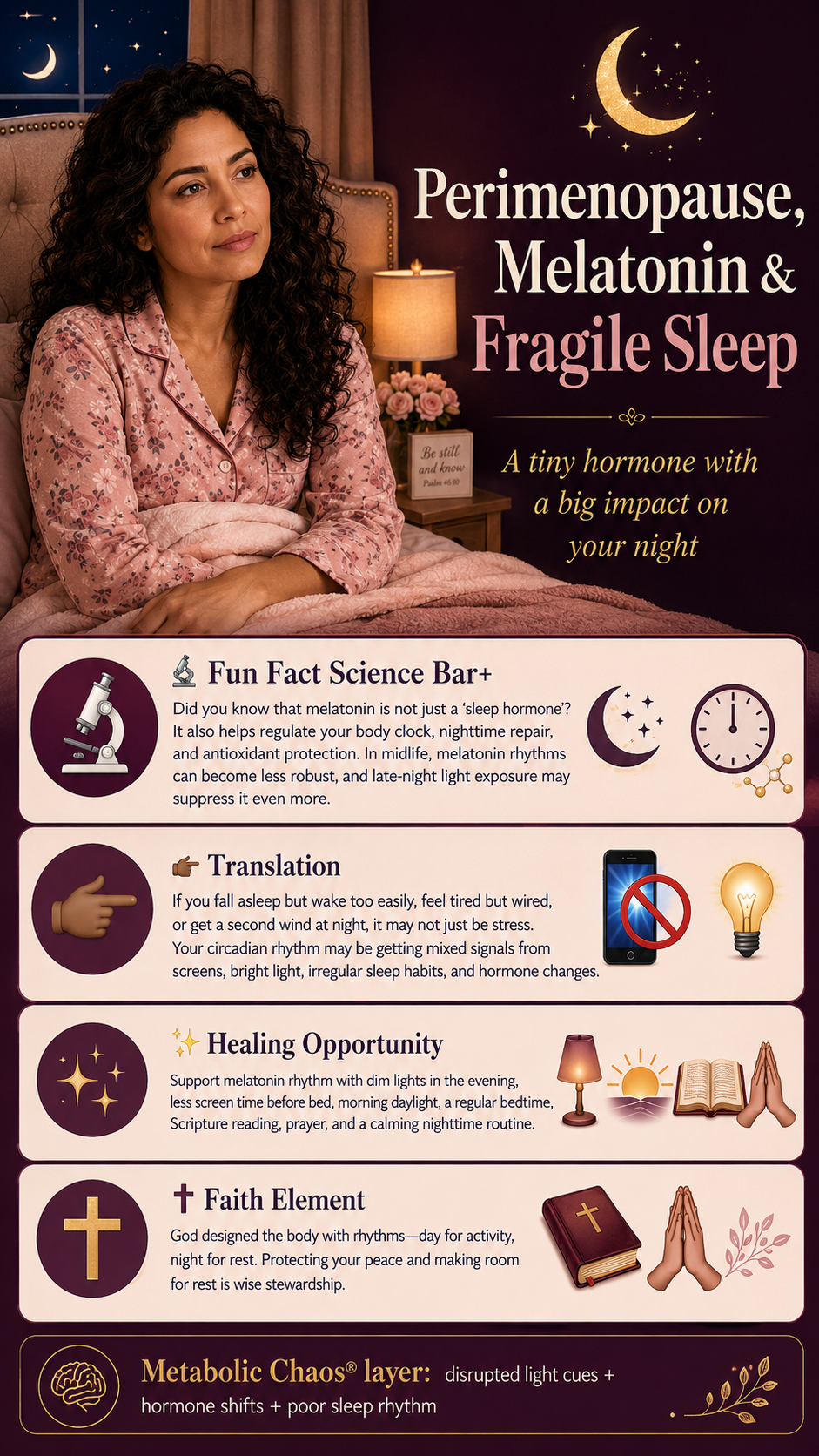
🔬Fun Fact Science Bar+
Did you know that melatonin is not just a “sleep hormone”? It also helps regulate your body clock, nighttime repair, and antioxidant protection. In midlife, melatonin rhythms can become less robust, and late-night light exposure from phones, tablets, or TVs may suppress it even more. That can make sleep feel lighter, shorter, and easier to interrupt — especially in perimenopause, when hormones are already shifting.
👉🏾 Translation:
If you are falling asleep but waking too easily, feeling “tired but alert,” or getting that annoying second wind at night, it may not just be stress. Your circadian rhythm may be getting mixed signals from late-night light, screen time, irregular sleep habits, and hormone changes. In FDN® language, that becomes another Metabolic Chaos® layer.
✨ Healing Opportunity:
Support your melatonin rhythm with dim lights in the evening, less screen exposure before bed, a regular bedtime, morning daylight, and calming nighttime habits. Think: warm shower, Scripture reading, gentle prayer, calming book, and a bedroom that feels like rest—not a second office.
✝️ Faith Element:
God designed the body with rhythms—day for activity, night for rest. Protecting your evenings, guarding your peace, and making room for true rest is not laziness; it is wise stewardship. 🌙🙏🏾
🍽️ Is It a Blood-Sugar Crash?
Possibly—but let us avoid turning every 3 AM awakening into an emergency bowl of almond butter.
Low blood glucose can cause sweating, shaking, palpitations, hunger and waking, particularly in people who have diabetes or use glucose-lowering medication.
For women without diabetes, true clinically significant nocturnal hypoglycaemia is less common than social media may suggest.
However, unstable eating patterns may still matter.
Some businesswomen run on caffeine, meetings and determination all day, eat very little, then consume their largest meal late at night. Others dramatically restrict carbohydrates, fast for long periods or under-eat while also exercising intensely.
That pattern can create a body that is tired but physiologically unsettled.
Rather than assuming you need a bedtime snack, look at the whole day:
Did you eat enough?
Were your meals balanced?
Did you include adequate protein, fibre and nourishing carbohydrates?
Did you skip lunch and call coffee a meal?
Did you eat a large, heavy dinner immediately before lying down?
Are you using medication that can lower glucose?
Testing fasting glucose, HbA1c and other metabolic markers may be appropriate when symptoms or risk factors point in that direction.
The goal is not to fear carbohydrates or worship continuous glucose monitors.
The goal is metabolic stability.
😴 The Culprits That Often Get Blamed on Menopause
Hormones matter, but every sleep problem in a woman over 40 is not automatically menopause.
🫁 Obstructive Sleep Apnoea
Sleep apnoea may become more common after menopause, and women do not always present with the stereotypical loud snoring and dramatic gasping.
Women may report:
insomnia
frequent awakenings
morning headaches
anxiety
fatigue
nocturia
poor concentration
or waking with a racing heart
🦵🏾 Restless Legs and Iron Status
Do your legs feel uncomfortable, restless, twitchy or as though they must move when you lie down?
Iron deficiency can contribute to restless legs syndrome, even when the person is not yet severely anaemic. Heavy or unpredictable perimenopausal bleeding can also reduce iron stores.
Do not blindly supplement large amounts of iron.
Check the pattern, investigate the cause and test appropriately.
🦋 Thyroid Dysfunction
An overactive thyroid may contribute to anxiety, heat intolerance, palpitations and insomnia.
An underactive thyroid may contribute to fatigue, low mood, constipation, weight changes and poor sleep quality.
Because thyroid and menopause symptoms overlap, it can be unwise to assume that everything is “just hormones.”
🔥 Reflux, Pain and Digestive Distress
Bloating, reflux, abdominal discomfort, histamine-like reactions, diarrhoea, constipation and food-triggered symptoms may repeatedly pull the nervous system out of sleep.
The gut may not be the sole cause of insomnia, but it can certainly become one of the noisy neighbours.
🧬 Test, Don’t Guess—but Do Not Test Everything That Has a Barcode
Testing can be valuable when it answers a specific question.
It becomes expensive confusion when panels are ordered without understanding:
what the test measures
what it cannot measure
whether the result will change the plan
and whether medical evaluation is needed first
A single hormone result may be misleading during perimenopause because hormones can fluctuate considerably.
Functional testing is therefore not about simply “proving” that a woman is in perimenopause or menopause.
It is about exploring the individual patterns surrounding her symptoms.
🩸 Functional Blood Chemistry Analysis—FBCA
Functional Blood Chemistry Analysis is a pattern-based review of conventional blood chemistry alongside symptoms, history, medications, nutrition and lifestyle.
Depending on the woman’s presentation and what her medical provider considers appropriate, useful conventional markers may include:
complete blood count
ferritin and a full iron panel
thyroid markers
fasting glucose and HbA1c
liver and kidney markers
vitamin B12 and folate
vitamin D
lipids
electrolytes
and selected inflammatory markers
A woman waking at 3 AM may not need an exotic “sleep supplement.”
She may need her iron status investigated.
She may need a thyroid assessment.
She may need treatment for sleep apnoea.
She may need better blood-glucose management.
Or she may need a referral.
That is why we test thoughtfully.
🌅 DUTCH Plus™ or DUTCH Complete™
The DUTCH Complete evaluates sex hormones, hormone metabolites and patterns of free and metabolised cortisol across the day.
The DUTCH Plus adds salivary measurements used to evaluate the cortisol awakening response—the rise in cortisol occurring after waking.
This may help explore questions such as:
Is the morning cortisol response robust, exaggerated or blunted?
Does free cortisol remain elevated later in the day?
Is the daily rhythm relatively flat?
How do cortisol and cortisone patterns compare?
What patterns are present in estrogen, progesterone and androgen metabolites?
However, DUTCH testing does not diagnose sleep apnoea, insomnia, Cushing’s syndrome or adrenal insufficiency.
Suspected endocrine disease requires appropriate medical testing and specialist evaluation.
🧬 DNAlife® DNA Hormones
DNAlife DNA Hormones is a nutrigenetic test.
It does not tell us what your hormone level is tonight.
It looks at selected inherited variants involved in areas such as:
steroid hormone production
hormone transport and binding
estrogen metabolism
phase I and phase II biotransformation
oxidative balance
and selected clotting-related pathways
It may provide information about predispositions that can be considered alongside symptoms, environment, laboratory findings and lifestyle.
Genes may influence the terrain.
They do not write the entire story.
🦠 GI-MAP®
The GI-MAP is a stool test using quantitative PCR technology to measure selected microbial DNA and markers related to digestion, immune activity and intestinal inflammation.
It may be considered when disrupted sleep occurs alongside significant:
bloating
reflux
constipation or diarrhoea
abdominal pain
suspected H. pylori
food intolerance
or other persistent gastrointestinal symptoms
GI-MAP is not a cortisol or menopause test.
It helps investigate another part of the overall picture.
🍓 MRT® Food-Sensitivity Testing
MRT is a practitioner-used blood test intended to evaluate changes associated with mediator release after exposure to selected foods and food chemicals.
It may be considered in selected cases involving persistent food-associated inflammatory symptoms.
It does not diagnose menopause, insomnia or IgE-mediated food allergy.
The goal is never to hand a woman a terrifying list of 47 foods and leave her afraid to eat.
The goal is to use the findings—when appropriate—to build a nourishing, personalised eating plan.
🧩 The Functional Perspective: Which Pattern Is Driving the Wake-Up?
In my work as a Traditional Naturopath and Functional Diagnostic Nutrition Practitioner, I am not asking only:
“How do we knock you out for eight hours?”
I am also asking:
What woke you?
What happened during the previous day?
Is the bedroom too warm?
Are night sweats present?
What does your menstrual pattern look like?
Are you ovulating consistently?
Are you under-eating?
Are you relying heavily on caffeine?
Are you experiencing pain, reflux or bladder urgency?
Do you snore, gasp or wake with headaches?
Are your legs restless?
Is iron low?
Is thyroid function involved?
What medications and supplements are you taking?
What story does your nervous system tell when you wake?
This is the difference between chasing a symptom and identifying Metabolic Chaos®.
The body does not operate in separate filing cabinets marked “hormones,” “gut,” “stress,” “blood sugar” and “sleep.”
These systems talk to one another all night long.
Sometimes rather loudly.
🌿 Healing Opportunities: Supporting the Rhythm Instead of Fighting the Body
There is rarely one magical solution.
The most effective approach often comes from combining several small, targeted changes.
☀️ Anchor the Morning
A consistent waking time and exposure to morning daylight can help strengthen circadian timing.
Try to get outside in natural morning light when possible—even if the British sky looks as though it has forgotten the sun exists.
☕ Reconsider the Afternoon Coffee Meeting
Caffeine can remain active for hours and may reduce sleep depth even when you can fall asleep normally.
Your 3 PM latte may be attending your 3 AM meeting.
Consider experimenting with an earlier caffeine cut-off and observe your response.
🍲 Eat Like Your Body Deserves Fuel
Aim for balanced meals built around:
plant-based protein
colourful vegetables
fibre-rich carbohydrates
healthy fats
and adequate overall nourishment
Do not spend the day surviving on coffee and then wonder why your body files a formal complaint overnight.
🌡️ Create a Cooler Sleep Environment
Breathable bedding, layered covers, a cool bedroom, a fan and lightweight sleepwear may reduce the disruption caused by night sweats.
🏋🏾♀️ Build Daytime Resilience
Regular movement, resistance training, walking and appropriate cardiovascular exercise support metabolic health, mood and sleep.
The word is appropriate.
More is not always better when a woman is exhausted, under-fuelled and already running on stress hormones and stubbornness.
📵 Give Your Brain a Landing Strip
Create a transition between work and sleep.
This might include:
dimmer evening lighting
prayer
journalling
gentle stretching
calming music
reading
putting tomorrow’s tasks on paper
or setting a firm boundary around late-night business emails
The nervous system needs evidence that the working day is over.
📖 Meditate on Scripture or Read Something Calming
When you wake during the night, try not to immediately reach for your phone, check emails or begin solving tomorrow’s problems.
Instead, gently redirect your attention toward something peaceful and familiar.
You might:
meditate on a favourite Bible verse
quietly repeat one of God’s promises
pray slowly rather than anxiously
read a few pages from the Bible
listen to an audio Bible at a low volume
or read a favourite calming book
Verses such as Psalm 4:8 can provide a grounding reminder:
“I will both lay me down in peace, and sleep: for thou, Lord, only makest me dwell in safety.”
This is not about forcing yourself to feel calm or using Scripture as another performance task.
It is about giving the mind somewhere safe to rest.
Choose reading that is peaceful rather than stimulating. A gripping thriller, heated theological debate or late-night business book may not exactly escort your nervous system back to sleep.
Keep the lighting low, avoid clock-watching and allow your body to become sleepy again naturally.
🩺 Discuss BHRT and Other Medical Options
When hot flushes, night sweats or other menopausal symptoms are driving sleep disruption, speak with a menopause-informed prescriber about individualised treatment options, including bioidentical hormone replacement therapy—BHRT.
BHRT may include hormones such as body-identical estradiol and micronised progesterone, depending on the woman’s symptoms, medical history, uterine status and individual risk profile.
For some women, appropriately prescribed BHRT may help reduce:
hot flushes
night sweats
repeated night-time awakenings
vaginal and urinary symptoms
and other disruptive menopausal symptoms
Progesterone may also be relevant to sleep because of its relationship with calming neurosteroid pathways. However, hormone therapy is not one-size-fits-all, and treatment should be prescribed and monitored by a qualified healthcare professional.
Sometimes she needs nutrition.
Sometimes she needs an herb.
Sometimes she needs body-identical progesterone, estradiol or another prescribed treatment.
Sometimes she needs more time in Scripture and less time staring at the clock.
Sometimes she needs CPAP.
Sometimes she needs iron investigated.
Sometimes she needs a gastroenterology, endocrinology, sleep-medicine or menopause referral.
That is personalised care.
🕊️ Your Body Was Designed for Rhythm, Not Relentless Hustle
From a faith-based perspective, I find it meaningful that rhythm was woven into creation from the beginning:
Evening and morning.
Light and darkness.
Work and rest.
Six days and Sabbath.
Sabbath is not a biohack, and prayer is not a replacement for appropriate healthcare.
But Sabbath is a weekly reminder that human beings were not created to produce, perform and push without pause.
Rest is not laziness.
It is part of stewardship.
Sometimes the body begins whispering before it starts shouting. The 3 AM awakening may be an invitation to examine what has become out of rhythm—not only your hormones, but your meals, workload, light exposure, boundaries, nervous system, health and spiritual rest.
This is not the end of your vitality.
It is a new season requiring a new strategy.
🚩 When the 3 AM Club Needs Medical Attention
Please seek medical evaluation when sleep disruption is persistent, worsening or accompanied by:
loud snoring, choking or witnessed pauses in breathing
significant daytime sleepiness
morning headaches
chest pain or severe palpitations
fainting or marked dizziness
unexplained weight loss
drenching night sweats unrelated to a warm room
persistent vomiting, reflux or abdominal pain
severe depression, panic or thoughts of self-harm
unusually heavy or unexplained bleeding
symptoms of thyroid disease
symptoms of diabetes or recurrent low glucose
or possible adrenal disease
Do not allow every serious symptom to be dismissed as menopause.
And do not allow menopause itself to be dismissed as something you simply have to endure.
🌳 Your Next Chapter Does Not Have to Be Written at 3 AM
Perimenopause and menopause can expose where the body has lost resilience.
But exposure is not always destruction.
Sometimes it is information.
Your symptoms may reveal healing opportunities involving sleep rhythm, nutrition, hormone support, nervous-system regulation, gut health, metabolic health, medical treatment or a combination of approaches.
At Leaves from the Tree of Life LLC, we help Businesswomen who are Hormonal, Anxious, and Bloated through Functional Nutrition Coaching + Labs.
We take a personalised, root-cause approach using your health history, symptoms, lifestyle and selected testing to help identify the patterns contributing to your unique Metabolic Chaos®.
Because you deserve more than being told:
“It is just your age.”
This is not the end.
It is a new season.
A new chapter.
And preferably one you do not have to read wide awake at 3:13 in the morning.
👉🏾 CLICK HERE to jump on a Discovery Call.
Let us explore what your body may be communicating and create a more personalised path forward.

🌙Golden Pear & Chamomile Dream Pots
With Vanilla Cashew Cream and Maple–Pecan Moon Dust
Silky chamomile-infused vanilla cream layered with warm cinnamon pears and finished with a crisp maple–pecan crumble. It is creamy, fragrant, gently sweet and cosy enough to make your evening feel like it has officially clocked out. 😌
This is an original whole-food, plant-based dessert created to complement the Cortisol, Sleep & the 3 AM Wake-Up Club blog.
⏰ Time & Servings
Preparation: 20 minutes
Cooking: 15 minutes
Chilling: 1 hour
Total: 1 hour 35 minutes
Serves: 4
🛒 Organic Ingredients
🍐 Cinnamon Pear Layer
3 ripe organic pears, peeled and diced
1 tablespoon organic pure maple syrup
1 teaspoon organic Ceylon cinnamon
¼ teaspoon organic ground cardamom
1 teaspoon fresh organic lemon juice
Small pinch of pink Himalayan salt
🌼 Chamomile–Vanilla Cashew Cream
1 cup organic raw cashews, soaked for at least 4 hours and drained
¾ cup strongly brewed organic chamomile tea, cooled
3 soft organic Medjool dates, pitted
1 teaspoon organic pure vanilla extract
1 teaspoon organic lemon juice
Small pinch of pink Himalayan salt
🌰 Maple–Pecan Moon Dust
½ cup organic rolled oats
⅓ cup organic pecans, roughly chopped
1 tablespoon organic almond butter
1 tablespoon organic pure maple syrup
½ teaspoon organic Ceylon cinnamon
Small pinch of pink Himalayan salt
✨ Optional Finishing Touches
Thin slices of fresh pear
A light dusting of cinnamon
Crushed pecans
Edible organic chamomile flowers
👩🏾🍳 Step-by-Step Instructions
1. 🌼 Brew the chamomile
Steep two organic chamomile tea bags—or two teaspoons of loose culinary chamomile—in one cup of hot water for 8–10 minutes.
Measure out ¾ cup and allow it to cool completely.
The tea should be fragrant and slightly stronger than you would normally drink because it will be blended with the other ingredients.
2. 🍐 Make the warm spiced pears
Add the diced pears, maple syrup, cinnamon, cardamom, lemon juice and pink Himalayan salt to a small saucepan.
Cook over medium-low heat for 8–10 minutes, stirring occasionally, until the pears become tender, glossy and lightly caramelised.
Leave a little texture rather than cooking them into applesauce’s pear-shaped cousin. Remove from the heat and allow them to cool.
3. 🌰 Prepare the moon dust
Preheat the oven to 175°C/350°F.
Combine the rolled oats, chopped pecans, almond butter, maple syrup, cinnamon and salt in a small bowl.
Rub the mixture together with your fingers until small clusters form.
Spread it onto a lined baking tray and bake for 8–10 minutes, stirring once halfway through. Allow it to cool completely so it becomes crisp and crumbly.
4. 🤍 Blend the cashew cream
Place the soaked cashews, cooled chamomile tea, dates, vanilla, lemon juice and salt into a high-speed blender.
Blend until completely smooth, thick and velvety.
Pause to scrape down the sides as needed. The finished cream should resemble a luxurious vanilla custard. Add one tablespoon of chamomile tea if it is too thick, but avoid making it runny.
5. 🥄 Assemble the dream pots
Divide half of the spiced pears between four small dessert glasses.
Spoon a generous layer of chamomile–vanilla cream over the pears.
Add the remaining pears, followed by another swirl of cream.
6. ❄️ Chill and settle
Refrigerate the pots for at least one hour. Chilling allows the cream to thicken and the flavours to mingle.
7. ✨ Add the finishing crunch
Just before serving, scatter the maple–pecan moon dust over each dessert.
Finish with sliced pear, crushed pecans, cinnamon or a few edible chamomile flowers.
Serve chilled—or allow the pots to sit at room temperature for ten minutes for an even silkier texture.
🌿 Health Benefits of Each Ingredient
🍐 Organic Pears
Pears provide soluble and insoluble fibre, which supports digestive regularity, the gut microbiome and steadier glucose absorption. Their natural sweetness creates a comforting dessert without needing large amounts of added sugar.
🌼 Chamomile Tea
Chamomile has traditionally been used as a gentle evening herb. It contains apigenin, a plant compound studied for its interaction with receptors associated with relaxation and sleepiness.
It is support—not a herbal sleeping pill in a teacup.
🌰 Raw Cashews
Cashews create the creamy base while providing magnesium, copper, healthy fats and plant-based protein. Magnesium contributes to normal nervous-system and muscle function.
🌴 Medjool Dates
Dates provide natural sweetness, fibre, potassium and polyphenols. They also help make the cashew cream thick and caramel-like without refined sugar.
🌾 Rolled Oats
Oats contain beta-glucan fibre, which supports digestive health, cholesterol regulation and a more gradual post-meal glucose response.
🌰 Pecans
Pecans provide monounsaturated fats, manganese, copper and antioxidant plant compounds. They add buttery richness and a satisfying crunch.
🥜 Almond Butter
Almond butter contributes vitamin E, magnesium, healthy fats and a little plant protein. The fats also help the crumble feel decadent without dairy butter.
🍁 Pure Maple Syrup
Maple syrup provides sweetness in a concentrated form, so a small amount is sufficient. It also contains trace minerals and plant compounds, although it should still be enjoyed as an added sugar rather than treated as a supplement wearing a delicious disguise.
🤎 Ceylon Cinnamon
Ceylon cinnamon adds warmth and natural sweetness. It contains aromatic polyphenols and may complement balanced meals that support healthy glucose regulation.
🌿 Cardamom
Cardamom brings a floral, gently warming flavour and contains aromatic plant compounds traditionally used to support digestion.
🍋 Lemon Juice
Lemon brightens the dessert, balances the sweetness and provides a small amount of vitamin C.
🧂 Pink Himalayan Salt
A small pinch sharpens the vanilla, pear and maple flavours, allowing the dessert to taste sweeter without needing excessive added sugar.
🌙 Why It Works with the Blog
This dessert is intentionally soothing rather than overly heavy or intensely sweet. It combines fibre-rich pears and oats with healthy fats from cashews, pecans and almond butter, making it more balanced than many conventional desserts.
Enjoy it after dinner rather than directly before lying down—especially if reflux, bloating or overnight digestive discomfort contributes to your own 3 AM Wake-Up Club membership.
Please note: Chamomile may not be appropriate for people with certain plant allergies—particularly ragweed-family allergies—or those taking medicines that interact with sedative or blood-thinning herbs.
References
🌸 Perimenopause, Menopause & Sleep Changes
NICE. Menopause: Identification and Management (NG23). Updated April 2026. https://www.nice.org.uk/guidance/ng23 [1]
NHS. Symptoms of Menopause and Perimenopause.https://www.nhs.uk/conditions/menopause-and-perimenopause/symptoms/ [2]
Troìa L, et al. Sleep Disturbance and Perimenopause: A Narrative Review. PMC, 2025. https://pmc.ncbi.nlm.nih.gov/articles/PMC11901009/ [3]
🔥 Cortisol, the HPA Axis & Circadian Rhythm
O’Byrne NA, et al. Sleep and Circadian Regulation of Cortisol: A Short Review. PMC. https://pmc.ncbi.nlm.nih.gov/articles/PMC8813037/ [4]
Endotext. HPA Axis and Sleep. NCBI Bookshelf. https://www.ncbi.nlm.nih.gov/books/NBK279071/ [5]
Cohn AY, et al. Effects of Sleep Fragmentation and Estradiol Decline on Cortisol in Women. PMC. https://pmc.ncbi.nlm.nih.gov/articles/PMC10584010/ [6]
💛 Micronised Progesterone, BHRT & Sleep
Nolan BJ, et al. Efficacy of Micronized Progesterone for Sleep: A Systematic Review and Meta-Analysis. PubMed. https://pubmed.ncbi.nlm.nih.gov/33245776/ [7]
The Menopause Society. Hormone Therapy and Bioidentical Hormones.https://menopause.org/patient-education/menopause-topics/hormone-therapy [8]
British Menopause Society. Bioidentical HRT: Regulated versus Compounded Preparations. Updated April 2026. https://thebms.org.uk/publications/consensus-statements/bioidentical-hrt/ [9]
British Menopause Society. Progestogens and Endometrial Protection. May 2026. https://thebms.org.uk/wp-content/uploads/2026/05/14-NEW-BMS-TfC-Progestogens-and-endometrial-protection-MAY2026-A.pdf [10]
Endocrine Society. Compounded Bioidentical Hormone Therapy Position Statement.https://www.endocrine.org/advocacy/position-statements/compounded-bioidentical-hormone-therapy [11]
😴 Other Causes of Night-Time Waking
NHS. Insomnia: Causes, Symptoms and Sleep Support.https://www.nhs.uk/conditions/insomnia/ [12]
NHS. Night Sweats.https://www.nhs.uk/symptoms/night-sweats/ [13]
NHS. Restless Legs Syndrome.https://www.nhs.uk/conditions/restless-legs-syndrome/ [14]
NHS. Iron-Deficiency Anaemia.https://www.nhs.uk/conditions/iron-deficiency-anaemia/ [15]
🧬 Functional & Personalised Testing
Precision Analytical. DUTCH Plus® with Cortisol Awakening Response.https://dutchtest.com/dutch-plus [16]
DNAlife. DNA Hormones Nutrigenetic Test.https://www.dnalife.healthcare/products/dna/dna-hormones [17]
Diagnostic Solutions Laboratory. GI-MAP®—GI Microbial Assay Plus.https://www.diagnosticsolutionslab.com/tests/gi-map [18]
Oxford Biomedical Technologies. Mediator Release Test—MRT®.https://www.nowleap.com/the-patented-mediator-release-test/ [19]
The laboratory websites explain what each specialised panel measures. Results should be interpreted alongside symptoms, health history and appropriate conventional medical testing.
🌱 Faith-Aligned Rest & Whole-Person Health
Ellen G. White. The Ministry of Healing.https://media4.egwwritings.org/pdf/en_MH.pdf [20]
NEWSTART®. Rest, Trust in God and the Eight Lifestyle Principles.https://newstart.com/about/ [21]
Blog Disclaimer
The health information on this blog is for general educational purposes only and is not intended to diagnose, treat, cure, or prevent any disease. It should not be used as a substitute for professional medical advice. Always consult a qualified healthcare provider before making any health-related decisions
This blog may contain affiliate links, meaning Leaves from the Tree of Life LLC may earn a small commission if you purchase a product or service through these links—at no additional cost to you. Your support helps us continue to provide valuable content. Thank you!
