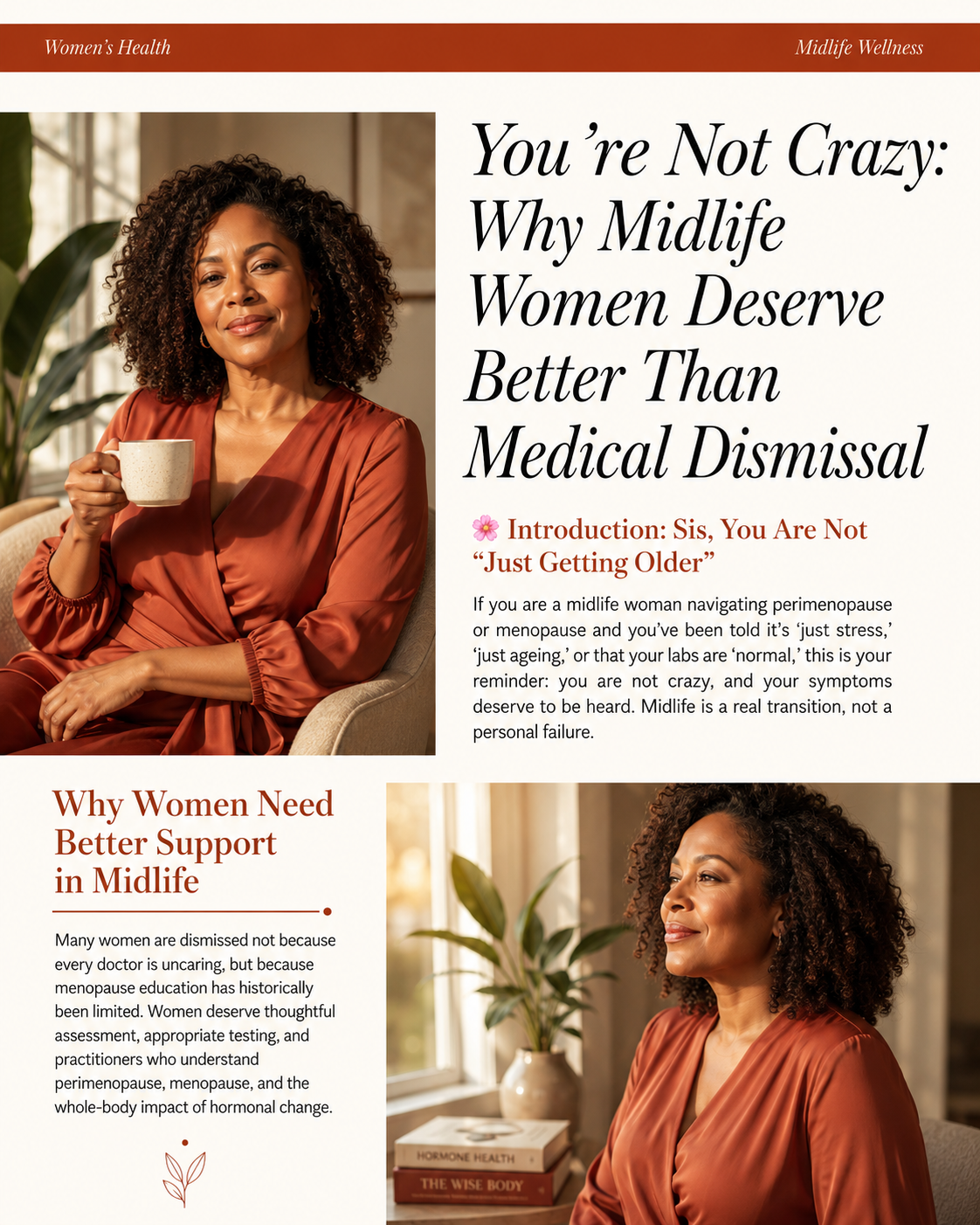
You’re Not Crazy: Why Midlife Women Deserve Better Than Medical Dismissal
🌸 Introduction: Sis, You Are Not “Just Getting Older”
Let us start here:
You are not crazy.
You are not dramatic.
You are not “just stressed.”
You are not falling apart because you suddenly forgot how to be a functioning adult with a calendar, a bra, and a nervous system.
If you are a midlife woman navigating perimenopause or menopause and you have walked into an appointment feeling exhausted, anxious, bloated, foggy, emotional, inflamed, sleepless, heavier, hotter, colder, sweatier, drier, moodier, or just plain “not yourself,” only to be told your labs are “normal” or it is “just age”…
I want you to know something very clearly:
Your symptoms deserve to be heard. Your story deserves to be investigated. And your body is not betraying you — it is communicating.
Now, before anyone starts clutching their stethoscope, this blog is not here to demonise doctors, GPs, nurses, or medical professionals. Absolutely not. Many are compassionate, brilliant, overworked, under-supported, and doing their best within systems that are often stretched thinner than gluten-free pastry.
But we do need to have an honest conversation.
Many women are being dismissed during perimenopause and menopause — not always because their doctor does not care, but because many healthcare professionals have historically received limited education in this area. Menopause care has not always been given the depth, urgency, or nuance it deserves.
And women are tired.
Tired of being told, “Everything looks normal.”
Tired of being offered antidepressants without a deeper conversation.
Tired of being told to lose weight, calm down, or accept decline.
Tired of feeling like their bodies became a mystery nobody has time to solve.
But here is the good news: the conversation is changing.
The medical world is finally beginning to listen more closely to women’s health needs. Slowly, yes. Imperfectly, yes. But the door is opening.
And while it opens, women must learn how to advocate wisely, partner with the right professionals, and see symptoms not as shame — but as healing opportunities.
🧠 The Midlife Medical Gap: Why So Many Women Feel Dismissed
Perimenopause and menopause are not fringe topics. Every woman who lives long enough will transition through menopause, and many will spend years in perimenopause before reaching it.
Yet for far too long, midlife women have been expected to suffer politely.
Hot flashes? Normal.
Anxiety? Stress.
Weight gain? Eat less.
Brain fog? You are busy.
Low mood? Maybe depression.
Insomnia? Try sleep hygiene.
Heavy bleeding? That happens.
Low libido? Welcome to marriage.
Bloating? Maybe IBS.
Rage? Pray harder, sis.
Now listen — prayer is powerful. I am a woman of faith. I believe in taking everything to the Lord. But sometimes what we are calling “lack of self-control” is actually hormonal fluctuation, blood sugar dysregulation, nutrient depletion, gut inflammation, thyroid changes, poor sleep, chronic stress, or nervous system overload.
Sometimes you do not need another guilt trip.
Sometimes you need a proper assessment.
Many GPs are generalists. Their job is broad, complex, and demanding. They are expected to know a little — and often a lot — about everything: children, elderly care, infections, medication, mental health, chronic disease, emergencies, hormones, referrals, safeguarding, and more.
So when a woman comes in with a constellation of symptoms that touch hormones, digestion, mood, metabolism, sleep, joints, skin, weight, libido, cognition, and stress resilience, it can be challenging if that practitioner has not had strong training in perimenopause and menopause.
That does not make them bad doctors.
It means the system needs to do better.
And until it does, women need to know how to recognise dismissal, ask better questions, and seek practitioners who are educated in this transition.
Because midlife is not a medical afterthought.
🔥 Perimenopause Is Not a Personality Flaw
One of the most damaging messages women receive is that their symptoms are somehow a character issue.
You are anxious because you cannot cope.
You are tired because you do too much.
You are gaining weight because you lack discipline.
You are emotional because you are sensitive.
You are forgetful because you are ageing.
You are irritable because you need to calm down.
Ma’am. No.
Perimenopause is a profound biological transition. Hormones do not just affect periods. They influence the brain, nervous system, gut motility, insulin sensitivity, inflammation, sleep architecture, bone health, cardiovascular health, vaginal and urinary tissues, skin, hair, mood, and energy.
This is why one woman may experience hot flashes and night sweats, while another has anxiety, insomnia, histamine issues, digestive chaos, joint pain, heavy periods, migraines, or sudden intolerance to stress.
The body is not random. It is interconnected.
In Functional Diagnostic Nutrition, we often talk about Metabolic Chaos® — the idea that symptoms are not isolated little annoyances floating around independently. They are signals that multiple systems may be under stress at the same time.
Hormones may be shifting.
Blood sugar may be unstable.
The gut may be inflamed.
The liver may be overwhelmed.
The thyroid may be struggling.
The nervous system may be living in emergency mode.
Nutrient status may be depleted.
So no, you are not “just hormonal” in the dismissive sense.
You are hormonal because you are human.
You are symptomatic because something is asking for attention.
And your symptoms may be showing us where the healing opportunities are.
🩺 Not Every Doctor Will Be the Right Doctor — And That Is Okay
Here is where we need maturity and wisdom.
Not every doctor will be the right fit for your menopause care. That does not mean you have to leave the appointment angry, discouraged, or hopeless. It means you may need to keep advocating until you find someone who is better suited to your needs.
Just like you would not expect every mechanic to specialise in electric cars, every doctor will not specialise in women’s hormonal transitions. Some are excellent with menopause. Some are still learning. Some may be more medication-focused. Some may be cautious with hormone therapy. Some may be dismissive without realising it. Some may be wonderful listeners but limited by appointment time, NHS pathways, insurance systems, or local referral options.
The goal is not to fight every medical professional.
The goal is to build the right care team.
A good menopause-informed practitioner should be willing to listen, ask thoughtful questions, explain options, consider risks and benefits, and investigate symptoms that do not fit neatly into “normal menopause.”
Because yes, perimenopause is common.
But common does not mean “ignore it.”
And natural does not mean “suffer through it.”
Childbirth is natural too, but nobody sane says, “Just breathe and hope for the best, beloved.” We monitor. We assess. We support.
Midlife women deserve support too.
📋 Advocate Like a Woman With Receipts
If you have ever walked into an appointment and suddenly forgotten every symptom you have had for the last six months, welcome to the club. The fluorescent lights, the 10-minute appointment, the paper sheet on the examination bed — it can humble the best of us.
This is why I encourage women to bring receipts.
Not attitude.
Not panic.
Receipts.
Before your appointment, write down:
Your main symptoms
When they started
Whether they are cyclical or constant
Changes in your period
Sleep patterns
Mood changes
Digestive symptoms
Weight or body composition changes
Hot flashes or night sweats
Migraines or headaches
Pain, bleeding, or anything unusual
Current medications or supplements
Family history
Questions you want answered
You can also track symptoms for two to three cycles if you are still menstruating. This can help you see patterns that may otherwise be missed.
When speaking with your GP or doctor, try language like:
“I understand perimenopause can be diagnosed clinically, but I would like to discuss whether my symptoms fit that picture or whether something else needs investigating.”
“I would like to rule out other contributors such as thyroid issues, iron deficiency, inflammation, blood sugar changes, or nutrient deficiencies.”
“Can we discuss my options, including lifestyle, non-hormonal support, HRT if appropriate, and referral if needed?”
“If this is outside your area of focus, could you refer me to someone with more menopause experience?”
That is not being difficult.
That is being wise.
A woman who advocates for herself is not a problem patient. She is a steward of her body.
And as Seventh-day Adventists often emphasise through the health message, stewardship matters. Our bodies are not disposable. They are temples — entrusted to us by God — and caring for them is not vanity. It is worshipful responsibility.
🔬 Fun Fact Science Bar
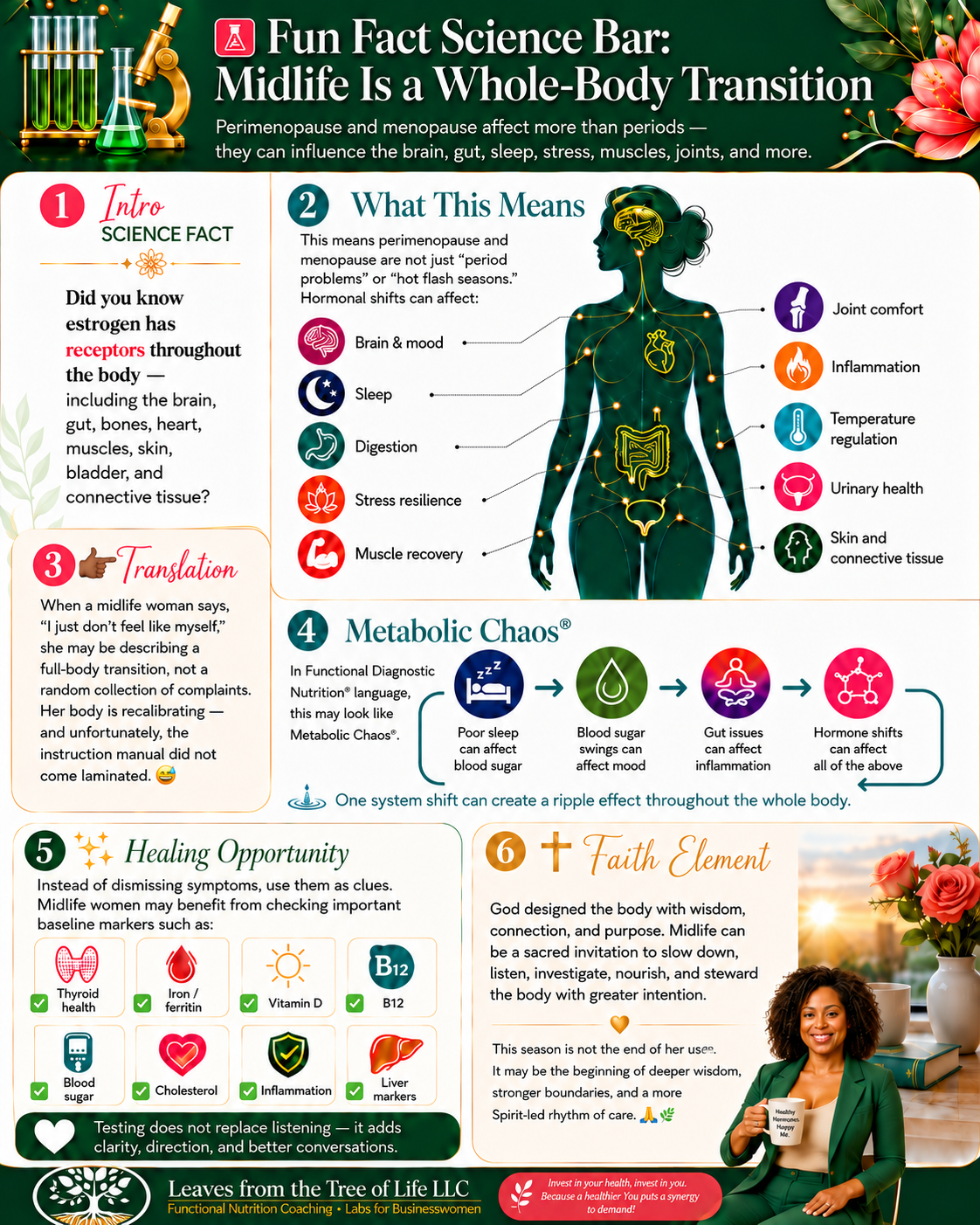
Did you know that estrogen has receptors throughout the body — including the brain, gut, bones, heart, muscles, skin, bladder, and even connective tissue? That means perimenopause and menopause are not just “period problems” or “hot flash seasons.” They can influence how a woman thinks, sleeps, digests, recovers, responds to stress, holds muscle, regulates temperature, manages inflammation, and even experiences joint stiffness or urinary changes.
👉🏾 Translation: When a midlife woman says, “I just don’t feel like myself,” she may be describing a full-body transition — not a random collection of complaints. The brain may be adjusting to hormone shifts, the gut may become more sensitive, sleep may become lighter, muscles may recover slower, and stress resilience may feel lower than before. So no, sis is not malfunctioning. Her body is recalibrating — and unfortunately, the instruction manual did not come laminated. 😅
In Functional Diagnostic Nutrition® language, this is where we may see Metabolic Chaos®: one system shift creates another. Poor sleep can affect blood sugar. Blood sugar swings can affect mood. Gut issues can affect inflammation. Stress can affect digestion. Hormone changes can affect all of the above. This is why midlife care needs a whole-woman approach, not a “take this and hush” approach.
✨ Healing Opportunity: Instead of treating symptoms like isolated annoyances, use them as clues. A woman entering midlife may benefit from checking her baseline markers — such as thyroid health, iron/ferritin, vitamin D, B12, blood sugar, cholesterol, inflammation, liver markers, and other appropriate labs depending on her symptoms. Testing does not replace listening, but it can help bring clarity, direction, and better conversations with the right practitioner.
✝️ Faith Element: God designed the body with wisdom, connection, and purpose. When one part struggles, the whole person feels it — body, mind, and spirit. Midlife can be a sacred invitation to slow down, listen, investigate, nourish, and steward the temple with more intention. This season is not the end of her usefulness; it may be the beginning of deeper wisdom, stronger boundaries, and a more Spirit-led rhythm of care. 🙏🏾🌿
🧪 Testing Matters — But Let’s Use It Wisely
Now let us talk about testing, because this is where things can get confusing.
For many women over 45, perimenopause and menopause are often identified based on symptoms and menstrual history rather than hormone blood tests alone. This is because hormones can fluctuate wildly during perimenopause. One day your estrogen may look like it packed its bags and left. Another day it may return with luggage, drama, and a marching band.
So when we talk about testing, we need to be clear.
Testing is not always about “proving” perimenopause.
Testing is about establishing a baseline, ruling out other contributors, and understanding the wider terrain of the body.
Because a woman can be in perimenopause and also have:
Low ferritin or iron deficiency
Thyroid dysfunction
Vitamin D deficiency
B12 or folate insufficiency
Poor blood sugar regulation
Insulin resistance
Chronic inflammation
Liver stress
Gut dysbiosis
Food sensitivities
High stress chemistry
Poor detoxification capacity
Nutrient depletion
Autoimmune patterns
Cardiometabolic risk changes
This is why I believe baseline testing is important.
Not because every symptom needs a fancy test.
Not because more data automatically means better care.
And definitely not because we want women spending money on random “meno-friendly” tests from the internet.
No, beloved. We are not doing “add to cart” healthcare.
We test with purpose.
From a Traditional Naturopathic and Functional Diagnostic Nutrition perspective, testing can help us understand where the body is struggling and where support may be most needed.
Conventional labs may include things like a full blood count, ferritin, thyroid markers, vitamin D, B12, folate, fasting glucose, HbA1c, lipids, liver enzymes, kidney markers, inflammatory markers, and other tests depending on symptoms and medical history.
Functional labs may help explore digestion, gut health, stress hormones, organic acids, nutrient patterns, detoxification markers, or food sensitivities when appropriate.
Testing gives us a baseline.
And a baseline gives us something powerful: direction.
Because when you know where you are starting, you can make more informed decisions, track progress, and stop guessing your way through midlife like you are wandering through a hormonal fog with a broken compass.
🌿 Beyond “Normal Labs”: The Bigger Functional Picture
Many women have heard the phrase: “Your labs are normal.”
Sometimes that is reassuring.
But sometimes it leaves a woman thinking, “If everything is normal, why do I feel like my body has joined a secret rebellion?”
Here is the nuance: normal lab ranges are not the same as optimal function. And labs must always be interpreted in context.
A woman may technically be “in range” but still trending toward imbalance. She may have symptoms long before conventional markers become obviously abnormal. She may also have multiple borderline patterns that, when viewed together, tell a bigger story.
This is where functional work can be helpful.
Functional nutrition does not replace medical care. It complements it by asking deeper lifestyle and systems-based questions:
How is she sleeping?
How is her digestion?
Is she absorbing nutrients?
Is her blood sugar stable?
Is chronic stress affecting cortisol rhythm?
Is inflammation driving symptoms?
Is her liver able to process hormones efficiently?
Is constipation affecting estrogen clearance?
Is she eating enough protein and minerals?
Is she over-exercising, under-recovering, or running on fumes?
Is her nervous system stuck in survival mode?
Midlife women do not need a one-size-fits-all protocol. They need personalised care.
Because your symptoms are not random.
They are clues.
And when we stop treating the body like separate departments and start seeing it as one beautifully designed, God-created system, the picture becomes clearer.
💛 Compassion for Both Sides: Women and Medical Professionals Are in a Transition
Here is something important: women are not the only ones in a transition.
The medical world is also transitioning.
For decades, women’s midlife health did not receive the attention it deserved. Menopause was often reduced to hot flashes and periods stopping, when in reality it can affect multiple body systems and quality of life.
Now, more women are speaking up. More research is being discussed. More training is being created. More clinicians are becoming menopause-informed. More conversations are happening in workplaces, homes, churches, clinics, podcasts, and public health spaces.
This is good.
But change takes time.
So we need compassion on both sides.
Women need to be believed, listened to, and properly assessed.
Medical professionals need better training, resources, time, and support.
Women need to advocate without apologising for existing.
Practitioners need humility to say, “Let’s investigate,” or “Let me refer you.”
Women need patience.
Doctors need curiosity.
Everyone needs less ego and more truth.
Imagine what could happen if women and medical professionals stopped standing on opposite sides of the room and started working together.
That is the new chapter we need.
Not doctor-bashing.
Not woman-dismissing.
But collaborative, respectful, informed care.
A softer system.
A wiser system.
A system where midlife women are not treated like expired milk after 40.
Because excuse me — some of us are just getting seasoned. And seasoning matters. Ask any good stew.
👑 Midlife Is Not the End — It Is a New Assignment
Society has been deeply unkind to midlife women.
Too often, the message is:
Stay young.
Stay small.
Stay quiet.
Stay attractive.
Stay productive.
Stay agreeable.
Stay invisible.
Absolutely not.
Midlife is not the end of your value.
It is not the closing chapter of your beauty, wisdom, calling, or purpose.
It is not the point where you fade into the background while everyone younger gets the spotlight.
This can be a sacred season of refinement.
A season where you stop performing and start discerning.
A season where you stop abandoning yourself to please everyone else.
A season where your body asks for deeper nourishment, stronger boundaries, better rhythms, and more honest care.
A season where you become the woman younger women look at and think, “I want to age like that — with wisdom, strength, humour, health, faith, and fire.”
You are still valuable.
You are still precious.
You are still called.
You are still needed.
You are still becoming.
Do not let inner doubt or society’s tired narrative convince you otherwise.
The world may worship youth, but God honours wisdom.
Proverbs 31 reminds us that strength and honour are clothing. Not youth and approval. Strength and honour.
And midlife women?
You have earned some strength.
You have walked through some fires.
You have prayed through some nights.
You have carried more than people know.
Now it is time to create a new narrative.
Not “I am declining.”
But “I am listening.”
Not “My body is broken.”
But “My body is asking for support.”
Not “This is over.”
But “This is a new chapter.”
Not “I am invisible.”
But “I am becoming a voice.”

🌺 What Women Can Do Next
If you are feeling dismissed, here are some grounded next steps:
Track your symptoms clearly.
Ask for appropriate baseline labs.
Request copies of your results.
Learn what your numbers mean.
Seek a menopause-informed doctor if needed.
Ask for referral when symptoms are complex.
Do not ignore red flags like heavy bleeding, severe pain, unexplained weight loss, chest pain, new neurological symptoms, or postmenopausal bleeding.
Support your foundations: food, sleep, stress, movement, hydration, digestion, sunlight, minerals, community, and spiritual grounding.
Work with qualified professionals who respect both science and the body’s innate healing design.
And please remember: advocating for yourself is not rebellion. It is stewardship.
✨ Call to Action: You Deserve Care That Sees the Whole Woman
If you are a businesswoman who is hormonal, anxious, bloated, exhausted, and tired of being told everything is “normal” while your body is clearly waving a little red flag with glitter on it…
You do not have to keep guessing.
At Leaves from the Tree of Life LLC, we help businesswomen who are hormonal, anxious, and bloated through Functional Nutrition Coaching + Labs.
As a Traditional Naturopath and Functional Diagnostic Nutrition Practitioner, my goal is not to diagnose or replace your doctor. My goal is to help you look at the bigger picture — the patterns, foundations, stressors, and healing opportunities that may be contributing to your Metabolic Chaos®.
We use education, functional nutrition, lifestyle support, and appropriate lab testing to help you better understand your body and advocate for yourself with more clarity.
Because midlife is not the end.
It is a new season.
A new chapter.
A new invitation to listen deeply, nourish wisely, and rise differently.
And sis, you are still very much worth the investigation.
Invest in your health, invest in you, because a healthier lifestyle is a luxury you deserve!
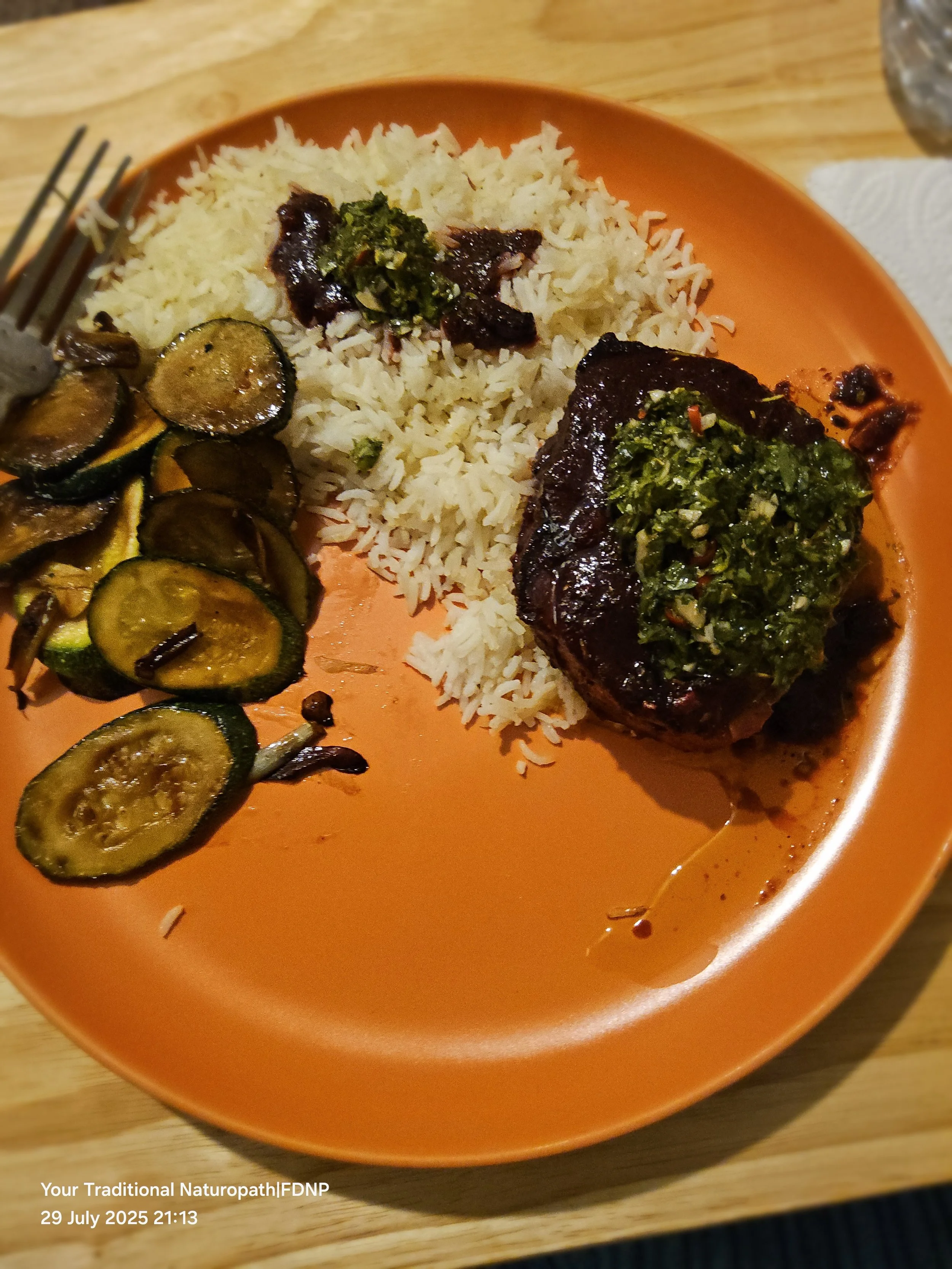
🍽️Herby Chimichurri Tofu Steak Plate
A Bold, Plant-Based “Steak Night” with Rice + Sautéed Courgette
This is giving “I wanted steak vibes, but make it plant-based, gut-loving, herbaceous, and grown-woman nourishing.” 😌🌿
Thick slabs of tofu are marinated, seared until beautifully glazed, then topped with fresh, zesty chimichurri. Serve with fluffy rice and sautéed courgette for a simple but satisfying plate.
⏱️ Time
Prep time: 15 minutes
Marinating time: 20–30 minutes
Cook time: 20 minutes
Total time: 55–65 minutes
For deeper flavour, marinate the tofu for 2–4 hours.
🛒 Ingredients
🧱 For the Tofu “Steaks”
1 block organic extra-firm tofu, pressed
2 tbsp tamari or coconut aminos
1 tbsp tomato paste
1 tbsp ACV vinegar
1 tbsp olive oil or avocado oil
1 tsp smoked paprika
1 tsp garlic powder
½ tsp onion powder
½ tsp dried thyme and oregano
¼ tsp black pepper
Pinch of cayenne or chilli flakes, optional
1–2 tsp maple syrup or date syrup, optional for caramelised edges
🌿 For the Chimichurri
1 packed cup fresh parsley, finely chopped
¼ cup fresh coriander/cilantro, optional
3 garlic cloves, finely minced
1 small red chilli, finely chopped, or ½ tsp chilli flakes
1 tbsp fresh oregano or 1 tsp dried oregano
2 tbsp red wine vinegar or apple cider vinegar
¼ cup extra virgin olive oil
Juice of ½ lemon
Salt and black pepper to taste
🍚 For Serving
1–2 cups cooked basmati rice or jasmine rice
1 courgette/zucchini, sliced
½ red onion, sliced
1–2 tsp olive oil
Pinch of salt, pepper, garlic powder, and smoked paprika
👩🏾🍳 Instructions
1. Press the tofu 🧱
Wrap the tofu in a clean towel and place something heavy on top for 15–20 minutes. This helps remove extra water so the tofu becomes firm, meaty, and able to soak up flavour.
2. Slice into “steaks” 🔪
Cut the tofu block into 2–4 thick slabs. Keep them chunky so they feel hearty on the plate.
3. Make the marinade 🍅
In a bowl, mix tamari, tomato paste, balsamic vinegar, oil, smoked paprika, garlic powder, onion powder, thyme, black pepper, and optional maple syrup.
Brush or spoon the marinade over the tofu steaks until fully coated.
4. Marinate 🌿
Let the tofu sit for 24 hours, or longer if you have time.
5. Cook the tofu steaks 🔥
Heat a skillet over medium heat with a little oil. Sear the tofu for 4–5 minutes per side, until dark, glossy, and caramelised around the edges.
For a deeper “steak-style” finish, spoon extra marinade over the tofu as it cooks.
6. Make the chimichurri 🌿
In a small bowl, mix parsley, coriander, garlic, chilli, oregano, vinegar, olive oil, lemon juice, salt, and pepper.
Let it sit for 24 to 48 hours so the flavours mingle like they are at a family reunion. 😅
7. Sauté the courgette 🥒
In a separate pan, cook sliced courgette and red onion with olive oil, fresh garlic, smoked paprika, salt, and pepper for 6–8 minutes, until golden and tender.
8. Plate it beautifully 🍽️
Add fluffy rice to the plate, place the tofu steak on the side or on top, spoon chimichurri generously over the tofu, and serve with the sautéed courgette.
🌿 Health Benefits of Each Main Ingredient
🧱 Organic Tofu
A rich plant-based protein source that contains iron, calcium if calcium-set, and isoflavones. It helps make the meal more satisfying and supports muscle maintenance, especially important in midlife.
🌿 Parsley
Packed with vitamin K, vitamin C, antioxidants, and natural plant compounds that support fresh flavour and nourishment. It also gives chimichurri that bright “wake up your tastebuds” energy.
🧄 Garlic
Contains sulfur compounds that support immune health, cardiovascular wellness, and liver-supportive pathways. Also, garlic makes almost everything taste like someone cared. Amen.
🌶️ Chilli
Adds heat and contains capsaicin, which may support circulation and metabolism. It also gives the dish a little personality — because bland food is not our ministry.
🍋 Lemon Juice
Provides vitamin C and bright acidity, which helps balance the richness of the tofu and oil. It also supports iron absorption from plant-based foods.
🫒 Extra Virgin Olive Oil
Rich in monounsaturated fats and polyphenols, supporting heart health and helping absorb fat-soluble nutrients from the herbs.
🍅 Tomato Paste
Adds depth, umami, and lycopene, an antioxidant associated with heart and cellular health.
🥒 Courgette / Zucchini
Hydrating, gentle, and easy to digest for many people. It provides fibre, potassium, and antioxidants while keeping the plate light but nourishing.
🧅 Red Onion
Contains prebiotic fibres and antioxidant compounds like quercetin, which support gut and immune health.
🍚 Rice
A comforting carbohydrate that provides energy and pairs beautifully with strong flavours. For more fibre and blood sugar support, you can use brown rice, wild rice, quinoa, or cauliflower rice mixed with basmati.
✨ Optional Upgrades
For extra protein: add edamame or lentils on the side.
For more minerals: sprinkle pumpkin seeds over the chimichurri.
For gut support: add a side salad with bitter greens like rocket/arugula.
For lower carb: swap half the rice for cauliflower rice.
For extra “steakhouse” flavour: add a touch of liquid smoke to the marinade.
🌺 Final Plate Vibe
This tofu steak is bold, herby, tangy, smoky, juicy, and deeply satisfying — the kind of plant-based meal that says:
“I nourish my body, but I still require flavour, beauty, and a little sauce with attitude.” 😌🌿
References
🌸 Perimenopause, Menopause & Hormonal Changes
NICE. Menopause: identification and management (NG23). https://www.nice.org.uk/guidance/ng23
NHS. Symptoms of menopause and perimenopause. https://www.nhs.uk/conditions/menopause-and-perimenopause/symptoms/
ACOG. The Menopause Years. https://www.acog.org/womens-health/faqs/the-menopause-years
The Menopause Society. Menopause Topics & Resources. https://menopause.org/patient-education/menopause-topics
🩺 Medical Dismissal, Menopause Education & Finding the Right Practitioner
Dintakurti, N., et al. An online survey and interview of GPs in the UK for assessing gaps in menopause education. Post Reproductive Health / PMC. https://pmc.ncbi.nlm.nih.gov/articles/PMC9500171/
British Menopause Society. For healthcare professionals and specialists in post reproductive health. https://thebms.org.uk/
British Menopause Society. Find a BMS-recognised Menopause Specialist. https://thebms.org.uk/find-a-menopause-specialist/
The Menopause Society. Choosing a Healthcare Practitioner. https://menopause.org/patient-education/choosing-a-healthcare-practitioner
UK Government. Shattering the Silence about Menopause: 12-month progress report. https://www.gov.uk/government/publications/shattering-the-silence-about-menopause-12-month-progress-report/shattering-the-silence-about-menopause-12-month-progress-report
The Guardian. Women don’t need menopause tea and “meno-friendly” nighties. They need doctors to take them seriously. https://www.theguardian.com/commentisfree/2026/may/31/women-dont-need-menopause-tea-and-meno-friendly-nighties-they-need-doctors-to-take-them-seriously
🧪 Testing, Baseline Markers & Appropriate Assessment
NICE. Menopause: identification and management — Recommendations. https://www.nice.org.uk/guidance/ng23/chapter/recommendations
Mayo Clinic. Menopause: Diagnosis and treatment. https://www.mayoclinic.org/diseases-conditions/menopause/diagnosis-treatment/drc-20353401
Mayo Clinic. Perimenopause: Diagnosis and treatment. https://www.mayoclinic.org/diseases-conditions/perimenopause/diagnosis-treatment/drc-20354671
NHS. Menopause and perimenopause. https://www.nhs.uk/conditions/menopause-and-perimenopause/
The Guardian. Private menopause tests risk undermining NHS care, doctors say. https://www.theguardian.com/society/2025/sep/07/private-menopause-tests-risk-undermining-nhs-care-doctors-say
🧠 Whole-Body Effects: Brain, Mood, Sleep & Nervous System
Santoro, N., et al. Menopausal Symptoms and Their Management. Endocrinology and Metabolism Clinics of North America / PMC. https://pmc.ncbi.nlm.nih.gov/articles/PMC4890704/
Gava, G., et al. Cognition, Mood and Sleep in Menopausal Transition. Medicina. https://www.mdpi.com/1648-9144/55/10/668
SWAN Study. Depression in Women — From Midlife and Across the Menopause Transition. https://www.swanstudy.org/wps/wp-content/uploads/2023/04/SWAN-Fact-Sheets-Depression.pdf
ACOG. Mood Changes During Perimenopause Are Real. Here’s What to Know. https://www.acog.org/womens-health/experts-and-stories/the-latest/mood-changes-during-perimenopause-are-real-heres-what-to-know
🌿 Estrogen Receptors & Whole-Body Physiology
Chen, P., et al. Role of estrogen receptors in health and disease. Frontiers in Endocrinology / PMC. https://pmc.ncbi.nlm.nih.gov/articles/PMC9433670/
Hamilton, K. J., et al. Estrogen Hormone Biology. Current Topics in Developmental Biology / PMC. https://pmc.ncbi.nlm.nih.gov/articles/PMC6206851/
Chen, C., et al. The roles of estrogen and estrogen receptors in gastrointestinal disease. Oncology Letters / PMC. https://pmc.ncbi.nlm.nih.gov/articles/PMC6865762/
Rettberg, J. R., et al. Estrogen: A master regulator of bioenergetic systems in the brain and body. Frontiers in Neuroendocrinology / PMC. https://pmc.ncbi.nlm.nih.gov/articles/PMC4024050/
🔥 Metabolic Health, Blood Sugar, Cardiometabolic Risk & Midlife Changes
Stachowiak, G., et al. Metabolic disorders in menopause. Przeglad Menopauzalny / PMC. https://pmc.ncbi.nlm.nih.gov/articles/PMC4440199/
Shufelt, C., et al. Cardiometabolic changes in the menopause transition. Circulation Research / PMC. https://pmc.ncbi.nlm.nih.gov/articles/PMC13105580/
National Academies. Women’s Cardiovascular Health at Midlife. https://www.nationalacademies.org/cdn/materials/9fba0e71-de6d-4636-b559-05b4c4b2f444
The Menopause Society. Menopause and Heart Health. https://menopause.org/patient-education/menopause-topics/menopause-and-heart-health
💊 Hormone Therapy, Options & Individualised Care
The Menopause Society. Position Statements. https://menopause.org/professional-resources/position-statements
The Menopause Society. The 2022 Hormone Therapy Position Statement. https://journals.lww.com/menopausejournal/fulltext/2022/07000/the_2022_hormone_therapy_position_statement_of_the.4.aspx
ACOG. Hormone Therapy for Menopause. https://www.acog.org/womens-health/faqs/hormone-therapy-for-menopause
British Menopause Society. NICE Guideline: Menopause identification and management. https://thebms.org.uk/publications/nice-guideline/
🌱 Faith-Aligned Lifestyle Context: Stewardship, Rest & Whole-Person Health
Ellen G. White. The Ministry of Healing. https://media3.egwwritings.org/pdf/en_MH.pdf
Ellen G. White Writings. With Nature and With God. https://m.egwwritings.org/en/book/135.1344
Ellen G. White Writings. The Use of Remedies. https://m.egwwritings.org/en/book/135.1478
Adventist Health Ministries. Health Ministries resources. https://www.healthministries.com/
NEWSTART. NEWSTART Lifestyle Principles. https://newstart.com/
Blog Disclaimer
The health information on this blog is for general educational purposes only and is not intended to diagnose, treat, cure, or prevent any disease. It should not be used as a substitute for professional medical advice. Always consult a qualified healthcare provider before making any health-related decisions
This blog may contain affiliate links, meaning Leaves from the Tree of Life LLC may earn a small commission if you purchase a product or service through these links—at no additional cost to you. Your support helps us continue to provide valuable content. Thank you!
