
Perimenopause & Flight Edema: Why Long-Haul Travel can Causes Swelling + Root Cause Solutions
🛫🧳💦 Why Do My Ankles Swell When I Fly? Perimenopause, Hormones & the Bigger Picture
You packed the magnesium.
You wore the comfy shoes.
You avoided airport fries.
And yet… you land looking like your ankles signed a fluid-retention contract at 35,000 feet.
If you’re in perimenopause and experiencing swelling during long-haul travel, this is not random. It’s not vanity. And it’s definitely not “just aging.”
It’s physiology.
And if you’ve been Googling, DuckDuckGo-ing, scrolling Reddit threads, or reading half-helpful blog posts that leave you thinking, “Something is missing…” — you’re right.
Let’s fill in the missing pieces.
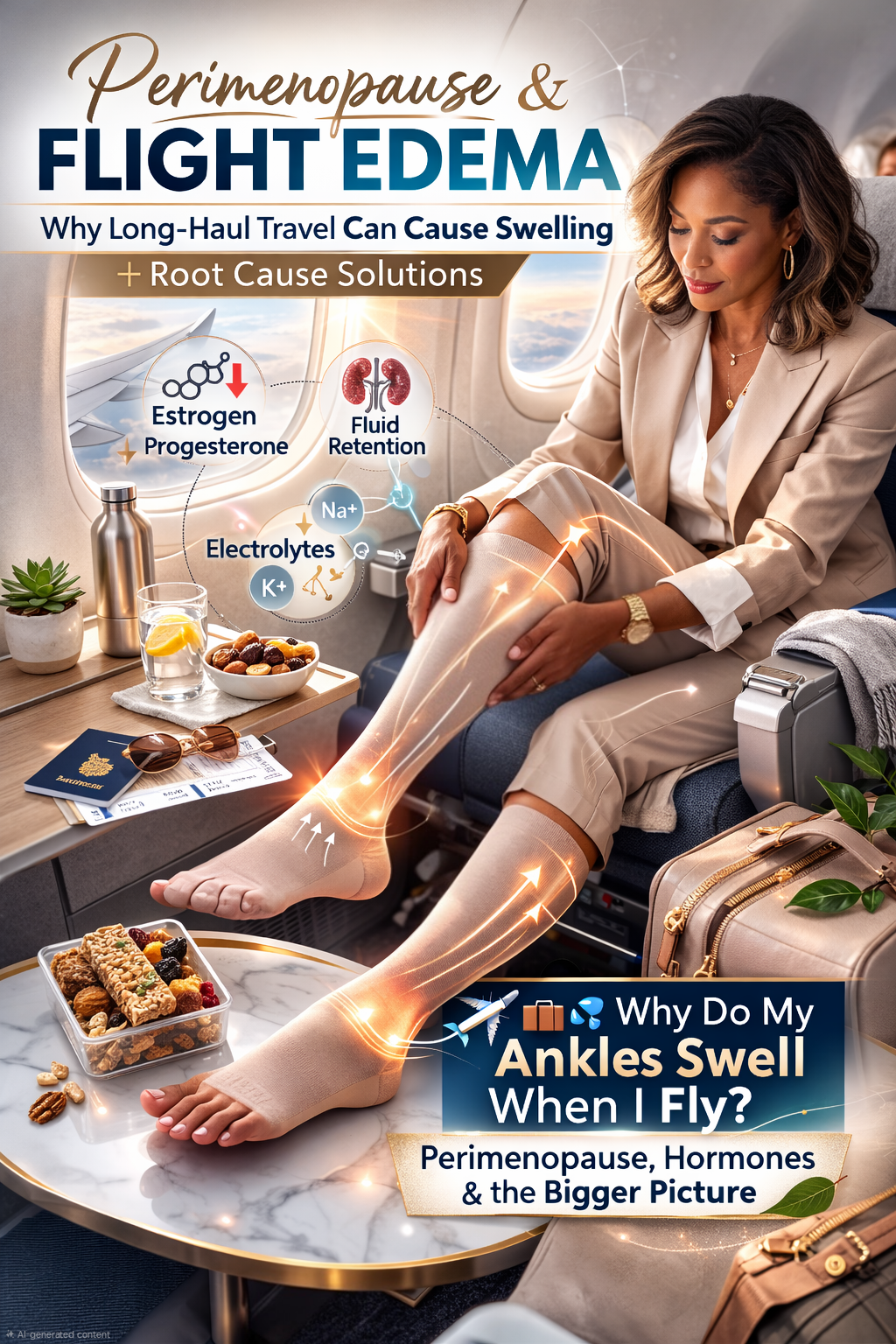
🧬🌊 Hormones & Fluid: The Perimenopause Connection
During perimenopause, estrogen and progesterone fluctuate — sometimes dramatically and unpredictably.
Estrogen influences:
Vascular elasticity
Sodium retention
Kidney signaling
Inflammatory tone
Progesterone has a mild natural diuretic effect. When progesterone drops relative to estrogen (a common perimenopause pattern), fluid retention can increase.
Now combine that with:
8–11 hours of immobility
Cabin pressure changes
Dehydration
Recycled air
Salty snacks
You’ve created the perfect environment for lower leg fluid pooling.
But here’s the deeper layer.
🔬⚠️ When It’s Not Just Mechanical: Enter Metabolic Chaos®
If your swelling feels excessive, lingers, or seems disproportionate, we zoom out.
In Functional Diagnostic Nutrition®, we look for patterns — what I call healing opportunities — not just symptoms.
Flight edema becomes more likely when underlying stressors exist:
🩸 Iron Deficiency Anemia
Low iron reduces oxygen delivery. The heart compensates. Circulatory efficiency shifts. Under stress (like long travel), fluid distribution can be affected.
🧫 Gut Dysfunction
Poor protein digestion can reduce albumin production. Albumin is a protein that keeps fluid inside blood vessels. Low albumin = fluid leaks into tissues.
Increased intestinal permeability (“leaky gut”) increases systemic inflammation, which affects capillary integrity.
🧂 Mineral & Electrolyte Imbalance
Sodium-potassium-magnesium balance regulates fluid distribution.
Hormonal shifts can alter this balance. Dehydration worsens it.
🫘 Kidney Stress
Estrogen influences the renin-angiotensin-aldosterone system — your body’s fluid regulation command center.
If kidneys are already strained, long flights amplify retention.
🍰 Blood Sugar Instability
Insulin promotes sodium retention.
Inflammation from glucose swings increases vascular permeability.
This is what metabolic chaos® looks like in real life — not abstract theory, but ankles that feel tight in your shoes.
🛫✨ Pre-Flight Protocol: Prepare the Terrain
If you know you’re flying, don’t leave your physiology to chance.
💧 Hydrate Strategically (48 Hours Before)
Increase water intake gradually.
Add trace minerals if testing supports it.
🍳 Prioritize Protein
Stable blood sugar and adequate albumin support matter.
👣 Lymphatic Priming
10–15 minutes on a vibration plate
Light rebounding
Brisk walking
The lymphatic system needs movement to flow.
🧦 Compression Socks
Graduated compression supports venous return and reduces pooling.
🌿 Targeted Support (If Appropriate)
CellCore KL-Support is often used in functional protocols to support kidney and lymphatic pathways. This is not casual supplementation — it should be guided by labs and practitioner oversight.
🚫 Avoid Excess Salt, Sugar & Alcohol
We’ll explain why in a moment — but think of this as reducing inflammatory inputs before stress.
✈️💺👣 In-Flight Strategy: Don’t Marinate in One Position
Stand every 60–90 minutes
Perform ankle pumps and calf raises
Hydrate (yes, bathroom trips are bonus movement)
Avoid crossing legs
Your calves are your second heart. Let them do their job.
🌿🌅 Post-Flight Reset: Restore the Flow
Landing isn’t the finish line. It’s recalibration time.
🚶🏾♀️ 1. Walk Before You Sit
20–30 minutes of walking reactivates venous return and reduces pooling.
🛋️ 2. Elevate Legs
Elevate above heart level for 15–20 minutes to assist redistribution.
🧦 3. Continue Compression (Short-Term)
If swelling is significant, keep compression socks on for several hours post-flight.
Supports capillary integrity
Reduces venous distention
Limits further fluid leakage
Think of it as vascular scaffolding while your system stabilizes.
🔥 4. Gentle Sweating
Infrared sauna or a warm bath supports circulation and detox pathways.
Hydrate before and after.
Sweating without rehydration makes swelling worse. Strategy matters.
🧂 5. Mineral Repletion (Data-Driven)
Flying disrupts electrolyte balance.
HTMA and functional blood chemistry can guide targeted repletion.
Potassium and magnesium support vascular tone.
Excess sodium promotes retention.
Balance — not extremes — is the goal.
🧴 6. Lymphatic Support
Dry brushing or vibration plate sessions encourage lymph flow.
The lymphatic system has no central pump. It relies on muscle contraction. A vibration plate provides rhythmic stimulation that helps move stagnant fluid.
🌿 Supplement Support (When Labs Support It)
🟢 CellCore KL-Support
Supports kidney and lymphatic pathways.
Helpful when renal signaling or fluid handling patterns are stressed.
🟢 Designs for Health Inflammatone™ (When Inflammation Is a Factor)
Depending on your individual findings, targeted support may include formulations such as Designs for Health Inflammatone™, which is often used in functional protocols to help modulate inflammatory pathways.
Why does this matter in the context of flight edema?
The liver produces albumin — a protein that helps keep fluid inside blood vessels. If albumin levels are suboptimal, fluid is more likely to shift into surrounding tissues.
Oxidative stress can weaken vascular integrity, making capillaries more prone to leakage.)
Insulin spikes promote sodium retention, which encourages fluid accumulation.
Inflammatory signaling intersects with all three of these systems — liver function, vascular tone, and metabolic regulation.
However, supplementation should never be random or trend-driven. What looks like “swelling” may be hormonal, mineral, renal, inflammatory, or circulatory in origin.
Supplements without testing are guesswork.
With appropriate testing, they become targeted tools supporting the body’s innate ability to restore balance.
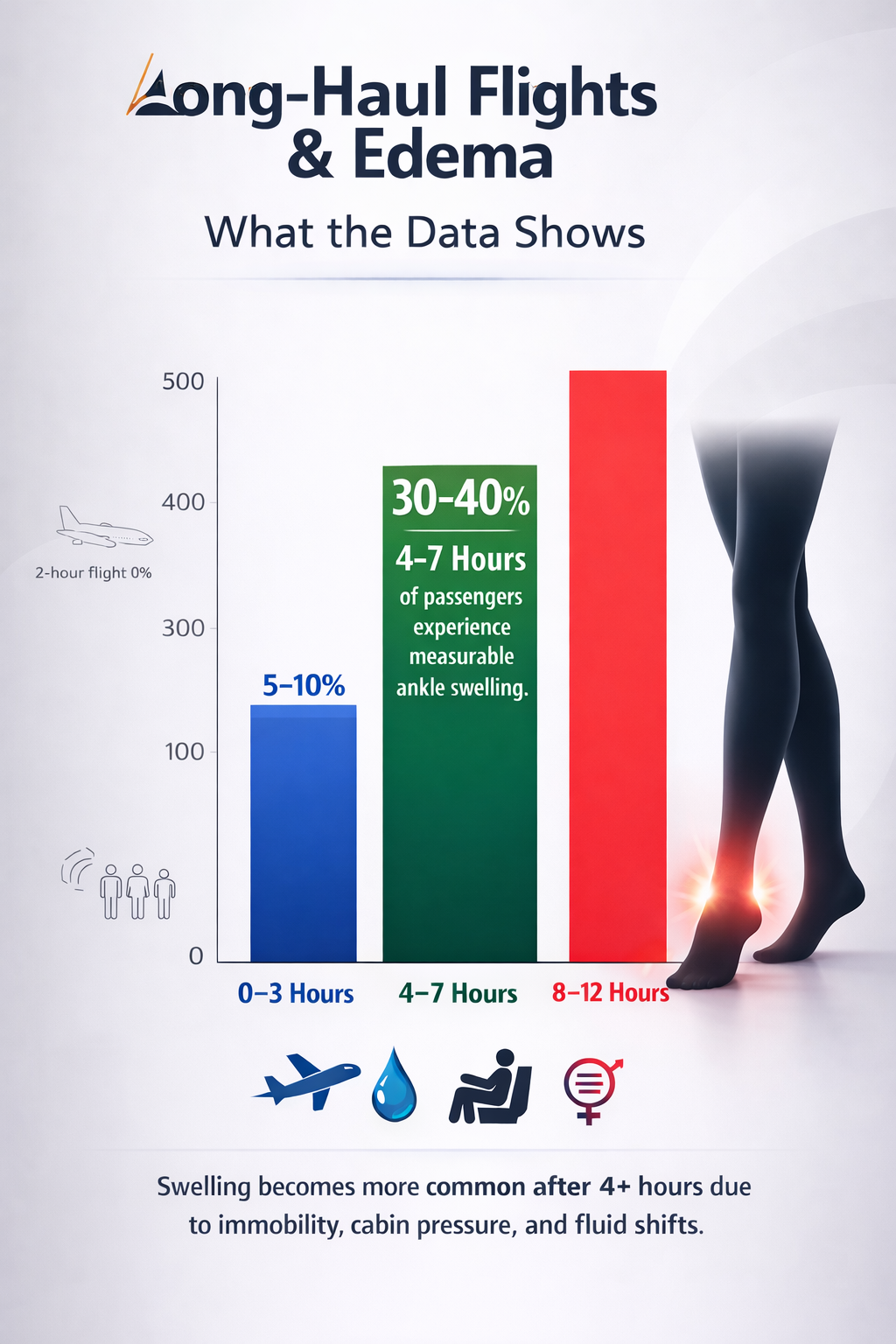
🔬 Fun Fact Science Bar+
Did you know that mild lower-leg swelling during long-haul flights (typically defined as 4+ hours) is extremely common? Studies suggest that up to 30–40% of healthy passengers experience measurable ankle swelling after long-distance air travel — even if they don’t notice it visually. In flights longer than 8–10 hours, fluid volume in the lower legs can increase by several hundred milliliters due to prolonged sitting, cabin pressure changes, and reduced calf muscle activity.
Women — particularly those in midlife hormonal transition — may experience more noticeable swelling due to estrogen’s influence on vascular tone and sodium handling.
👉🏾 Translation: If your ankles feel tighter after flying, it doesn’t automatically mean something is “wrong.” It means gravity + inactivity + cabin pressure + fluid shifts are doing what physics and physiology do. In Functional Diagnostic Nutrition® language, if underlying mineral imbalance, inflammation, or metabolic chaos® already exist, that normal fluid shift can become exaggerated.
✨ Healing Opportunity: Wear graduated compression socks on flights longer than 4 hours, stand or walk every 60–90 minutes, hydrate consistently (not just coffee and sparkling water), and support lymphatic flow before and after travel. If swelling is dramatic, persistent, or accompanied by pain, test and investigate — don’t dismiss.
✝️ Faith Element: Even travel reminds us we are embodied beings. Movement, hydration, rhythm, and rest are not luxuries — they are stewardship principles. “Temperance” includes how we travel, how we move, and how we care for the body-temple in every season. 🙌🏾
🚫 Why Avoid Alcohol, Sugar & Excess Salt After Flying?
🍷 Alcohol
Dehydrates
Disrupts fluid-regulating hormones
Increases inflammatory signaling
Causes rebound retention
🍰 Sugar
Triggers insulin spikes
Insulin promotes sodium retention
Increases capillary permeability
🧂 Excess Salt
Promotes water retention
Increases blood volume
Stresses kidneys recalibrating from dehydration
You’ve just stressed your circulatory system. Don’t add fuel to the fire.
🧪 Test, Don’t Guess: Because You’re Not “Overthinking”
If swelling is frequent or disproportionate, investigate.
Functional testing options include:
Functional Blood Chemistry Analysis (FBCA)
HTMA (Hair Tissue Mineral Analysis)
Hormone Panels
DNA Testing
GI-MAP (stool testing)
MRT Food Sensitivity Testing
These tests reveal patterns behind fluid retention — iron status, protein markers, kidney trends, mineral ratios, inflammatory load.
Edema is not the problem. It’s the clue.
🙏🏾🌿 A Faith-Based Perspective
Our bodies are temples. Stewardship requires wisdom, not panic.
Long flights disrupt rhythm — movement, hydration, rest.
Even Sabbath teaches rhythm. Work. Rest. Restore.
Swelling is not betrayal. It’s communication.
When we reduce metabolic chaos® and support the terrain intelligently, the body often responds beautifully.
That is not hype.
That is physiology functioning as designed.
🌸📞 Final Word: You Came Here Because Something Felt Incomplete
If you’ve been searching and sensing that surface-level advice isn’t enough, you’re right.
Mechanical factors matter.
Hormones matter.
Minerals matter.
Metabolic patterns matter.
Layered issues require layered insight.
If you’re ready to stop guessing and start understanding your unique physiology, connect with a practitioner trained in functional testing and targeted supplementation.
And if you’d like deeper, sustainable support — not just travel hacks but a true root-cause strategy — I offer consultations designed to help you interpret your labs, identify patterns, and create a personalized plan that works with your body, not against it.
Because your body isn’t dramatic.
It’s data-rich.
And when we listen carefully — with science, discernment, and faith — we often uncover profound healing opportunities.
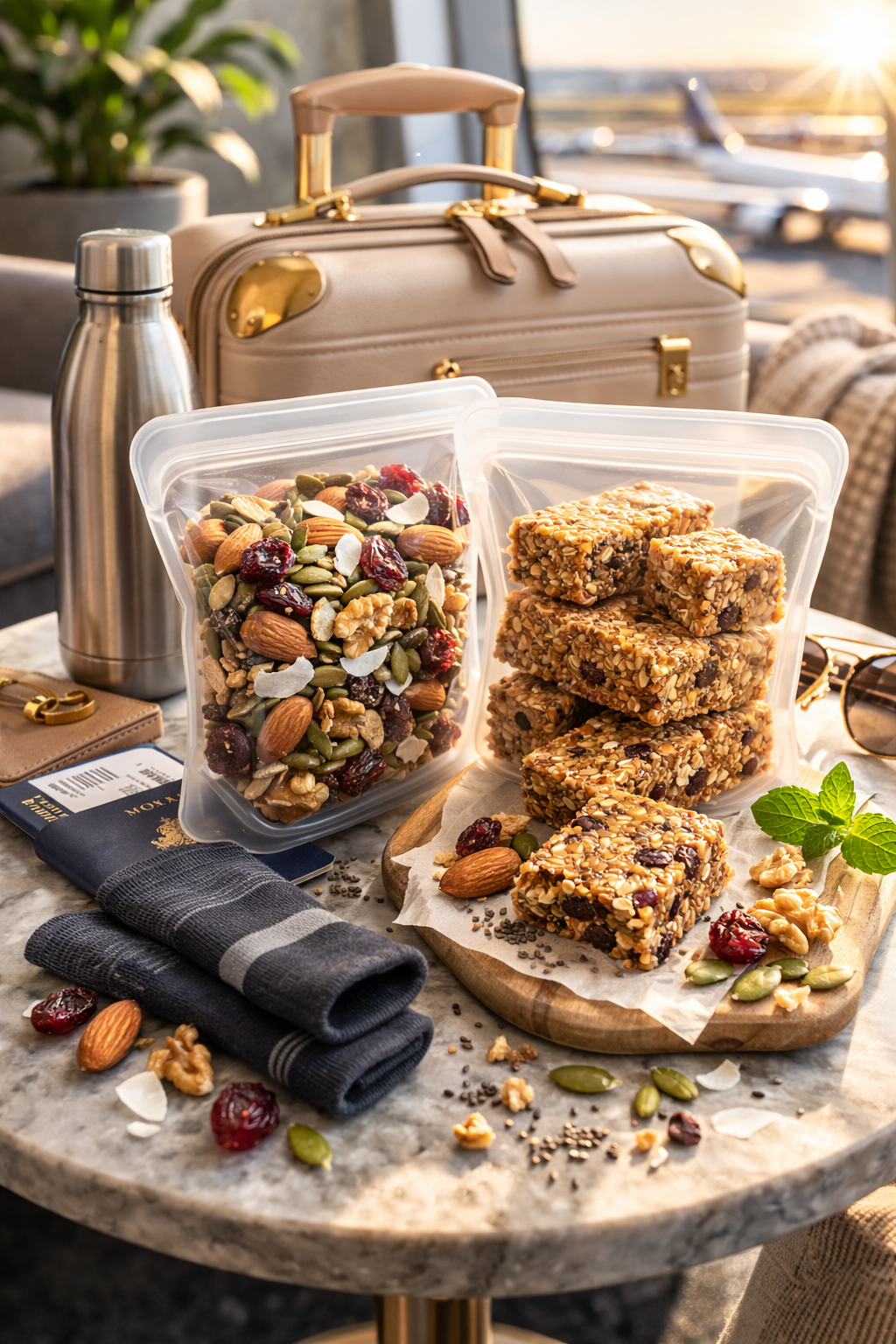
Travel Snacks 🥜 😋
🛫🥜💧 Recipe #1: “Carry-On Calm” Anti-Edema Trail Mix
Makes: ~8 servings (¼ cup each)
Time: 10 minutes
Shelf life: 3–4 weeks (airtight jar, cool/dry place)
✅ Why this works for flying
This mix prioritizes magnesium + potassium + polyphenols + fiber + protein while avoiding the classic airport trap: salt + sugar overload that encourages water retention.
🧺 Ingredients
🥜 1 cup raw unsalted almonds
🌰 1 cup raw unsalted walnuts (or pecans)
🎃 ¾ cup pumpkin seeds (pepitas)
🌻 ½ cup sunflower seeds
🥥 ½ cup unsweetened coconut flakes (optional but delicious)
🍇 ½ cup dried tart cherries or raisins (choose unsweetened if possible)
🍫 ⅓ cup cacao nibs (or very dark chocolate chips)
🧂 ½ tsp cinnamon
🍊 Optional: 1 tsp orange zest (dry zest works too)
👩🏽🍳 Step-by-step
🫙 Add all ingredients to a large bowl.
🌀 Sprinkle cinnamon (and orange zest if using).
🥄 Toss well until everything is evenly coated.
📦 Store in an airtight jar or snack bags.
✈️ Pack in portions (¼ cup) so you’re not free-pouring trail mix like it’s a hobby.
🌿 Benefits of each ingredient (quick + useful)
🥜 Almonds: magnesium for muscle/vascular support + protein for steadier blood sugar
🌰 Walnuts: omega-3 fats that support healthy inflammatory balance
🎃 Pumpkin seeds: magnesium + zinc (support stress resilience + fluid balance)
🌻 Sunflower seeds: vitamin E (antioxidant support for vascular integrity)
🍇 Tart cherries/raisins: potassium + polyphenols (help counter salty travel foods)
🍫 Cacao nibs: polyphenols that support circulation + mood (hello, airport patience)
🧂 Cinnamon: supports glucose stability—less insulin spike, less sodium retention tendency
🛫🍫💪🏽 Recipe #2: “Pressure-Proof” No-Bake Protein Bars (Low-Salt, Low-Fuss)
Makes: 10–12 bars
Time: 15 minutes + 1–2 hours set time
Shelf life:
7 days room temp (cool place, wrapped)
2–3 weeks in fridge
2–3 months freezer (best texture)
These are perfect for flights because they’re compact, not messy, and give you that “I brought my own sanity” feeling.
🧺 Ingredients
🥜 1 cup almond butter (or mixed nut butter)
🌾 1½ cups rolled oats (gluten-free if needed)
💪🏽 ½ cup protein powder (plain or vanilla; choose what you tolerate)
🌱 2 tbsp chia seeds
🌿 2 tbsp ground flaxseed
🍌 ½ cup mashed banana or ⅓ cup unsweetened applesauce
🍯 2 tbsp honey (optional—skip if very sugar-sensitive)
🧂 1 tsp cinnamon
🍫 2 tbsp cacao powder (optional but elite)
💧 2–6 tbsp water (as needed for texture)
🥥 Optional: ¼ cup unsweetened shredded coconut
👩🏽🍳 Step-by-step
🥣 In a bowl, mix oats + protein powder + chia + flax + cinnamon (and cacao if using).
🥄 Stir in almond butter + banana/applesauce (and honey if using).
💧 Add water 1 tbsp at a time until it becomes thick, pressable “dough.”
📦 Press into a lined loaf pan (or flatten into a rectangle on parchment).
❄️ Chill 1–2 hours until firm.
🔪 Slice into bars. Wrap individually for travel.
🌿 Benefits of each ingredient
🥜 Almond butter: magnesium + steady fats for stable energy
🌾 Oats: fiber supports gut motility (travel constipation = fluid drama’s best friend)
💪🏽 Protein powder: helps prevent blood sugar spikes that can worsen retention signals
🌱 Chia: gel-forming fiber supports hydration balance + digestion
🌿 Flax: supports healthy estrogen metabolism + anti-inflammatory fats
🍌 Banana / applesauce: potassium support + binding without needing baking
🧂 Cinnamon: helps smooth glucose response
🍫 Cacao: circulation-supportive polyphenols + mood support
✈️🧳 Plane-Snack Pro Tips (so TSA and your seatmate both approve)
✅ Keep portions in clear snack bags or a small container
✅ Avoid anything liquid >100ml (nut butter packets can be flagged as “liquid/gel”)
✅ Keep it unsalted and let your minerals come from whole foods, not sodium bombs
✅ Pair with water (not wine + pretzels… that’s how ankles file a complaint)
📚 References
✈️🦵🏽 Air Travel, Venous Pooling & Edema
Scurr et al., 2001 — Frequency and prevention of symptomless deep-vein thrombosis in long-haul flights
(Lancet – immobility, long flights, venous changes)
👉🏾 https://pubmed.ncbi.nlm.nih.gov/11597669/
Hagan et al., 2018 — The association between air travel and venous thromboembolism
(Journal of Travel Medicine – prolonged immobility effects)
👉🏾 https://academic.oup.com/jtm/article/25/1/tay010/4792443
Cleveland Clinic — Why do ankles swell on airplanes?
(Explains gravity, immobility, cabin pressure, fluid pooling)
👉🏾 https://health.clevelandclinic.org/ankle-swelling-after-flight/
Mayo Clinic — Leg swelling: Causes
(Explains dependent edema and prolonged sitting)
👉🏾 https://www.mayoclinic.org/symptoms/leg-swelling/basics/causes/sym-20050910
🌸💧 Estrogen, Hormones & Fluid Retention
Stachenfeld, 2008 — Sex hormone effects on body fluid regulation
(Exercise and Sport Sciences Reviews – estrogen, progesterone, sodium regulation)
👉🏾 https://pubmed.ncbi.nlm.nih.gov/18461095/
Charkoudian & Joyner, 2004 — Physiologic considerations for exercise in women
(Effects of estrogen on vascular tone and fluid balance)
👉🏾 https://pubmed.ncbi.nlm.nih.gov/14704244/
British Menopause Society — What is the Menopause?
(Discusses hormonal fluctuations and systemic symptoms)
👉🏾 https://thebms.org.uk/wp-content/uploads/2023/08/17-BMS-TfC-What-is-the-menopause-AUGUST2023-A.pdf
🧂⚖️ Kidney Function, Electrolytes & Fluid Balance
Hall, 2015 — Guyton & Hall Textbook of Medical Physiology (Renin-Angiotensin-Aldosterone System overview via NCBI)
(Explains RAAS and sodium-water regulation)
👉🏾 https://www.ncbi.nlm.nih.gov/books/NBK470410/
NIH — Fluid and Electrolyte Balance
(Overview of sodium, potassium, and fluid shifts)
👉🏾 https://www.ncbi.nlm.nih.gov/books/NBK507807/
National Kidney Foundation — How kidneys regulate fluid balance
👉🏾 https://www.kidney.org/atoz/content/howkidneyswork
🩸🫘 Protein, Albumin & Edema
MedlinePlus — Low albumin
(Explains how low albumin contributes to swelling)
👉🏾 https://medlineplus.gov/lab-tests/albumin-blood-test/
Levitt & Levitt, 2016 — Human serum albumin homeostasis
(Comprehensive review of albumin’s role in fluid balance)
👉🏾 https://pubmed.ncbi.nlm.nih.gov/26764093/
🧪🔥 Inflammation, Insulin & Sodium Retention
DeFronzo et al., 2015 — Insulin resistance and its implications
(Insulin’s effect on sodium retention and vascular changes)
👉🏾 https://pubmed.ncbi.nlm.nih.gov/25456690/
NIH — Hyperinsulinemia and sodium retention
👉🏾 https://pubmed.ncbi.nlm.nih.gov/3880295/
🧦🚶🏾♀️ Compression & Movement in Travel
Clarke et al., 2016 — Compression stockings for preventing deep vein thrombosis in airline passengers
(Cochrane Review)
👉🏾 https://www.cochranelibrary.com/cdsr/doi/10.1002/14651858.CD004002.pub3/full
Centers for Disease Control and Prevention (CDC) — Blood clots and travel
(Recommendations for movement and prevention)
👉🏾 https://wwwnc.cdc.gov/travel/page/dvt
🧠🌿 Lifestyle, Circulation & Rhythm
Harvard Health Publishing — Edema: Why it happens and what to do
👉🏾 https://www.health.harvard.edu/heart-health/edema-why-it-happens-and-what-to-do
Adventist Health Studies — Lifestyle and longevity
👉🏾 https://adventisthealthstudy.org/studies
Blog Disclaimer
The health information on this blog is for general educational purposes only and is not intended to diagnose, treat, cure, or prevent any disease. It should not be used as a substitute for professional medical advice. Always consult a qualified healthcare provider before making any health-related decisions
This blog may contain affiliate links, meaning Leaves from the Tree of Life LLC may earn a small commission if you purchase a product or service through these links—at no additional cost to you. Your support helps us continue to provide valuable content. Thank you!
