
Vaginal Microbiome & Perimenopause: Why It Changes + Functional Testing Guide
🌸 Your Vaginal Microbiome in Perimenopause: What Google Didn’t Fully Explain
You’ve been searching.
“Why do I keep getting BV?”
“Why does intimacy suddenly feel different?”
“Why am I dry, irritated, or prone to UTIs?”
You’re not crazy. You’re not dirty. And you’re definitely not alone.
Perimenopause is not just about hot flashes and mood swings. It’s a full-body transition — including your vaginal ecosystem. And if no one told you that your microbiome shifts during this phase, that’s a massive gap in education.
Let’s close it.
As a Traditional Naturopath and Functional Diagnostic Nutrition® Practitioner, I see this often. Women come in thinking something is “wrong” with them — when in reality, their body is transitioning. Understanding that transition turns panic into power.
🦠 The Vaginal Microbiome 101 (But Make It Midlife)
Your vaginal microbiome is a community of bacteria — primarily Lactobacillus species — that keep the environment slightly acidic (low pH). That acidity protects you from infections.
Enter estrogen.
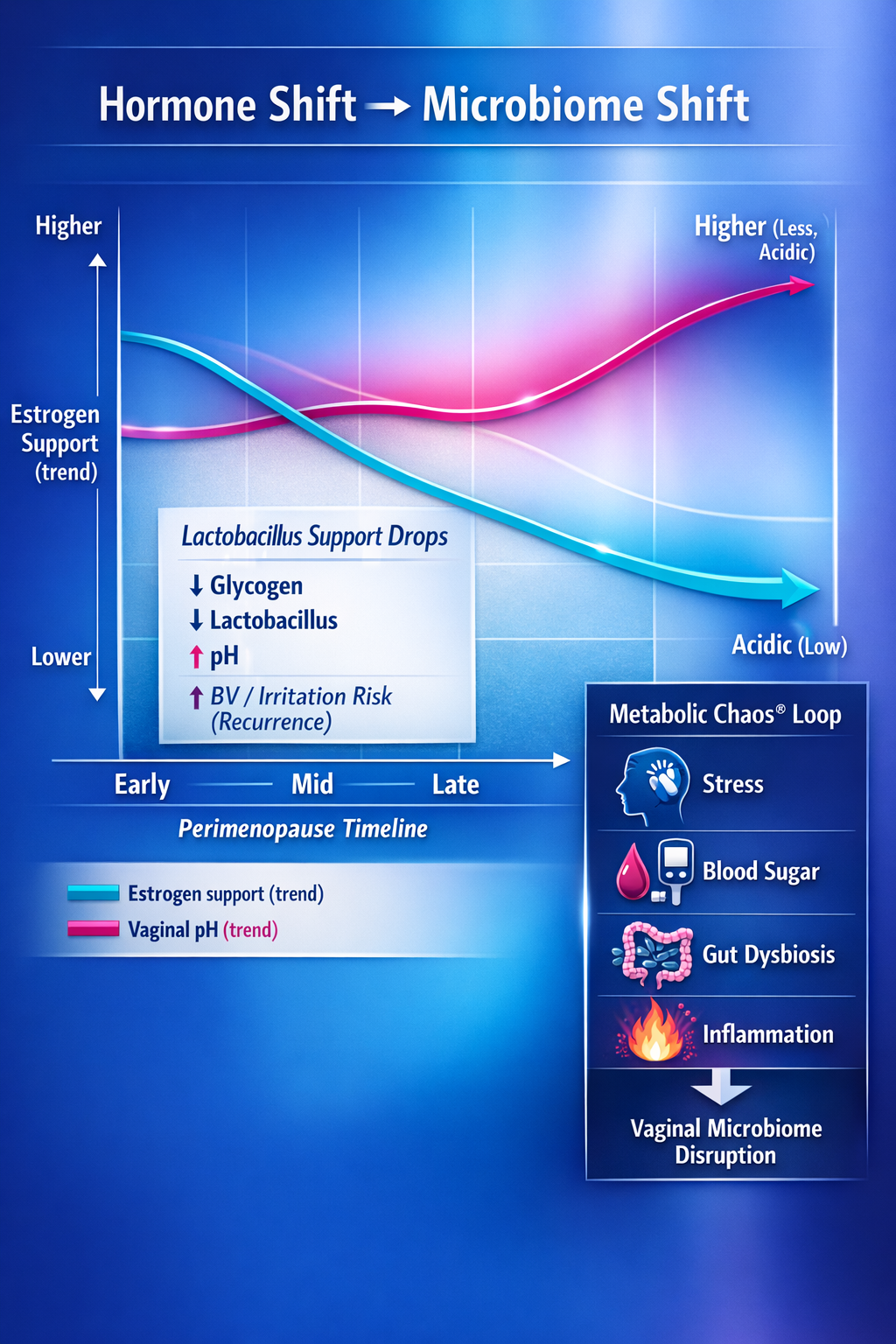
Estrogen helps maintain glycogen in vaginal tissues. Glycogen feeds beneficial bacteria. Beneficial bacteria maintain acidity. Acidity protects you.
When estrogen fluctuates (and eventually declines) during perimenopause:
• Glycogen decreases
• Lactobacillus populations can drop
• Vaginal pH rises
• Opportunistic microbes can overgrow
That’s when recurring BV, yeast, dryness, irritation, or UTIs start knocking like uninvited guests.
This is not random. It’s physiology.
And when this local shift combines with stress, blood sugar dysregulation, gut imbalance, poor sleep, or inflammatory foods — welcome to a Metabolic Chaos® loop.
Everything is connected.
🔬 Why “Test, Don’t Guess” Matters More Than Ever
You can absolutely implement supportive strategies. But if symptoms are recurring, persistent, or confusing, testing is wisdom — not weakness.
Functional testing helps you understand why your terrain is shifting.
In my practice, we may look at:
• Functional Blood Chemistry Analysis – patterns of inflammation, blood sugar imbalance, nutrient insufficiencies
• DNA Hormones, DNA Mind, DNA Gut – genetic predispositions affecting estrogen metabolism, detox pathways, stress resilience, and microbiome tendencies
• GI-MAP – gut pathogens, dysbiosis, immune markers
• DUTCH test – estrogen metabolites, cortisol rhythm, androgen balance
• Fluids IQ Permeability + Inflammation – intestinal barrier and systemic inflammation
• MRT Food Sensitivity Test – inflammatory food triggers affecting mucosal tissues
When we understand the internal terrain, we stop throwing supplements at symptoms and start building strategy.
This isn’t fear-based. It’s stewardship.
🌿 Supportive Strategies You Can Implement Now
Even before full testing, there are intelligent tools that can support your body — especially when symptoms are mild, cyclical, or clearly linked to hormonal shifts.
These are not “miracle cures.” They’re strategic supports.
🔬 Fun Fact Science Bar+
Did you know that estrogen helps keep the vaginal environment acidic and protected by supporting glycogen in vaginal tissues—basically “fuel” that feeds beneficial Lactobacillus bacteria? During perimenopause, as estrogen fluctuates and trends downward, vaginal glycogen can drop, Lactobacillus levels may decline, and vaginal pH can rise (becoming less acidic). That shift can make recurring issues like BV-like symptoms, irritation, dryness, and UTIs feel way more common—and way more annoying.
👉🏾 Translation: That “why does my vagina suddenly hate me?” moment isn’t you being dramatic—it’s your hormones, microbes, and mucosal tissues renegotiating their relationship. In Functional Diagnostic Nutrition® language, this can be part of a Metabolic Chaos® loop, where stress + inflammation + blood sugar swings + gut dysbiosis can spill over into pelvic and vaginal microbiome imbalance.
✨ Healing Opportunity: Support the ecosystem, not just the symptom. Prioritize blood sugar stability (protein + fiber at meals), stress downshifts (nervous system care), and consider targeted vaginal microbiome support (strain-specific probiotics) plus pelvic tissue support (like red/near-infrared light therapy) to encourage healthier tissue resilience and circulation. And if things keep recurring? Test, don’t guess—because precision beats panic every time.
✝️ Faith Element: Perimenopause isn’t a personal failure—it’s a transition. Practise stewardship with compassion: your body is still God’s workmanship, even when it’s being a little… extra. 🙃 Ask for wisdom (James 1:5), and choose practical steps—rest, nourishment, and informed support—as an act of honoring the body-temple you’ve been entrusted with. 🙏🏽
🦠 Restore the Microbial Balance
Microbiome Labs Vaginal Balance
When estrogen drops, beneficial Lactobacillus species often decline. As pH rises, opportunistic microbes gain ground.
Microbiome Labs Vaginal Balance contains clinically researched probiotic strains selected specifically for vaginal flora support — and that specificity matters.
Targeted vaginal strains may help:
• Support healthy vaginal pH
• Encourage recolonization of beneficial bacteria
• Reduce recurrence risk of bacterial imbalance
• Support urinary tract resilience
• Modulate mucosal immune response
What many women don’t realize is this: the gut and vaginal microbiomes communicate. Gut dysbiosis can reseed the vaginal environment.
That’s why probiotic support works best when paired with blood sugar regulation, inflammation reduction, and gut integrity work.
Support the microbes. Support the terrain.
You can access practitioner-grade support here:
👉🏾 https://us.fullscript.com/welcome/leavesfromthetreeoflife
🔴 Support Pelvic Tissue at the Cellular Level
Fringe Light Therapy Wand
Now let’s talk mitochondria — your cellular power plants.
The Fringe Light Therapy Wand uses red and near-infrared light therapy (photobiomodulation). These wavelengths penetrate tissue and stimulate mitochondrial ATP production — cellular energy.
When energy improves, tissues function better.
In the pelvic region, this may support:
• Improved circulation
• Healthier collagen and elastin production
• Improved tissue tone and elasticity
• Reduction in mild dryness and discomfort
• Enhanced cellular resilience during estrogen decline
Perimenopause can thin vaginal tissue due to lower estrogen. Supporting circulation and cellular energy can be especially helpful for women seeking non-hormonal adjunct options.
This isn’t cosmetic marketing.
This is cellular physiology.
Light therapy has been studied for wound healing, inflammation modulation, and tissue repair. When applied appropriately, it becomes a powerful adjunct in pelvic wellness protocols.
View the pelvic wand here:
👉🏾 https://leavesfromthetreeoflife.fdnstores.com/light-therapy-pelvic-wand.html
🥗 Blood Sugar + Stress Regulation
Vaginal health is not isolated from your nervous system.
Elevated cortisol and unstable glucose disrupt immune signaling and microbiome balance.
That’s why we address:
• Protein-forward meals
• Fiber intake
• Anti-inflammatory fats
• Sleep hygiene
• Gentle movement
• Sabbath-style rest rhythms
Rest is not laziness. It’s biological obedience.
💛 Compassion During the Transition
Perimenopause is not a malfunction. It’s a design shift.
Scripture reminds us we are “fearfully and wonderfully made.” That includes transitions.
When we understand physiology, we respond with curiosity instead of shame.
Men in your life need to understand this too. Vaginal dryness, irritation, mood shifts — these are biochemical changes. Education builds empathy.
When couples understand the terrain, intimacy becomes a conversation, not a battlefield.
🔄 From Confusion to Clarity: Your Healing Opportunities
If you’ve been searching and feeling like something is missing — this may be it.
The missing piece isn’t another article.
It’s a strategy.
Perimenopause often amplifies imbalances that have been brewing quietly for years. That amplification reveals healing opportunities.
When we:
• Test intelligently
• Personalize protocols
• Support the microbiome
• Strengthen tissue resilience
• Stabilize hormones
• Address inflammation and stress
We move from reactive to proactive.
That’s wisdom.
✨ If You’re Ready for Real Clarity
If this blog felt like it was written directly to you — that’s not an accident. It’s because I work with women exactly like you.
Women who are intelligent.
Women who’ve already researched.
Women who sense something deeper is happening.
If you’re ready to move from:
Confusion → Understanding
Recurring symptoms → Root-cause strategy
Self-doubt → Informed decisions
Then it’s time.
Let’s test wisely.
Let’s build a protocol that honors how God designed your body to adapt and heal.
Perimenopause is not the end of vitality.
It’s a recalibration season.
And you don’t have to walk through recalibration alone.
With the right guidance, this transition becomes less frightening and more empowering — a sacred season of deeper awareness, intentional stewardship, and intelligent healing.

🌸Perimenopause Microbiome Reset Herbal Bath
(Soothing • Anti-inflammatory • Nervous system calming)
🌿 Ingredients
🫖 1 cup dried calendula flowers
✨ Supports skin repair and mucosal tissue soothing. Traditionally used for irritated or delicate tissue.
🌼 1 cup dried chamomile flowers
✨ Anti-inflammatory, calming to irritated skin, gently antimicrobial, and wonderful for stress reduction.
🌿 ½ cup dried lavender buds
✨ Supports nervous system regulation, mild antimicrobial properties, and encourages deep relaxation.
🍃 ½ cup dried plantain leaf (Plantago major)
✨ Traditionally used for tissue integrity and soothing minor irritation. Supports skin barrier function.
🧂 1 cup magnesium flakes (magnesium chloride)
✨ Supports muscle relaxation, stress reduction, and nervous system downshifting — because cortisol absolutely influences your microbiome.
🥥 1 tablespoon fractionated coconut oil (optional)
✨ Light moisturising support for dry skin. Avoid heavy oils internally; this is for bath water dispersion only.
🚫 No essential oils directly in the bath (especially internally). Perimenopausal tissue can be more sensitive.
🛁 Step-by-Step Instructions
1️⃣ Bring 4–6 cups of filtered water to a gentle boil.
2️⃣ Turn off heat and add calendula, chamomile, lavender, and plantain.
3️⃣ Cover and steep for 20–30 minutes (like you’re making a strong herbal tea).
4️⃣ Strain herbs through a fine mesh sieve or muslin cloth.
5️⃣ Fill your bath with warm (not hot) water.
6️⃣ Add the strained herbal infusion + magnesium flakes. Stir gently.
7️⃣ Soak for 20 minutes. Breathe slowly. No scrolling.
Optional: pour a small amount of cooled infusion over the vulvar area during soaking (external only).
🧠 Why This Supports the Vaginal Microbiome
• Calms local irritation without disrupting pH
• Supports skin and mucosal barrier integrity
• Reduces systemic stress load
• Encourages parasympathetic (“rest and repair”) dominance
• Helps exit the Metabolic Chaos® stress loop
Remember: when cortisol drops, inflammation tends to soften. When inflammation softens, tissues behave better. When tissues behave better, microbiomes stabilise more easily.
See how this is never just about one organ?
✨ Healing Opportunity Ritual
Before stepping in, say:
“Lord, thank You for a body that adapts. Teach me to steward it wisely.”
Yes. Science and faith coexist beautifully here.
⚖️ Important Note
This bath supports external tissue and nervous system regulation. It does not replace evaluation if you’re experiencing:
• Recurrent BV
• Persistent itching
• Painful urination
• Bleeding
• Severe dryness
That’s when testing — not guessing — becomes your best friend.
🌿 Bonus Upgrade (Optional)
After your bath, apply:
• A gentle, fragrance-free vulvar moisturiser
• Cotton underwear only
• Early bedtime (deep sleep repairs tissue)
Finish eating 3 hours before bed so your body focuses on repair, not digestion drama.
Perimenopause is not the end of vitality. It’s a recalibration. And recalibration seasons require gentleness, strategy, and sometimes… a really intentional bath.
📚 References
🌸 Perimenopause & Genitourinary Syndrome of Menopause (GSM)
British Menopause Society — Genitourinary Syndrome of Menopause (GSM) Consensus Statement 👉🏾 https://thebms.org.uk/publications/consensus-statements/genitourinary-syndrome-of-menopause-gsm/
NHS — Vaginal dryness (symptoms, causes, and management) 👉🏾 https://www.nhs.uk/symptoms/vaginal-dryness/
NHS — Menopause: Treatment Options (including vaginal oestrogen for dryness) 👉🏾 https://www.nhs.uk/conditions/menopause/treatment/
🦠 Vaginal Microbiome, pH & Lactobacillus
PubMed — The Vaginal Microbiome: Associations with Vaginal pH, Menopause and Metabolic Parameters 👉🏾 https://pubmed.ncbi.nlm.nih.gov/40572205/
MDPI — Vaginal Microbiome in Reproductive Medicine (role of Lactobacillus & acidic pH) 👉🏾 https://www.mdpi.com/2075-4418/12/8/1948
Frontiers in Microbiology — Lactobacilli dominance and vaginal pH 👉🏾 https://www.frontiersin.org/articles/10.3389/fmicb.2016.01936/full
Microbiome labs 👉🏾 https://microbiomelabs.com/home/products/vaginal-balance/
🔬 Estrogen’s Role in Vaginal Tissue & Microbiome Stability
PubMed/U.S. National Library of Medicine — Hormonal influences on microbiome and pH changes with life stage 👉🏾 https://pubmed.ncbi.nlm.nih.gov/40572205/
🧫 Probiotics & Vaginal Health
NIH National Center for Complementary and Integrative Health (NCCIH) — Probiotics: What You Need to Know 👉🏾 https://www.nccih.nih.gov/health/probiotics-what-you-need-to-know
MDPI — The Vaginal Microbiome & Hygiene Practices (Lactobacillus dominance and health outcomes) 👉🏾 https://www.mdpi.com/2076-2607/11/2/298
🔴 Photobiomodulation / Red Light Therapy & Tissue Support
PubMed — Photobiomodulation in Tissue Repair and Inflammation 👉🏾 https://www.ncbi.nlm.nih.gov/pmc/articles/PMC5523874/
🩸 Blood Sugar, Stress & Microbiome Interactions
NHS — Type 2 Diabetes (blood sugar regulation overview) 👉🏾 https://www.nhs.uk/conditions/type-2-diabetes/
PubMed — Vaginal microbiome changes with age and metabolic parameters 👉🏾 https://pubmed.ncbi.nlm.nih.gov/40572205/
🧪 Hormone & Functional Testing Context
(While specific DUTCH and GI-MAP pages vary by provider, here is a general overview resource)
DUTCH Test Overview — What hormone testing can show about estrogen, progesterone, and cortisol patterns 👉🏾 https://dutchtest.com/resources/dutch-interpretive-guide/ (official provider info) — link from original provider site.
Diagnostics Solutions Laboratory — GI-MAP Test Overview 👉🏾 https://www.diagnosticsolutionslab.com/tests/gi-map/ (diagnostic test resource)
Blog Disclaimer
The health information on this blog is for general educational purposes only and is not intended to diagnose, treat, cure, or prevent any disease. It should not be used as a substitute for professional medical advice. Always consult a qualified healthcare provider before making any health-related decisions
This blog may contain affiliate links, meaning Leaves from the Tree of Life LLC may earn a small commission if you purchase a product or service through these links—at no additional cost to you. Your support helps us continue to provide valuable content. Thank you!
