
Puberty vs Perimenopause: Why It Feels Like Puberty in Reverse (and What to Test)
🌪️ “Why do I feel 13 again… but with bills?”
If you’ve been Googling (or DuckDuckGo-ing) “perimenopause feels like puberty” at 2:00 AM while wide awake, slightly sweaty, and irrationally irritated by the sound of someone breathing—welcome. You’re not crazy. You’re not “just stressed.” And you’re definitely not alone.
Perimenopause often feels like puberty in reverse because it’s another major hormonal transition—one that affects your brain, sleep, metabolism, mood, skin, cycle, and stress response. The difference is: puberty came with a health class and maybe a pamphlet. Perimenopause often comes with… silence, confusion, and people telling you to “try magnesium.” (Magnesium is great. But also: ma’am. Come on.)
Here’s the truth: when you understand the pattern of what’s happening, you can stop moralizing your symptoms and start responding with compassion + strategy—with real healing opportunities instead of shame spirals.
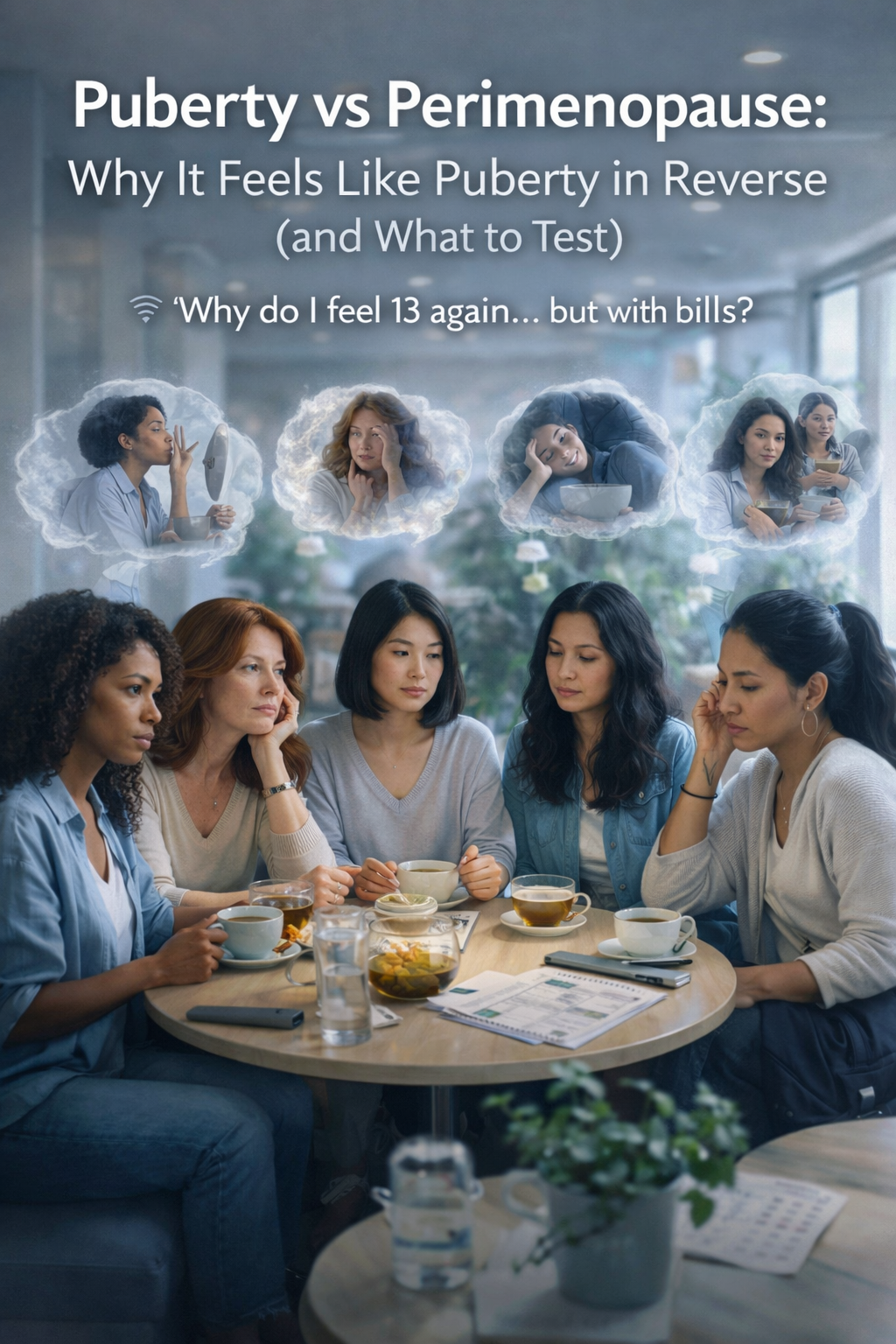
🧠 Puberty vs Perimenopause: Same axis, different direction
Let’s nerd out for a second (in plain language).
Puberty = the system powering up
Puberty begins when the brain increases signaling through the hypothalamus–pituitary–gonadal (HPG) axis, which ramps up reproductive hormones and drives body changes.
For girls, puberty commonly starts around 8–13, and it’s not just physical—it affects emotions and social stress tolerance too.
Perimenopause = the system powering down (but not smoothly)
Perimenopause is the transition before menopause where cycles change and hormones fluctuate—often before they eventually decline. Early perimenopause commonly shows up as cycle pattern changes (often ~7+ days from your norm).
Menopause is officially when periods stop due to lower hormone levels, usually between 45–55.
So yes—same hormone “control center,” but the dial is turning the opposite direction. And the dial can be glitchy.
🔥 “Puberty in Reverse”: What that actually looks like in real life
This is why so many women say, “I feel like I’m back in middle school”:
1) 😵💫 Mood swings, anxiety, and the “who even am I?” feeling
During puberty, rising hormones can amplify emotional reactivity. During perimenopause, fluctuating hormones can also impact mood, anxiety, and cognition (“brain fog”).
2) 😴 Sleep disruption (aka: your pillow becomes your enemy)
Sleep disruption is a common perimenopause complaint, and once sleep gets shaky, everything else gets louder—cravings, irritability, pain sensitivity, and stress resilience.
3) 🩸 Cycle chaos (heavier, lighter, shorter, longer, skipped… surprise!)
Cycle variability is a hallmark of the menopause transition—sometimes subtle at first, then more dramatic later.
4) ⚡ Body changes that feel “unfair”
Energy, appetite, body composition, and motivation can shift because hormones are interacting with insulin sensitivity, cortisol rhythms, inflammation, and gut function. It’s not vibes—it’s physiology. And when the system feels unstable, that’s often where Metabolic Chaos® sneaks in: blood sugar swings, stress spirals, sleep debt, gut disruption, and hormone turbulence all feeding each other.
🫱🏾🫲🏼 Compassion for women… and for the men who love them
Perimenopause can be disorienting because it’s not just “hot flashes.” It can feel like your body has new rules, and nobody handed you the manual.
Understanding this transition helps women say:
“I’m not broken.”
“My body is adapting.”
“I need support, not self-hate.”
And it helps men/partners say:
“This isn’t a personality flaw.”
“This is a season.”
“How can I support you without trying to ‘fix’ you?”
Compassion doesn’t replace action—it makes action possible.
🧪 Testing, Not Guessing: the missing piece for the “I know something’s off” crowd
Important reality check: major guidelines note that blood tests are rarely required to diagnose perimenopause/menopause in people over 45, because hormones fluctuate and a single snapshot can mislead.
So why test at all?
Because the goal in functional work isn’t just “Are you in perimenopause?”
It’s: What is perimenopause doing to you—your metabolism, thyroid, iron status, inflammation, gut, detox capacity, stress load, and nutrient needs? That’s where the clarity (and relief) lives.
🩸 Functional Blood Chemistry Analysis (FBCA)
This means using standard labs (like CBC, CMP, lipids, glucose/insulin markers, thyroid markers, iron markers, etc.) but interpreting them through a root-cause lens to identify patterns that may be fueling symptoms—fatigue, mood shifts, hair changes, sleep issues, weight changes, and more.
🧬 DNA testing (your “tendencies,” not your destiny)
When used appropriately, nutrigenomic testing can highlight genetic variants related to hormone metabolism, neurotransmitter pathways, gut resilience, detox capacity, and histamine breakdown—helpful for personalization.
And here’s the key “puberty in reverse” connection: your genes don’t change, but your hormone seasons do. So if you carry any one of these gene patterns, it can help explain why puberty felt intense, and why perimenopause feels intense now—same wiring, different hormonal environment.
In a nutshell, these tendencies can show up in both seasons like this:
NOS3 (blood flow): headaches/migraines, circulation shifts, stress/exercise sensitivity—often louder when estrogen fluctuates.
PEMT (choline + bile/liver support): sluggish digestion, constipation, skin issues, and “hormone clearance” strain—especially when the liver is processing shifting hormone byproducts.
DAO (histamine breakdown): flushing, itching, hives/sinus issues, reflux, anxiety, sleep disruption, and food/environment reactions—often worse around cycle changes.
MTHFR (methylation pathways): higher nutrient demand for mood balance, inflammation control, detox support, and stress resilience during big transitions.
GST/GPX (glutathione/antioxidant): chemical sensitivity, slower recovery from stress/exposures, stronger reaction to alcohol/fragrance/mold—more noticeable when inflammation rises.
MAOA (neurotransmitters + cravings): mood swings, worry loops, emotional eating, sleep changes—especially when blood sugar and stress are unstable.
COMT (stress chemistry + estrogen metabolites): “wired but tired,” overwhelm, irritability, insomnia, and sensitivity to estrogen shifts (hello, perimenopause).
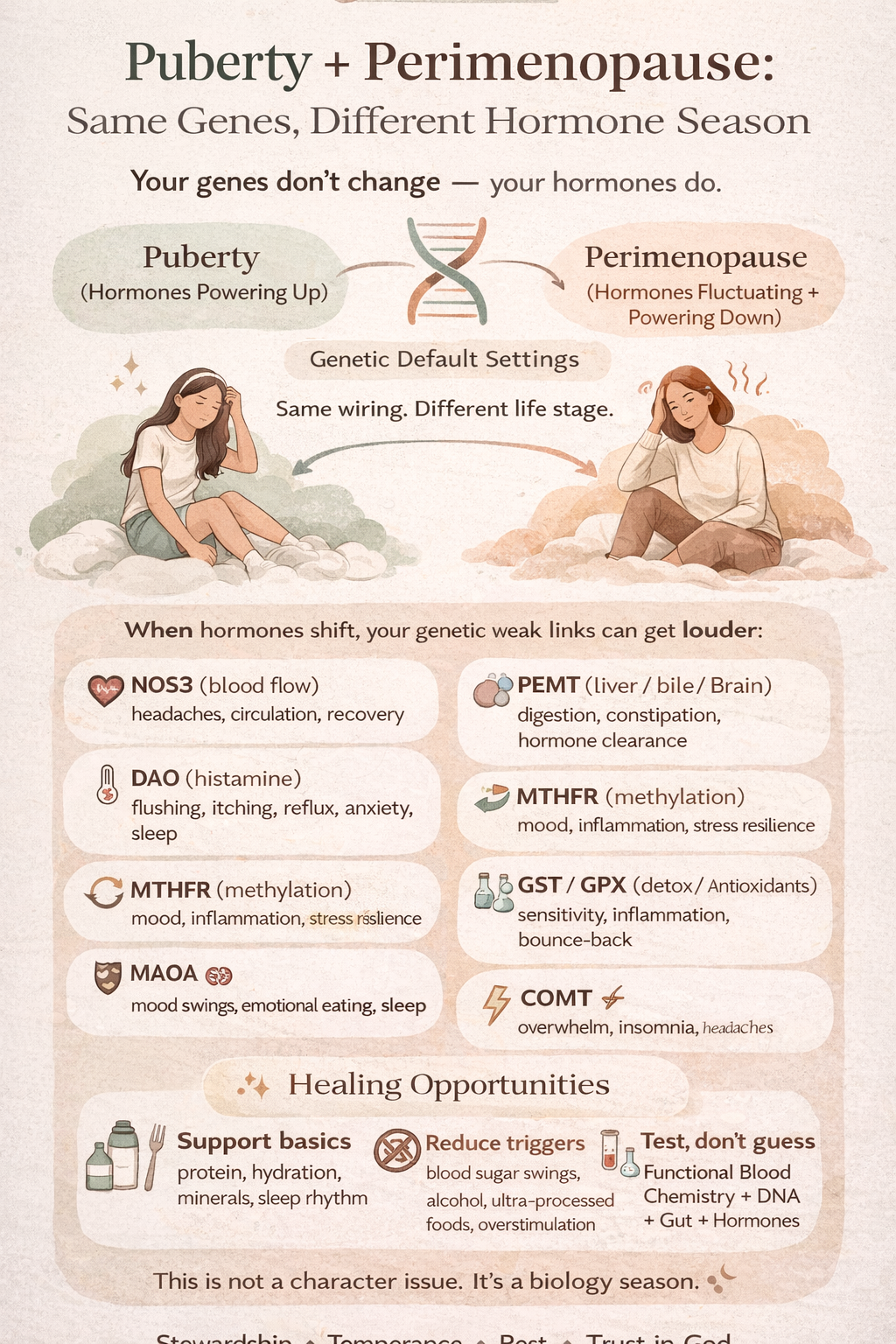
🔬Fun Fact Science Bar+
Did you know that puberty and perimenopause can “hit the same buttons” in your body—because your genes don’t change, even when your hormones do? That’s why some women feel like perimenopause is puberty in reverse: the hormone environment shifts, and your genetic “default settings” get stress-tested again—triggering familiar patterns like mood swings, skin flare-ups, fatigue, heavy periods, histamine reactions, and the classic, “Why am I reacting to everything?!”
👉🏾 Translation: If puberty felt intense and perimenopause feels intense, it’s not that you’re “too much.” It may be that your body has predictable pressure points—like:
DAO (histamine) → flushing, itching, reflux, anxiety, sleep disruption
COMT / MAOA (brain chemistry + stress response) → overwhelm, irritability, cravings, insomnia
PEMT (liver/bile support) → sluggish digestion, constipation, estrogen-clearance strain (hello, Metabolic Chaos® loop)
NOS3 (blood flow) → headaches/migraines, circulation shifts, recovery issues
MTHFR + GST/GPX (methylation + antioxidant capacity) → inflammation flares, chemical sensitivity, slower bounce-back
In Functional Diagnostic Nutrition® language, this is often where Metabolic Chaos® shows up—because hormones, gut, detox pathways, sleep, and stress chemistry all start arguing at once.
✨ Healing Opportunity: Instead of guessing, use this season as a data-driven reset:
Support the basics first (protein, hydration, minerals, sleep rhythm, gentle movement)
Reduce triggers that amplify histamine + stress load (poor sleep, blood sugar spikes, ultra-processed foods, alcohol, chronic overstimulation)
Consider testing, not guessing—so your plan matches your wiring and your current hormone season (DNA panels + gut + hormones + functional blood chemistry).
✝️ Faith Element: Puberty and perimenopause are reminders that the body has seasons. There’s wisdom in slowing down and practicing stewardship—especially through temperance, rest, and trust in God. Perimenopause isn’t a personal failure; it can be an invitation to greater compassion, deeper rhythm, and wiser care of the body-temple. 🙏🏾🌿
Translation: if puberty was rough and perimenopause is rough, you’re not “too much.” Your body may simply have predictable stress points—and testing helps us personalize support so you can move from Metabolic Chaos® into real healing opportunities.
Examples our clients may explore:
DNALife DNA Hormones (sex hormone metabolism/detox pathways)
DNA Mind (variants tied to pathways influencing mental health biology)
DNA Gut (variants associated with gut homeostasis tendencies)
DNA Histamine (variants affecting histamine degradation enzymes like DAO/HNMT)
💩 Gut + inflammation mapping
Diagnostic Solutions Laboratory GI-MAP® uses qPCR technology to detect microbial DNA and includes markers relevant to digestion, inflammation, and immune patterns.
🧴 Hormone + stress rhythm insight
Precision Analytical DUTCH (Dried Urine Test for Comprehensive Hormones) is designed to assess sex/adrenal hormones and metabolites via dried urine samples.
(Translation: it’s often used to explore patterns alongside symptoms—especially when someone is stuck in that “I feel off but I can’t prove it” zone.)
🧫 Gut barrier / permeability + inflammation (when clinically appropriate)
FLUIDS iQ Permeability + Inflammation (Intestinal iQ™ series) uses a dried blood spot method and reports markers including zonulin-family peptides.
Key point: These tools are not about chasing perfect numbers. They’re about reducing blind spots—so you can stop throwing random supplements at your symptoms like confetti.
✨ Faith thread: your body isn’t betraying you—it’s transitioning
As a Seventh-day Adventist–rooted practitioner, I never want women to feel like they have to hustle their way out of being human.
Perimenopause is a reminder that the body is not a machine—it’s a living system designed with rhythms: work and rest, building and releasing, seasons and transitions. Sabbath isn’t just a doctrine; it’s a physiological mercy.
You are not failing because you need more rest, more nourishment, more support, and more clarity. You’re being invited into wiser stewardship.
🧭 What to do next: a simple “Start Here” path
If you’re in the “I’ve researched a ton but still feel like something is missing” stage, here’s a grounded next step:
Track your symptoms + cycle changes for 30 days (sleep, mood, energy, bleeding patterns, heat episodes, cravings).
Rule out common imitators (thyroid dysfunction, anemia/iron issues, blood sugar instability, inflammation patterns).
Personalize support using testing when appropriate—especially if you’re stuck, overwhelmed, or reacting to everything.
Build a sustainable protocol (food-first, nervous system support, targeted supplements, lifestyle rhythm—no perfectionism required).
That’s how we turn Metabolic Chaos® into healing opportunities—with clarity and compassion.
📣 Call to Action: You don’t need more guesses—you need a map
If this blog felt like it was describing your life a little too accurately, that’s a sign. You’ve done the searching. Now you deserve real guidance.
I’m Rosalyn Antonio-Langston—Traditional Naturopath + Functional Diagnostic Nutrition® Practitioner—and I help women make sense of hormone transitions through root-cause strategy, functional testing (when needed), and lifestyle frameworks that honor faith, physiology, and real life.
Next steps:
Book a consult to review your symptoms and decide what testing actually fits.
Or start with a structured “first steps” plan so you’re not trying to rebuild your health from internet scraps.
Perimenopause isn’t you “falling apart.” It’s your body asking for a new operating system—one built for this season.

🫖🧬 “Puberty in Reverse” Tea-Tonic Parfait Bowls
🍵 Recipe 1: “Puberty in Reverse” Nervous System Tea Latte (Caffeine-Free) 🌙🫖
Creamy, spiced, and comforting—like a warm blanket for your hormones.
⏱️ Time + Yield
⏳ 8–10 minutes
☕ Makes 1 large mug (or 2 small)
🛒 Ingredients
1½ cups water
1 rooibos tea bag (or loose leaf)
½ tsp cinnamon
¼ tsp ground ginger
Pinch ground cardamom (optional but chef’s kiss)
¾ cup unsweetened almond milk (or oat milk)
1 tsp vanilla
1–2 tsp honey or maple syrup (optional)
Pinch sea salt (tiny, but makes it taste “round”)
Optional: ¼ tsp lavender (food grade) OR 1 chamomile tea bag (extra calm)
👩🏽🍳 Step-by-step
Steep the base 🫖
Bring water to a near-boil. Add rooibos (and chamomile/lavender if using). Steep 6–7 minutes.Warm the milk 🥛
In a small pan, warm almond milk with cinnamon, ginger, cardamom, vanilla, and a pinch of salt for 2–3 minutes (don’t boil).Combine + sweeten 🍯
Remove tea bag(s). Pour tea into your mug. Add warm spiced milk. Sweeten lightly if desired.Froth (optional but fun) ✨
Use a handheld frother or whisk for 15 seconds to make it latte-like.
🌿 Why it helps (in plain language)
Rooibos: caffeine-free comfort → supports calmer evenings 😴
Cinnamon + ginger: digestion + blood sugar steadiness ⚖️
Warm milk ritual: nervous system cue that it’s safe to downshift 🧠💛
This is a cozy tool for reducing Metabolic Chaos® vibes (stress + sleep + cravings).
🥣 Recipe 2: “Reverse Puberty” Protein Parfait Bowl (Glow + Steady Energy) 🫐✨
This one tastes like dessert but behaves like breakfast: protein + fiber + healthy fats.
⏱️ Time + Yield
⏳ 7–10 minutes
🍽️ Makes 1 big bowl
🛒 Ingredients
Base
1 cup plain Greek yogurt (or coconut yogurt)
½ tsp vanilla
1–2 tsp honey or maple syrup (optional)
Mix-ins
1 tbsp chia seeds
1 tbsp ground flaxseed (or extra chia)
1 tbsp hemp hearts (optional but great)
Toppings
½–1 cup blueberries (or mixed berries)
1–2 tbsp almond butter 🥄
2 tbsp granola (or toasted pumpkin/sunflower seeds)
Sprinkle cinnamon
Optional: dark chocolate chips or cacao nibs (small amount)
👩🏽🍳 Step-by-step
Make the base 🥣
Stir yogurt + vanilla + (optional) honey/maple until smooth.Add the stabilizers 🌱
Mix in chia + flax + hemp hearts. Let sit 2–3 minutes to thicken.Build the bowl 🍓
Top with berries, granola/seeds, cinnamon.Almond butter drizzle (the best part) 😮💨
Warm almond butter for 10–15 seconds so it drizzles like a sauce. Spoon over the top.
🌿 Health benefits (why your body likes this)
Protein (yogurt): steadier energy + fewer cravings 💪🏾
Chia + flax: fiber supports regularity + hormone metabolite “exit routes” 🚽
Berries: antioxidants for skin + cellular support ✨
Almond butter: healthy fats → helps stabilize blood sugar + mood ⚖️
This bowl supports the “don’t let blood sugar swings amplify symptoms” strategy—aka fewer Metabolic Chaos® loops.
✨ Bonus: “Puberty in Reverse” pairing tip
Have the parfait mid-morning and the tea latte late afternoon/evening. That combo tends to support steadier energy by day and calmer nervous system at night—two things that make perimenopause feel less like a plot twist.
📚 References
🌸 Perimenopause/Menopause Basics (Symptoms + Cycle Changes)
British Menopause Society — What is the menopause? (Tool for Clinicians PDF) 👉🏾 https://thebms.org.uk/wp-content/uploads/2026/01/17-NEW-BMS-TfC-What-is-the-menopause-JAN2026-A.pdf
NHS — Menopause: Symptoms (mood changes, anxiety, brain fog, period changes) 👉🏾 https://www.nhs.uk/conditions/menopause/symptoms/
The Menopause Society — Perimenopause (patient education) 👉🏾 https://menopause.org/patient-education/menopause-topics/perimenopause
🧠😴 Mood + Sleep in Perimenopause (Support + Management)
NHS — Menopause: Things you can do (rest, exercise, relaxation, CBT) 👉🏾 https://www.nhs.uk/conditions/menopause/things-you-can-do/
NHS Inform — Menopause and your mental wellbeing (sleep + anxiety/irritability link) 👉🏾 https://www.nhsinform.scot/healthy-living/womens-health/later-years-around-50-years-and-over/menopause-and-post-menopause-health/menopause-and-your-mental-wellbeing/
🧾 Testing & Diagnosis Guidance (Why symptoms matter, not just “one number”)
NICE NG23 — Menopause: identification and management (recommendations; avoid certain lab tests for diagnosis age 45+) 👉🏾 https://www.nice.org.uk/guidance/ng23/chapter/recommendations
NICE Quality Standard QS143 — Diagnosing perimenopause and menopause (summary statement on testing) 👉🏾 https://www.nice.org.uk/guidance/qs143/chapter/quality-statement-1-diagnosing-perimenopause-and-menopause
British Menopause Society — Menopause Practice Standards (diagnosis often symptom-based) 👉🏾 https://thebms.org.uk/wp-content/uploads/2022/07/BMS-Menopause-Practice-Standards-JULY2022-01D.pdf
🌱 Puberty Science (HPG axis / hormone “powering up”)
Endocrine Society / Oxford Academic (Endocrine Reviews) — HPG axis activity across life stages (includes puberty) 👉🏾 https://academic.oup.com/edrv/article/45/4/460/7618576
Society for Endocrinology — Timing of puberty: why is it changing and why does it matter? (HPG axis overview) 👉🏾 https://www.endocrinology.org/endocrinologist/134-winter19/features/timing-of-puberty-why-is-it-changing-and-why-does-it-matter/
🧬 Gene Function References (for the “same genes, different hormone season” section)
MedlinePlus Genetics — COMT gene (catechol-O-methyltransferase) 👉🏾 https://medlineplus.gov/genetics/gene/comt/
MedlinePlus Genetics — MAOA gene (monoamine oxidase A; neurotransmitter breakdown) 👉🏾 https://medlineplus.gov/genetics/gene/maoa/
MedlinePlus Genetics — MTHFR gene (methylenetetrahydrofolate reductase; folate pathway enzyme) 👉🏾 https://medlineplus.gov/genetics/gene/mthfr/
NCBI Gene — NOS3 (nitric oxide synthase 3 / eNOS) 👉🏾 https://www.ncbi.nlm.nih.gov/gene/4846
NCBI Gene — PEMT (phosphatidylethanolamine N-methyltransferase; phosphatidylcholine synthesis) 👉🏾 https://www.ncbi.nlm.nih.gov/gene/10400
NCBI Gene — GSTM1 (glutathione S-transferase; detoxification enzyme family) 👉🏾 https://www.ncbi.nlm.nih.gov/gene/2944
🌡️ Histamine + DAO (Background for sensitivity/histamine lens)
NCBI Gene — AOC1 (amine oxidase copper containing 1; DAO/histaminase gene) 👉🏾 https://www.ncbi.nlm.nih.gov/gene/26
PMC — Cumulative effect of AOC1 (DAO) gene variants… (DAO + histamine degradation context) 👉🏾 https://pmc.ncbi.nlm.nih.gov/articles/PMC10288193/
🧪 Functional / Specialty Labs Mentioned in the Blog (Official Pages)
Diagnostic Solutions Laboratory — GI-MAP® (stool test; qPCR; microbial DNA) 👉🏾 https://www.diagnosticsolutionslab.com/tests/gi-map
Precision Analytical — DUTCH Complete (dried urine hormones + metabolites + cortisol patterns) 👉🏾 https://dutchtest.com/dutch-complete
PubMed — Reliability of a dried urine test for comprehensive hormones… (DUTCH method reliability study) 👉🏾 https://pubmed.ncbi.nlm.nih.gov/33722278/
FLUIDS iQ — Permeability + Inflammation (dried blood spot; markers listed on product page) 👉🏾 https://fluidsiq.com/en/product/permeability-inflammation/?v=05c7c5a71e52
🧬 DNALife Panels (Product Pages)
DNALife — DNA Hormones 👉🏾 https://www.dnalife.healthcare/products/dna/dna-hormones
DNALife — DNA Mind 👉🏾 https://www.dnalife.healthcare/products/dna/dna-mind
DNALife — DNA Gut 👉🏾 https://www.dnalife.healthcare/products/dna/gut
DNA Histamine (DNALife-distributed) — DNA Histamine (HNMT + DAO focus) 👉🏾 https://fxmed.co.nz/product/dna-histamine/
Blog Disclaimer
The health information on this blog is for general educational purposes only and is not intended to diagnose, treat, cure, or prevent any disease. It should not be used as a substitute for professional medical advice. Always consult a qualified healthcare provider before making any health-related decisions
This blog may contain affiliate links, meaning Leaves from the Tree of Life LLC may earn a small commission if you purchase a product or service through these links—at no additional cost to you. Your support helps us continue to provide valuable content. Thank you!
