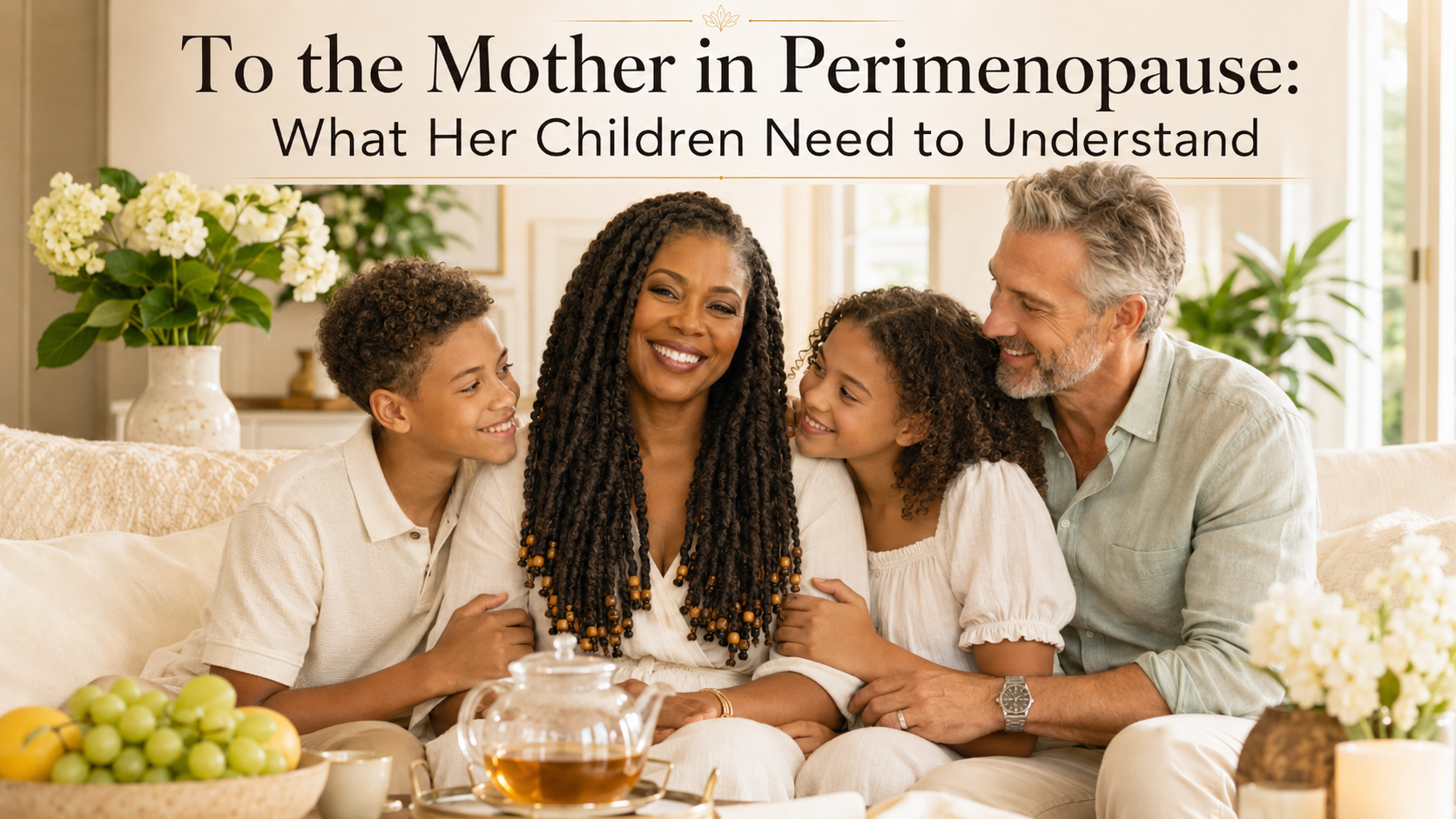
💐 To the Mother in Perimenopause: What Her Children Need to Understand
💐 To the Mother in Perimenopause: What Her Children Need to Understand
Mother’s Day often comes wrapped in flowers, cards, brunch, and sweet words. Beautiful, yes. But for many mothers, it also arrives during a season that feels tender, confusing, and deeply under-discussed:
Perimenopause.
This blog is dedicated to the mother who is still pouring out while her own body is shifting.
The mother who loves deeply but feels exhausted.
The mother who wants to be patient but feels easily irritated.
The mother who is praying, working, serving, cooking, cleaning, nurturing, and somehow still remembering everyone else’s appointments, preferences, emotions, and missing socks.
And this is also for her children — young children, teenagers, adult children, and anyone who has been loved, raised, corrected, fed, prayed over, or guided by a mother.
Because sometimes the greatest Mother’s Day gift is not another candle.
Sometimes it is understanding.
🌸 Dear Children, Your Mother Is Not “Just Being Moody”
When a mother enters perimenopause, she is not suddenly becoming difficult for no reason.
Her body is undergoing a real biological transition.
Perimenopause is the season leading up to menopause when estrogen and progesterone begin to fluctuate. These hormones influence much more than cycles. They affect the brain, sleep, mood, metabolism, bones, skin, muscles, cardiovascular health, nervous system, and stress resilience.
So yes, she may feel different.
She may be more tired.
More forgetful.
More anxious.
More easily overwhelmed.
More sensitive to noise.
More irritated by things that never used to bother her.
More annoyed when everyone needs something, yet nobody can see the laundry basket, dishes, or the item sitting directly in front of their face.
From a Traditional Naturopathic and Functional Diagnostic Nutrition perspective, this season is not about blaming hormones alone. Hormones matter, but they are rarely the whole story.
Perimenopause can reveal patterns that were already brewing beneath the surface, such as blood sugar instability, poor sleep, gut imbalances, mineral depletion, chronic stress, inflammation, thyroid strain, nervous system dysregulation, nutrient insufficiencies, and years of self-neglect disguised as “being strong.”
This is where we may begin to see Metabolic Chaos® — multiple body systems under stress at the same time, creating symptoms that feel confusing, random, and exhausting.
So children, when your mother seems different, do not rush to label her.
Pause.
Listen.
Pray.
Ask what she needs.
Her symptoms may not be attitude.
They may be messages from a body asking for support.
🧠 Brain Fog Does Not Mean She Is Not Listening
Children, if your mother forgets what she was saying mid-sentence, repeats a question, loses her keys, or walks into a room and stares like she has just entered a spiritual loading screen…
Please be kind.
Brain fog during perimenopause is real, and for mothers it can feel especially frustrating because they often carry the invisible world of the family.
The birthdays.
The grocery list.
The prayer requests.
The appointments.
The school forms.
The emotional conversations.
The laundry.
The family history.
The fact that someone does not like onions unless they are blended beyond recognition.
So when she forgets something, do not mock her or make her feel small.
Try saying:
“Let me write that down for you.”
“I’ll remind you.”
“Don’t worry, Mum, I’ve got it.”
That kind of gentleness is medicine too.
And yes, doing the task without being asked seven times also counts as natural medicine.
Very potent. Highly recommended.
🔥 She Loves You, Even When She Is Irritated, Annoyed, and Overstimulated
This is important.
A mother needing quiet does not mean she loves her children less.
A mother feeling irritated does not mean she has stopped caring.
A mother needing rest does not mean she is withdrawing her affection.
A mother feeling annoyed by constant noise, questions, mess, and emotional demands does not mean she is a bad mother.
It means she is human.
Perimenopause can make the nervous system more reactive. Noise, clutter, bright lights, overlapping conversations, constant interruptions, emotional pressure, and household chaos can feel heavier than they once did.
The mother who used to manage five conversations, a boiling pot, a ringing phone, a child looking for socks, and someone asking where the charger is may now feel like her nervous system is one minor inconvenience away from sending a resignation letter.
And she may hate that.
Because many mothers do not want to be irritated.
They do not want to snap.
They do not want to feel annoyed by the people they love.
They do not want to need silence just to survive the afternoon.
But some days, that is the honest reality.
This is not an excuse for cruelty, harshness, or emotional dumping. Love still requires accountability. Apologies still matter. Self-control is still a fruit of the Spirit.
But compassion matters too.
A mother in perimenopause may be fighting battles nobody sees:
Poor sleep
Hot flashes
Night sweats
Heavy or irregular cycles
Brain fog
Anxiety
Mood swings
Blood sugar dips
Inflammation
Joint pain
Exhaustion
Overstimulation
Hormonal fluctuations
Years of carrying everyone else while ignoring herself
So children, when your mother seems edgy, do not instantly label her as “mean,” “dramatic,” or “always upset.”
Ask yourself:
Has she rested?
Has she eaten?
Has anyone helped her?
Is the house loud?
Is she carrying too much?
Has she had space to breathe?
Sometimes the most loving thing you can do is not take her irritation personally, but respond with maturity and care.
Ask:
“Do you need quiet?”
“Can I help with something?”
“Would you like me to give you space?”
“Can I pray with you?”
Those questions can soften a mother’s heart more than you know.
And let’s be honest: if everyone keeps asking her where things are instead of actually looking, even Proverbs 31 may need a prayer closet and a locked door.
😴 Sleep Loss Changes Everything
One of the hardest parts of perimenopause is disrupted sleep.
A mother may go to bed exhausted and still wake with hot flashes, night sweats, racing thoughts, anxiety, or that mysterious 3 a.m. alertness that says, “Let’s review every responsibility you have ever had.”
Then morning comes, and everyone expects her to function.
Breakfast.
Work.
Appointments.
Laundry.
Ministry.
Errands.
Family needs.
Emotional support.
More laundry, because apparently laundry multiplies when unsupervised.
But poor sleep affects nearly everything.
From a functional perspective, sleep disruption can influence blood sugar, cravings, mood, cortisol rhythm, inflammation, immune resilience, digestion, hormone metabolism, and nervous system recovery.
So if a mother is more tired, more sensitive, or less patient, it may not be because she is “snappy.”
It may be because she has not had restorative sleep in weeks, months, or even years.
Children, this is where compassion becomes practical.
Lower the noise.
Help with the home.
Respect her rest.
Do not treat her need for quiet like rejection.
And please, for the love of Proverbs 31 and common sense, do not wait until she is visibly exhausted to ask what is for dinner.
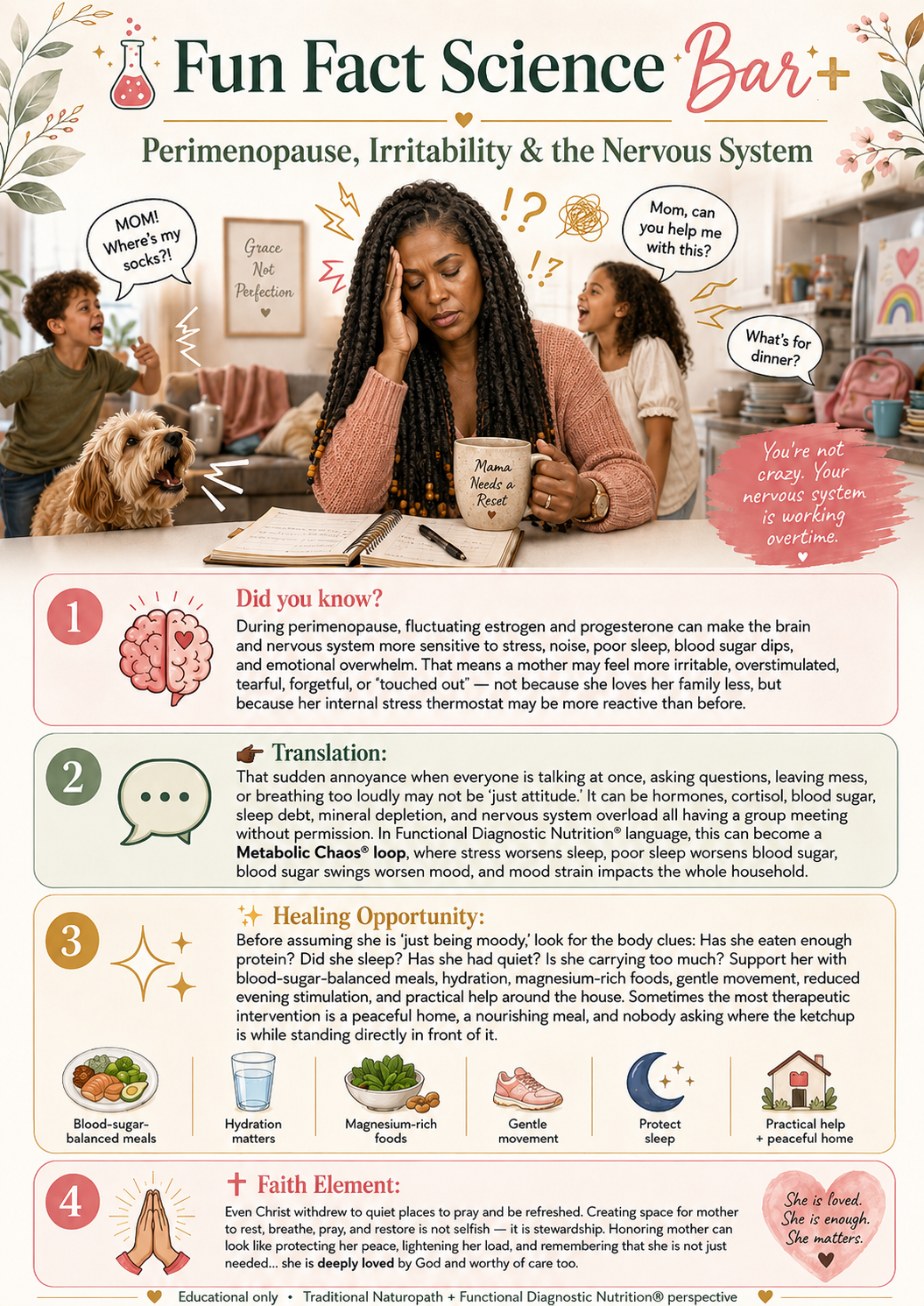
🔬 Fun Fact Science Bar+
Did you know that during perimenopause, fluctuating estrogen and progesterone can make the brain and nervous system more sensitive to stress, noise, poor sleep, blood sugar dips, and emotional overwhelm? That means a mother may feel more irritated, overstimulated, tearful, forgetful, or “touched out” — not because she loves her family less, but because her internal stress thermostat may be more reactive than before.
👉🏾 Translation:
That sudden annoyance when everyone is talking at once, asking questions, leaving mess, or breathing too loudly — yes, we said it 😅 — may not be “just attitude.” It can be hormones, cortisol, blood sugar, sleep debt, mineral depletion, and nervous system overload all having a group meeting without permission. In Functional Diagnostic Nutrition® language, this can become a Metabolic Chaos® loop, where stress worsens sleep, poor sleep worsens blood sugar, blood sugar swings worsen mood, and mood strain impacts the whole household.
✨ Healing Opportunity:
Before assuming she is “just being moody,” look for the body clues: Has she eaten enough protein? Did she sleep? Has she had quiet? Is she carrying too much? Support her with blood-sugar-balanced meals, hydration, magnesium-rich foods, gentle movement, reduced evening stimulation, and practical help around the house. Sometimes the most therapeutic intervention is a peaceful home, a nourishing meal, and nobody asking where the ketchup is while standing directly in front of it.
✝️ Faith Element:
Even Christ withdrew to quiet places to pray and be refreshed. Creating space for mother to rest, breathe, pray, and restore is not selfish — it is stewardship. Honoring mother can look like protecting her peace, lightening her load, and remembering that she is not just needed… she is deeply loved by God and worthy of care too. 🙏🏾🌿
🍲 Mother Needs Nourishment, Not Just “Treat Yourself” Culture
Mother’s Day treats can be lovely.
Brunch? Beautiful.
A thoughtful dessert? Precious.
A homemade meal where she does not have to clean the kitchen afterward? Practically sanctified.
But mothers in perimenopause often need more than occasional treats. They need consistent nourishment.
Not diet culture.
Not guilt.
Not “just lose weight.”
Not a sad lettuce leaf with a motivational quote on the side.
They need meals that support blood sugar, hormone resilience, gut health, energy, minerals, and mood.
A functional approach may include protein, fiber-rich plants, healthy fats, colorful vegetables, mineral-rich foods, balanced carbohydrates, hydration, stable meal timing, and less ultra-processed food.
Because when a woman is under-eating, over-giving, under-sleeping, over-caffeinating, and living on stress hormones, the body may shift into survival mode.
And survival mode is not where healing thrives.
In this season, food is not just fuel.
It is communication.
It tells the body:
“You are safe.”
“You are nourished.”
“You do not have to run on fumes.”
“We are not surviving on coffee, crumbs, and silent resentment today.”
And yes, that last one was for somebody.
🌿 Symptoms Are Not Enemies — They Are Healing Opportunities
One of the greatest shifts I encourage women to make is this:
Stop seeing symptoms as random annoyances.
Start seeing them as clues.
Perimenopause symptoms can feel frustrating, but they can also reveal deeper healing opportunities.
Fatigue may invite investigation into sleep, thyroid patterns, iron status, blood sugar, mitochondrial health, or adrenal stress.
Mood swings may point toward blood sugar dips, mineral depletion, gut-brain imbalances, sleep deprivation, or hormone fluctuations.
Heavy periods should be properly evaluated and not dismissed.
Hot flashes may connect with hormone shifts, stress response, blood sugar patterns, inflammation, or liver burden.
Brain fog may connect with sleep, stress, nutrient status, inflammation, hormones, or blood sugar regulation.
Weight changes may reflect metabolic shifts, insulin resistance, stress chemistry, inflammation, thyroid patterns, muscle loss, or lifestyle demands.
From a Functional Diagnostic Nutrition perspective, we are not diagnosing disease or replacing medical care. We are looking for patterns, stressors, and healing opportunities that help the body move toward better function.
Because “normal for your age” should not be used as a polite way to ignore suffering.
A mother deserves to be heard.
She deserves more than being told to push through.
💛 What Mothers May Want Their Children to Know
This Mother’s Day, if a mother in perimenopause could speak freely to her children, she might say:
🌷 “I love you deeply, even when I am tired.”
Fatigue does not cancel love. Quietness does not mean rejection. Needing rest does not mean she does not enjoy her family.
😤 “Sometimes I am irritated, but I still love you.”
Irritation does not mean absence of love. It often means her capacity is stretched. She may need quiet, food, rest, help, prayer, or a moment where no one asks where the ketchup is while standing directly in front of it.
💆🏾♀️ “When I say I need space, please believe me.”
Space is not rejection. Space may be how she regulates her nervous system, gathers her thoughts, prays, breathes, and returns with more patience.
Following her around while she is trying to calm down is not support.
That is emotional tailgating.
🥺 “I may feel guilty after I snap.”
Many mothers replay their words, feel convicted, and wish they had responded differently.
If she apologizes, receive it with grace.
And if you need to apologize too, do it.
Healing in families is not about pretending nobody gets irritated. It is about learning how to repair with humility, love, and truth.
🧺 “Please help without making me manage the help.”
There is a difference between helping and waiting to be instructed like a confused intern.
Look around.
Wash the dishes.
Fold the laundry.
Take out the rubbish.
Prepare a meal.
Ask what needs doing, but also learn to notice.
🙏🏾 “Pray for me too.”
Many mothers pray over their children constantly, but mothers need prayer too.
Ask God to strengthen her.
Ask Him to give her peace.
Ask Him to help her feel seen.
Ask Him to restore what years of pouring out may have depleted.
🕊️ A Faith-Filled Word for the Mother Who Feels Worn Thin
Dear mother,
You are not failing because this season feels hard.
You are not less godly because you feel overwhelmed.
You are not weak because your body is asking for care.
You are not selfish because you need rest.
God sees the meals made when you were exhausted.
He sees the prayers whispered over children who may never know how much you carried.
He sees the tears you wiped before anyone entered the room.
He sees the appointments, the discipline, the encouragement, the forgiveness, the emotional labor, and the love.
And He also sees you.
Not just what you do.
You.
Perimenopause may feel like unfamiliar territory, but God is not absent in the transition.
There can be wisdom here.
There can be healing here.
There can be restoration here.
There can be an invitation to stop living only as the strong one and begin receiving care as a beloved daughter of God.
🌼 Practical Ways Children Can Honor Mother This Mother’s Day
This year, honoring mother may look like more than a card.
It may look like letting her rest without guilt, cleaning without being asked, speaking gently, listening without correcting, asking what support looks like, taking her symptoms seriously, praying for her health and peace, respecting her changing capacity, learning about perimenopause instead of dismissing it, making her a nourishing meal, creating a calmer home environment, and reminding her she is loved — not just needed.
Because mothers do not only need appreciation after they have poured themselves empty.
They need support while they are still pouring.
💌 Give Mother the Gift of Being Seen
This Mother’s Day, let’s honor mothers not only with flowers, but with understanding.
Let’s stop expecting women to silently endure every hormonal shift, emotional wave, sleepless night, irritated moment, metabolic change, and nervous system flare while still functioning like nothing is happening.
Let’s make room for the real mother.
The tired mother.
The overstimulated mother.
The mother who needs quiet.
The mother who is annoyed but still loving.
The mother who snaps and then feels guilty.
The mother who is praying for patience while also wondering why nobody can replace the toilet paper roll.
And to the mother reading this:
Your symptoms are not random.
Your body is not your enemy.
Your exhaustion is not a moral failure.
Your irritation does not erase your love.
Your changing capacity is not a lack of devotion.
There may be Metabolic Chaos® beneath the surface, but there may also be beautiful healing opportunities waiting to be uncovered.
At Leaves from the Tree of Life LLC, we help women look beyond surface-level symptoms and explore the bigger picture through a Traditional Naturopathic and Functional Diagnostic Nutrition lens — using education, lifestyle foundations, functional insight, and a whole-person approach to support the body’s God-designed ability to heal.
Because mothers deserve more than survival.
“Invest in your health, invest in you, because a healthier lifestyle is a luxury you deserve!” -Rosalyn Antonio-Langston
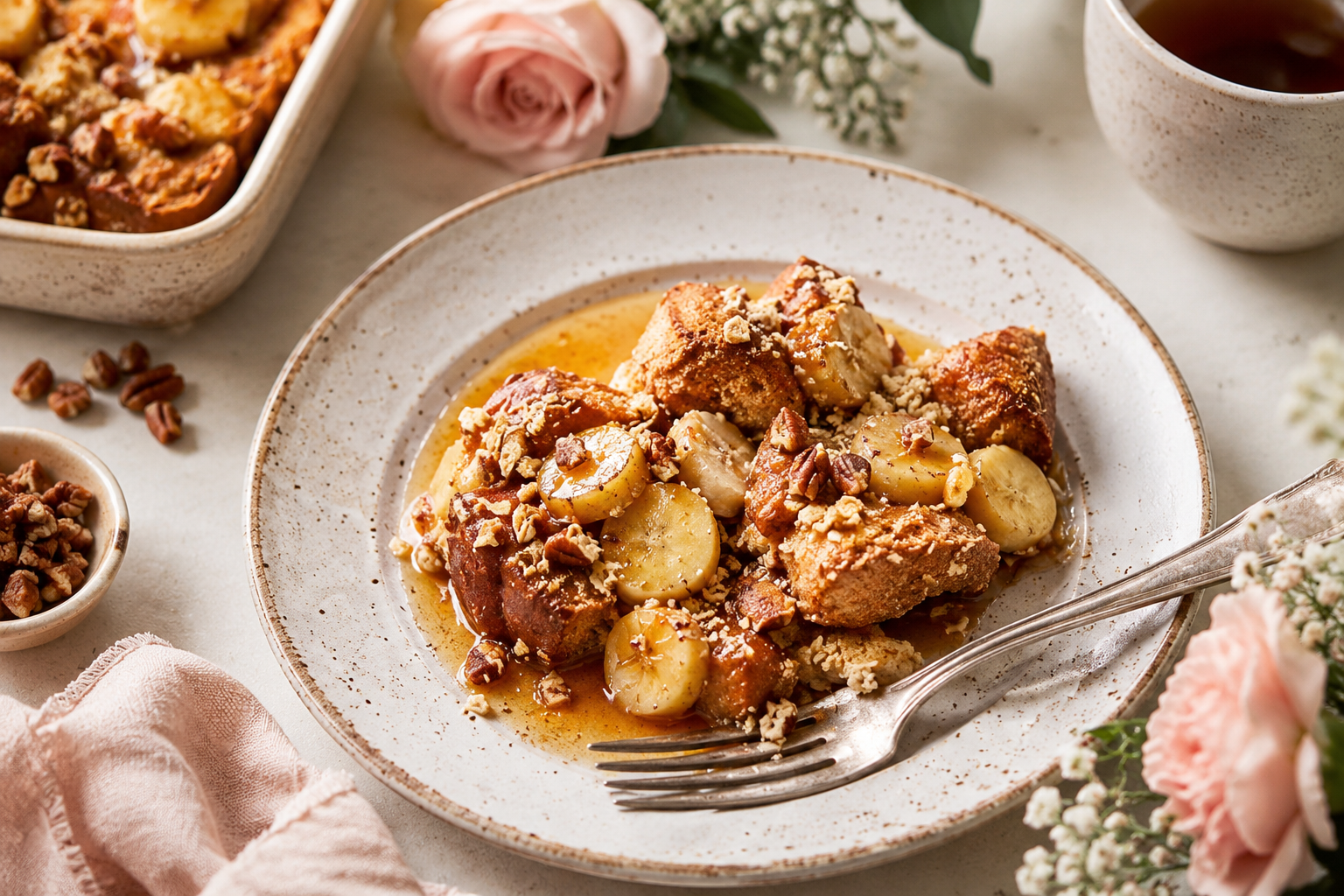
🍌Mother’s Day Banana-Cinnamon French Toast Bake✨
A cozy, plant-based brunch recipe for the mother who deserves nourishment and a quiet kitchen
This recipe is perfect for the Mother’s Day perimenopause blog because it feels comforting and celebratory, but still has a thoughtful functional twist: fiber, plant protein, healthy fats, gentle sweetness, and blood-sugar-friendlier ingredients. Because Mother’s Day brunch should feel special — not like a metabolic ambush with powdered sugar on top. 😅
⏱️ Time Needed
Prep time: 15 minutes
Bake time: 35–40 minutes
Total time: 50–55 minutes
Serves: 6
🛒 Organic Ingredients
🍞 For the French Toast Bake
12 slices organic 100% whole wheat bread or sprouted whole-grain bread, cut into triangles or cubes
1½ cups organic unsweetened plant-based milk — soy, almond, cashew, or oat
3 tablespoons organic chickpea flour
2 tablespoons organic ground flaxseed meal
2 teaspoons organic pure vanilla extract
1½ teaspoons organic ground cinnamon
¼ teaspoon organic ground nutmeg
1 cup organic crispy brown rice cereal, lightly crushed
2 large organic bananas, sliced
½ cup organic pure maple syrup
¼ cup organic fresh orange juice
Pinch of sea salt
🍓 Optional Garnishes
Organic fresh berries
Organic chopped toasted pecans
Organic fresh mint
Extra cinnamon
Orange zest
Drizzle of warm maple syrup
👩🏾🍳 Step-by-Step Instructions
1. 🔥 Preheat & Prepare
Preheat your oven to 350°F / 175°C.
Lightly grease a medium baking dish with a little coconut oil, avocado oil, or line it with parchment paper.
2. 🥣 Make the Custard
In a mixing bowl, whisk together:
Plant-based milk
Chickpea flour
Flaxseed meal
Vanilla extract
Cinnamon
Nutmeg
Sea salt
Orange juice
Maple syrup
Whisk until smooth and slightly thickened.
Let it sit for 5 minutes so the flaxseed and chickpea flour can begin to bind the mixture. This gives that lovely French-toast-style texture without eggs.
3. 🍞 Layer the Bread
Arrange the bread slices or cubes in your baking dish.
Tuck sliced bananas between the bread pieces so every serving gets those sweet, soft banana pockets.
Pour the custard mixture evenly over the bread.
Gently press the bread down so it soaks up the mixture.
4. ✨ Add the Crispy Topping
Sprinkle the lightly crushed crispy brown rice cereal over the top.
This adds a beautiful golden crunch without needing a heavy sugary crumble.
Optional but highly recommended: sprinkle a little extra cinnamon on top because cinnamon understands the assignment. 🤎
5. 🧡 Bake
Bake for 35–40 minutes, or until the top is golden, the center is set, and the edges are slightly crisp.
Let it rest for 5–10 minutes before serving.
This helps it firm up and makes slicing easier.
6. 🍓 Garnish & Serve
Top with fresh berries, chopped toasted pecans, mint, orange zest, and a light drizzle of warm maple syrup.
Serve warm with herbal tea, roasted dandelion “coffee,” or a cozy cup of cinnamon milk.
And please — let Mother sit down while someone else cleans the kitchen. That is part of the recipe. 😌
🌿 Health Benefits of Each Ingredient
🥛 Organic Unsweetened Plant-Based Milk
Provides a creamy base without dairy. Depending on the type used, it may offer plant protein, healthy fats, or minerals. Unsweetened is best to keep the recipe from becoming a sugar parade.
🫘 Organic Chickpea Flour
Adds plant-based protein, fiber, and a gentle binding texture. Chickpea flour helps make the custard more satisfying and supports steadier blood sugar compared with using refined flour alone.
🌾 Organic Ground Flaxseed Meal
Rich in fiber and plant-based omega-3 fats. Flaxseed also contains lignans, which are often discussed in women’s health because of their role in supporting healthy estrogen metabolism.
🍦 Organic Pure Vanilla Extract
Adds natural sweetness and warmth without needing extra sugar. Vanilla also gives the recipe that “brunch is special today” feeling.
🤎 Organic Cinnamon
A warming spice traditionally used to support healthy blood sugar balance and digestion. It also makes the kitchen smell like somebody has their life together.
✨ Organic Nutmeg
Adds depth, warmth, and a cozy bakery flavor. A little goes a long way.
🍚 Organic Crispy Brown Rice Cereal
Creates a light crunchy topping without a heavy streusel. Brown rice cereal gives texture and a little whole-grain goodness.
🍞 Organic 100% Whole Wheat or Sprouted Bread
Provides fiber and complex carbohydrates. Sprouted bread may be easier for some people to digest and can offer more nutrients than refined white bread.
🍌 Organic Bananas
Naturally sweet and rich in potassium, which supports muscle and nerve function. Bananas also provide fiber and make the bake feel indulgent without going overboard on added sweeteners.
🍁 Organic Pure Maple Syrup
A natural sweetener with trace minerals. It is still sugar, so we are using it intentionally — enough to feel celebratory, not enough to send everyone into a brunch coma.
🍊 Organic Fresh Orange Juice
Adds brightness, vitamin C, and natural citrus flavor. It lifts the recipe and pairs beautifully with cinnamon and banana.
🧂 Sea Salt
Balances the sweetness and enhances flavor. Just a pinch makes everything taste more complete.
🫐 Organic Berries
Rich in antioxidants, fiber, and color. Berries are a beautiful way to add freshness and support a more blood-sugar-friendly plate.
🌰 Organic Pecans
Add healthy fats, minerals, and satisfying crunch. They help make the meal more filling and supportive for energy.
🌿 Organic Fresh Mint
Adds freshness, beauty, and a gentle digestive touch. Also makes the plate look high-end without requiring culinary school trauma.
💛 Perimenopause-Friendly Brunch Tip
To make this more supportive for blood sugar and energy, serve it with a side of:
Organic tofu scramble
Unsweetened soy yogurt
Chia pudding
Fresh berries
Herbal tea
A handful of walnuts or pecans
This helps balance the natural sweetness with protein, fiber, and healthy fats — because mama deserves delicious and steady energy.
📚 References
🌸 Perimenopause, Menopause Symptoms & Whole-Body Changes
NHS — Menopause Symptoms
👉🏾 https://www.nhs.uk/conditions/menopause/symptoms/
The Menopause Society — Perimenopause Overview
👉🏾 https://menopause.org/patient-education/menopause-topics/perimenopause
Office on Women’s Health — Menopause Symptoms and Relief
👉🏾 https://womenshealth.gov/menopause/menopause-symptoms-and-relief
National Institute on Aging — Menopause Resources
👉🏾 https://www.nia.nih.gov/health/menopause
Cleveland Clinic — Perimenopause: Age, Stages, Signs, Symptoms & Treatment
👉🏾 https://my.clevelandclinic.org/health/diseases/21608-perimenopause
🧠 Mood Changes, Irritability, Anxiety & Emotional Shifts
ACOG — Mood Changes During Perimenopause Are Real
👉🏾 https://www.acog.org/womens-health/experts-and-stories/the-latest/mood-changes-during-perimenopause-are-real-heres-what-to-know
The Menopause Society — Mental Health During Menopause
👉🏾 https://menopause.org/patient-education/menopause-topics/mental-health
NHS Inform — Menopause and Your Mental Wellbeing
👉🏾 https://www.nhsinform.scot/healthy-living/womens-health/later-years-around-50-years-and-over/menopause-and-post-menopause-health/menopause-and-your-mental-wellbeing/
Office on Women’s Health — Menopause Symptoms and Relief
👉🏾 https://womenshealth.gov/menopause/menopause-symptoms-and-relief
Berkshire Healthcare NHS — Managing Low Mood and Worry with the Menopause Workbook
👉🏾 https://www.berkshirehealthcare.nhs.uk/media/uvhht32r/menopause-workbook.pdf
😴 Sleep, Night Sweats, Hot Flashes & Fatigue
National Institute on Aging — Sleep Problems and Menopause: What Can I Do?
👉🏾 https://www.nia.nih.gov/health/menopause/sleep-problems-and-menopause-what-can-i-do
National Institute on Aging — Hot Flashes: What Can I Do?
👉🏾 https://www.nia.nih.gov/health/menopause/hot-flashes-what-can-i-do
Office on Women’s Health — Menopause Symptom: Problems Sleeping
👉🏾 https://womenshealth.gov/menopause/menopause-symptoms-and-relief
NHS — Menopause Symptoms
👉🏾 https://www.nhs.uk/conditions/menopause/symptoms/
Sleep and Brain Function at Menopause — PMC
👉🏾 https://pmc.ncbi.nlm.nih.gov/articles/PMC11824937/
🧠 Brain Fog, Memory, Concentration & Cognitive Changes
The Menopause Society — Perimenopause Overview
👉🏾 https://menopause.org/patient-education/menopause-topics/perimenopause
The Menopause Charity — Brain Fog
👉🏾 https://themenopausecharity.org/information-and-support/symptoms/brain-fog/
NHS — Menopause Symptoms
👉🏾 https://www.nhs.uk/conditions/menopause/symptoms/
NHS Inform — Menopause and Your Mental Wellbeing
👉🏾 https://www.nhsinform.scot/healthy-living/womens-health/later-years-around-50-years-and-over/menopause-and-post-menopause-health/menopause-and-your-mental-wellbeing/
Let’s Talk Menopause — Brain Fog
👉🏾 https://www.letstalkmenopause.org/our-articles/brain-fog
🥗 Nutrition, Blood Sugar, Lifestyle & Menopause Support
NHS — Menopause: Things You Can Do
👉🏾 https://www.nhs.uk/conditions/menopause/things-you-can-do/
British Nutrition Foundation — Managing Menopause Symptoms with Nutrition and Diet
👉🏾 https://www.nutrition.org.uk/nutrition-for/women/menopause/managing-menopause-symptoms-with-nutrition-and-diet/
Cambridge University Hospitals NHS — Menopause: A Healthy Lifestyle Guide
👉🏾 https://www.cuh.nhs.uk/patient-information/menopause-a-healthy-lifestyle-guide/
Australasian Menopause Society — Lifestyle and Behavioural Modifications for Menopausal Symptoms
👉🏾 https://www.menopause.org.au/hp/information-sheets/lifestyle-and-behavioural-modifications-for-menopausal-symptoms
The Menopause Charity — Lifestyle Medicine: Small Steps to Feel Your Best Self
👉🏾 https://themenopausecharity.org/information-and-support/what-can-help/self-care/lifestyle-medicine/
👯🏾♀️ Family Support, Social Support & Being Seen
Role of Social Support in Reducing the Severity of Menopausal Symptoms — PMC
👉🏾 https://pmc.ncbi.nlm.nih.gov/articles/PMC11100633/
The Relationship Between Social Support, Stressful Events, and Menopause Symptoms — PMC
👉🏾 https://pmc.ncbi.nlm.nih.gov/articles/PMC7840006/
The Association of Menopausal Symptoms and Social Support/Lifestyle Factors — PMC
👉🏾 https://pmc.ncbi.nlm.nih.gov/articles/PMC9298676/
Social Support and Its Influencing Factors Among Perimenopausal Women — PMC
👉🏾 https://pmc.ncbi.nlm.nih.gov/articles/PMC12071810/
NHS — Menopause Help and Support
👉🏾 https://www.nhs.uk/conditions/menopause/help-and-support/
🌿 Heavy Periods, Symptoms That Deserve Investigation & Medical Support
ACOG — The Menopause Years
👉🏾 https://www.acog.org/womens-health/faqs/the-menopause-years
NHS — Menopause Symptoms
👉🏾 https://www.nhs.uk/conditions/menopause/symptoms/
Office on Women’s Health — Menopause Basics
👉🏾 https://womenshealth.gov/menopause/menopause-basics
Office on Women’s Health — Menopause Symptoms and Relief
👉🏾 https://womenshealth.gov/menopause/menopause-symptoms-and-relief
National Institute on Aging — What Is Menopause?
👉🏾 https://www.nia.nih.gov/health/menopause/what-menopause
🌱 Faith-Aligned Lifestyle Context: Rest, Stewardship & Creation-Based Health
Adventist Family Ministries — A Prescription for Optimum Health / NEWSTART Principles
👉🏾 https://family.adventist.org/a-prescription-for-optimum-health/
Adventist Health Ministries — Healthful Living Resources
👉🏾 https://www.healthministries.com/health-resources/healthful-living/
Adventist Health Ministries — NEWSTART Lifestyle Principles
👉🏾 https://www.healthministries.com/health-resources/newstart/
Ellen G. White Writings — Ministry of Healing, “The Use of Remedies”
👉🏾 https://m.egwwritings.org/en/book/135.1478
Ellen G. White Writings — Ministry of Healing, “With Nature and With God”
👉🏾 https://m.egwwritings.org/en/book/135.1344
Blog Disclaimer
The health information on this blog is for general educational purposes only and is not intended to diagnose, treat, cure, or prevent any disease. It should not be used as a substitute for professional medical advice. Always consult a qualified healthcare provider before making any health-related decisions
This blog may contain affiliate links, meaning Leaves from the Tree of Life LLC may earn a small commission if you purchase a product or service through these links—at no additional cost to you. Your support helps us continue to provide valuable content. Thank you!
